Key Findings
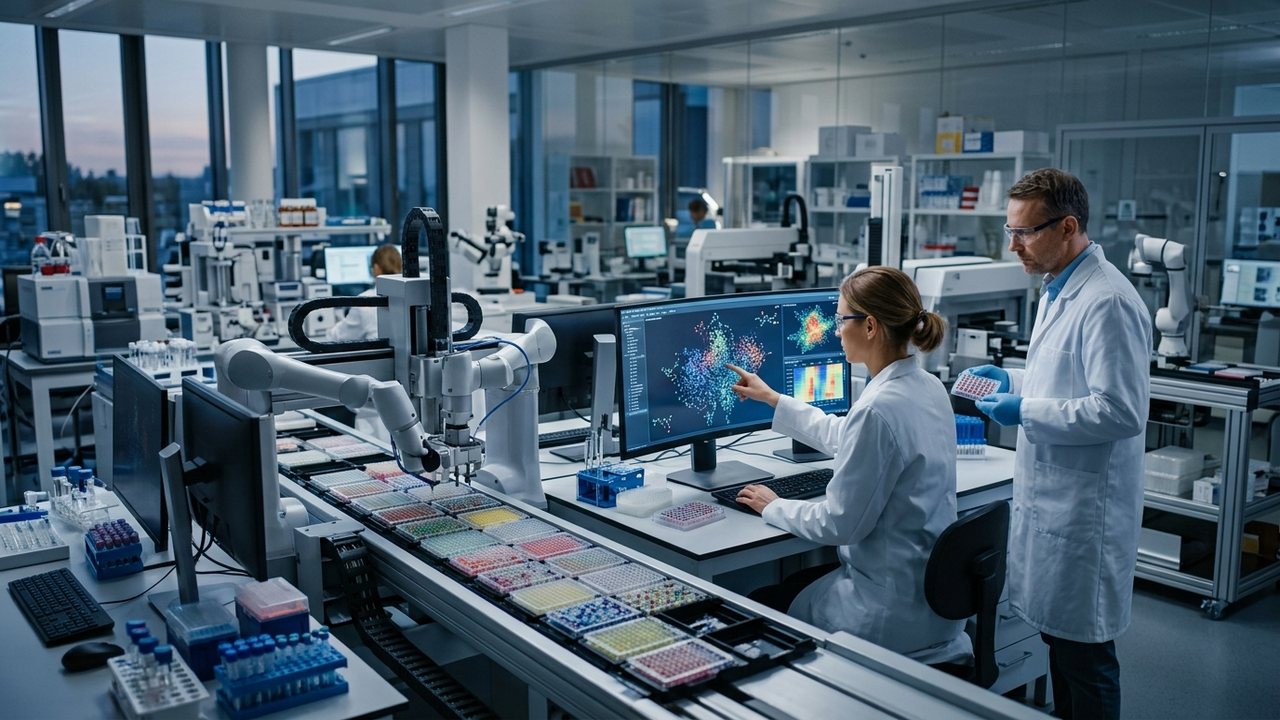
News-Medical reports that modern synthetic tools, spearheaded by AI-driven catalysis discovery, are bringing about a transformative shift in chemistry and drug discovery. These advanced tools integrate high-throughput experimentation with sophisticated machine learning algorithms, enabling researchers to efficiently explore vast chemical spaces that were previously inaccessible through conventional experimental methods. This novel approach promises to dramatically shorten the development timeline for catalytic systems and significantly accelerate reaction optimization in pharmaceutical, fine chemical, and materials research. In drug development, this could reduce the average time-to-market by over a decade, contributing to substantial cost savings and faster access to new medicines.
Technical & Clinical Details
AI-driven catalysis discovery fundamentally deviates from traditional trial-and-error methods, centering on data-driven prediction and optimization. The process begins with high-throughput experimentation, which involves the automated synthesis and screening of thousands to millions of compound libraries. The immense datasets generated from these experiments are then utilized to train machine learning models, which predict catalytic activity, selectivity, and stability for specific reactions. This allows researchers to focus on the most promising candidates, minimizing the number of actual experiments. For instance, AI can predict the impact of varying conditions—such as solvents, temperatures, pressures, and reactant concentrations—on catalyst performance, enabling rapid identification of optimal reaction parameters. This capability can reduce the lead time for catalyst development from months to weeks, improving efficiency by severalfold compared to conventional processes.
Background & Industry Context
Chemical synthesis and pharmaceutical development have historically been time-consuming and expensive processes, with the discovery of novel catalysts and optimization of reaction pathways often representing major bottlenecks. Developing a new drug, on average, costs over $2 billion and takes 10-15 years, with a significant portion of this expenditure occurring during the R&D phase. The introduction of modern synthetic tools, particularly AI, offers a powerful solution to these industry challenges. AI not only automates experiments but also supports researchers in hypothesis generation through more refined predictive analytics, shifting from intuition- and experience-based decision-making to data-driven insights. This acceleration is expected to facilitate the synthesis of complex molecules and the development of more sustainable, greener chemical processes, bringing about significant transformations across the chemical industry.
Strategic Significance & Outlook
The evolution of AI-driven synthetic tools will be indispensable in shaping the future of chemistry and drug discovery. Looking ahead, a complete integration of autonomous lab systems with AI could realize a ‘closed-loop’ research ecosystem where material ‘inverse design,’ synthesis, and characterization are performed without human intervention. This would enable the faster and more efficient discovery of new materials with previously unattainable functions and pharmaceutical compounds optimized for specific diseases. AI is increasingly becoming a crucial tool that augments chemists’ capabilities, allowing them to tackle more complex challenges and pursue fundamental scientific breakthroughs, thereby enhancing the overall pace and impact of scientific discovery.
Get our weekly technology intelligence — free
Receive an infographic that lets you judge at a glance whether each field’s analysis report is worth reading.
Subscribe Free — Weekly Tech Intelligence
By subscribing, you’ll receive Troy-Technical’s weekly technology intelligence newsletter.
- Your email and selected fields are used only to deliver the newsletter.
- We never share your information with third parties.
- You can unsubscribe anytime via the link in each email.
See our Privacy Policy for details.
Takes about a minute · Unsubscribe anytime








Comments