Key Findings
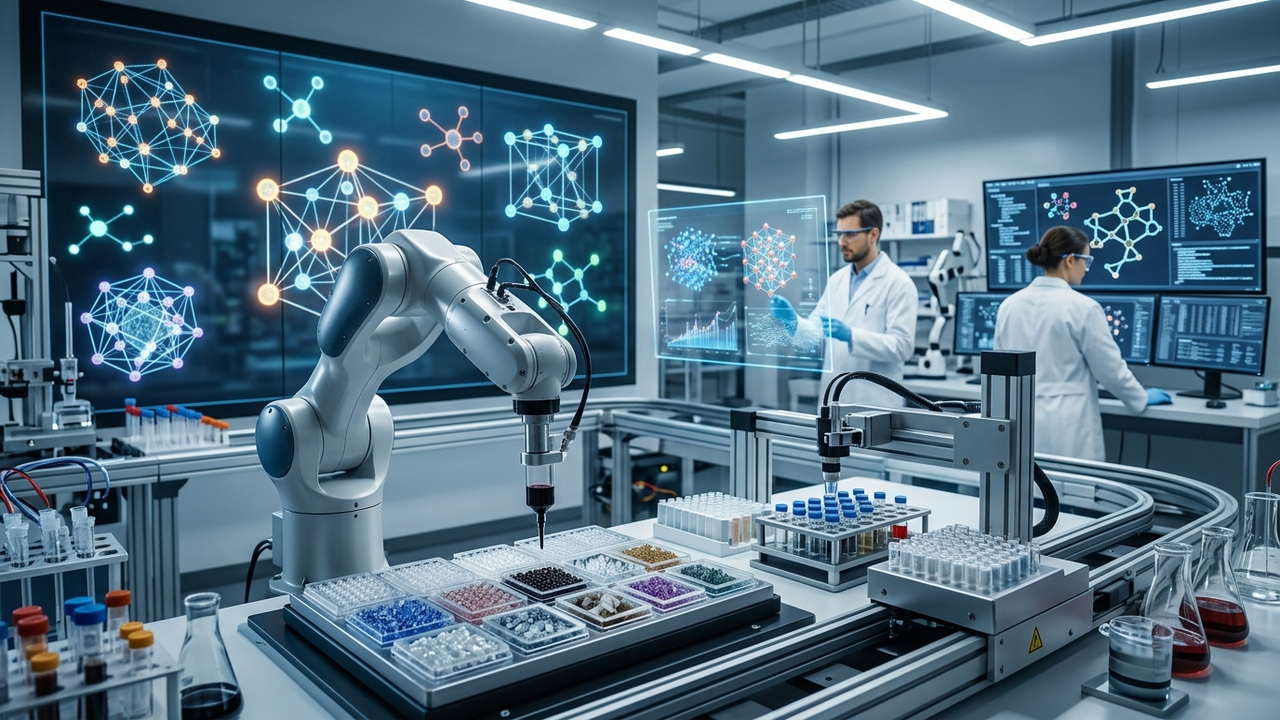
According to Cypris AI, the groundbreaking convergence of generative models, Graph Neural Networks (GNNs), and autonomous laboratories is dramatically shortening the timeline for materials research and development (R&D), reducing it from a traditional 10-20 years to just 1-2 years. This transformative shift is primarily fueled by advancements in GNN architectures, such as the new CT-GNN and SA-GNN models, which are enabling the generation of innovative new materials through inverse design approaches. Notably, AI is expanding its application in developing catalysts and battery materials, as exemplified by Google DeepMind’s GNoME project, which has predicted an astounding 2.4 million new materials, thereby achieving an exponential increase in R&D efficiency.
Technical & Clinical Details
At the core of this technological evolution is the synergistic effect of multiple AI technologies. Generative models accelerate the exploration of chemical space by proposing candidate structures for materials with desired properties. Graph Neural Networks (GNNs) are exceptionally effective in representing atomic arrangements and chemical bonds as graphs, learning and predicting complex structure-property relationships in materials. Specifically, new GNN architectures like the Convolutional Transformer Graph Neural Network (CT-GNN) and Self-Attention Graph Neural Network (SA-GNN) have further enhanced predictive accuracy and computational efficiency. These AI models, when integrated with autonomous laboratories, establish a ‘closed-loop’ R&D cycle that automatically synthesizes, characterizes, and feeds back results to the AI model. This significantly reduces manual intervention and trial-and-error processes, accelerating the entire materials discovery pipeline.
Background & Industry Context
Materials R&D has historically been a lengthy and costly process. The journey from discovery to commercialization of new materials typically takes 10 to 20 years, posing a significant barrier to technological innovation. However, the rapid advancements in machine learning and AI over the past few years, and their subsequent application in materials science, have fundamentally altered this landscape. Especially amidst growing demands for high-performance battery materials and efficient catalysts—driven by environmental concerns and the pursuit of sustainable societies—AI-accelerated materials development has become an indispensable factor for industries worldwide. Google DeepMind’s prediction of millions of new materials through GNoME underscores that AI is no longer merely an auxiliary tool but a leading force at the forefront of materials discovery.
Strategic Significance & Outlook
The future of AI-driven materials discovery, through the continued integration of generative models, GNNs, and autonomous labs, promises to enable material innovations previously unimaginable. In the future, scientists may simply specify desired functions or performance criteria to AI, which would then autonomously handle the entire process from material design, synthesis, to optimization in a ‘materials-on-demand’ era. This is expected to accelerate the development of revolutionary products across all industrial sectors, including energy storage, electronics, medicine, and aerospace. By shortening the material development cycle to 1-2 years, companies will be able to respond more swiftly to market needs and establish competitive advantages. This heralds the dawn of a new era where science, engineering, and business converge to drive unprecedented progress.
Get our weekly technology intelligence — free
Receive an infographic that lets you judge at a glance whether each field’s analysis report is worth reading.
Subscribe Free — Weekly Tech Intelligence
By subscribing, you’ll receive Troy-Technical’s weekly technology intelligence newsletter.
- Your email and selected fields are used only to deliver the newsletter.
- We never share your information with third parties.
- You can unsubscribe anytime via the link in each email.
See our Privacy Policy for details.
Takes about a minute · Unsubscribe anytime





Comments