Key Findings
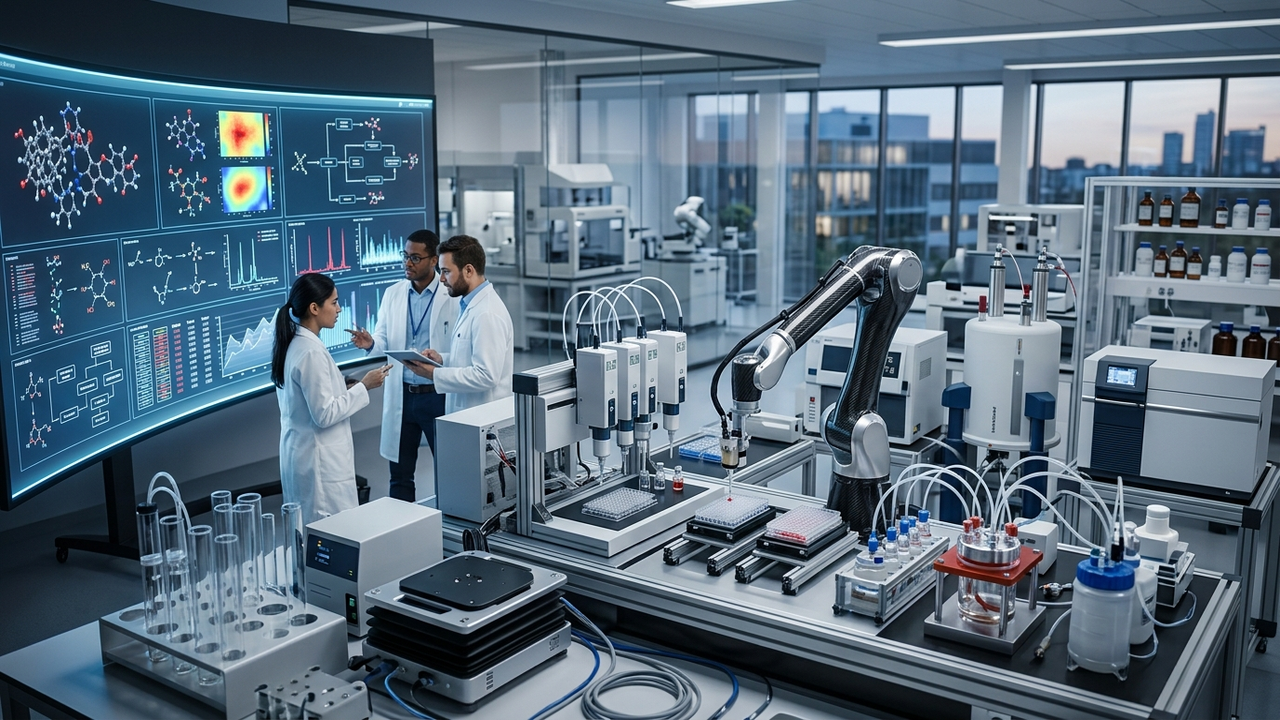
According to ChemCopilot’s Q3 2026 report, significant advancements are being made in chemical AI and autonomous laboratories. The ELLIS Institute Finland is highlighted for its specialization in predictive signal extraction in low-data environments, while the University of Toronto’s Acceleration Consortium is recognized as a global leader in self-driving labs. The Acceleration Consortium is reported to be achieving fully closed-loop hypothesis generation by directly integrating generative AI design models with automated robotic systems, dramatically reducing the lead time from new material discovery to commercialization.
Technical / Clinical Details
The ELLIS Institute Finland’s approach focuses on advanced machine learning algorithms and statistical methods to make reliable predictions even with limited data. This is particularly valuable in the early exploration stages of novel materials and complex chemical reactions. The Acceleration Consortium’s ‘self-driving lab,’ on the other hand, integrates AI algorithms, robotics, and sophisticated analytical instruments. It features a closed-loop system where AI generates hypotheses, robots autonomously conduct experiments, generated data is analyzed in real-time, and AI then determines the next experimental steps. This system shortens the material synthesis, characterization, and optimization cycle from months to days, accelerating the discovery of, for example, new polymers and catalysts. The potential for up to a tenfold increase in material development efficiency has been noted.
Background & Context
Digital transformation is impacting all facets of the chemical industry, and enhancing R&D efficiency is critical for maintaining global competitiveness. AI and autonomous labs are positioned as key technologies enabling breakthroughs in many fields, including drug discovery, catalyst design, and materials science. International hubs like the Acceleration Consortium, established with Canadian government support, aim to put researchers and companies worldwide at the forefront of AI-driven R&D. These initiatives are expected to resolve research bottlenecks and foster faster innovation, contributing to sustainable chemical processes and material development. The investment in such infrastructure reflects a global recognition of AI’s strategic importance.
Strategic Significance & Outlook
Chemical AI and autonomous lab technologies are expected to continue their rapid evolution. Research specializing in low-data learning, such as that at the ELLIS Institute Finland, will broaden the applicability of AI in fields involving rare materials or costly experiments. Closed-loop labs like the Acceleration Consortium are moving towards fully automating the material discovery process, autonomously exploring and optimizing increasingly complex material systems. In the future, these technologies will be adopted across a wider range of industries, driving digital transformation throughout chemical product design, manufacturing, and supply chains. This holds significant potential to reduce environmental impact, improve resource efficiency, and contribute substantially to the realization of a more sustainable society, establishing new benchmarks for innovation and operational excellence.
Get our weekly technology intelligence — free
Receive an infographic that lets you judge at a glance whether each field’s analysis report is worth reading.
Subscribe Free — Weekly Tech Intelligence
By subscribing, you’ll receive Troy-Technical’s weekly technology intelligence newsletter.
- Your email and selected fields are used only to deliver the newsletter.
- We never share your information with third parties.
- You can unsubscribe anytime via the link in each email.
See our Privacy Policy for details.
Takes about a minute · Unsubscribe anytime





Comments