
Key Findings
This article discusses that establishing a ‘closed-loop’ from hypothesis generation to experimental execution and subsequent hypothesis revision based on results is essential for accelerating AI-driven scientific discovery. It specifically highlights the central role of Large Language Model (LLM) agents in this closed-loop process, emphasizing their ability to generate scientific reasoning and actions, and dynamically adjust the posterior probability of hypotheses through interpretation of experimental results.
Technical / Clinical Details
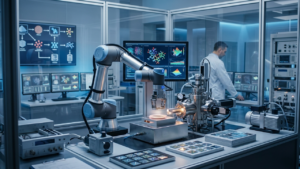
In a closed-loop discovery system, LLM agents first extract information from existing scientific literature and databases to generate novel hypotheses. Subsequently, based on these hypotheses, AI formulates experimental plans, and autonomous robotic systems (autonomous labs) physically conduct the experiments. The data obtained from experiments are then analyzed by the LLM agents, which determine whether the results support the original hypothesis, require modification, or should be entirely rejected. Through this iterative process, AI continuously learns and refines its hypothesis-forming capabilities. In materials discovery, Google DeepMind’s GNoME has demonstrated the ability to filter stable crystal structure candidates from a vast number of possibilities using learned energy models. Furthermore, Lawrence Berkeley National Laboratory’s A-Lab, as a fully autonomous closed-loop lab, has successfully synthesized previously unreported inorganic compounds, demonstrating AI’s capability to validate its proposals in the physical world.
Background & Context
Scientific discovery has traditionally been a human-led, time-consuming, and costly process. Especially in biomedical and materials science fields, the vastness of the exploration space has posed a significant challenge in identifying promising candidates. The evolution of AI, particularly LLMs, holds the potential to dramatically change this landscape. AI agents can integrate information from vast knowledge bases, which humans cannot process, generating new insights. Leading research institutions in the U.S., Europe, and Asia are accelerating investments in autonomous labs that integrate AI and robotics, aiming to overcome research bottlenecks and significantly increase the speed of discovery. This represents a critical strategic turning point in global scientific competition.
Strategic Significance & Outlook
The realization of closed-loop AI-driven scientific discovery is expected to expand to more fields in the coming years. LLM agents will become capable of addressing more complex scientific problems, accelerating the generation of new knowledge while enhancing collaboration with humans. For instance, in new drug development, a complete cycle could be achieved where AI hypothesizes disease mechanisms, lab robots synthesize and test drug candidates, and AI evaluates efficacy and toxicity to propose the next molecular structure. In materials science, as demonstrated by the success of GNoME and A-Lab, AI-designed new materials will be autonomously synthesized and evaluated, with results immediately fed back into AI models, dramatically improving the efficiency of materials discovery. This is expected to provide solutions to major societal challenges (e.g., disease treatment, energy problems, environmental pollution) at an unprecedented pace, globally transforming R&D paradigms.
Source: https://www.preprints.org/manuscript/202608.2107
Get our weekly technology intelligence — free
Receive an infographic that lets you judge at a glance whether each field’s analysis report is worth reading.
Subscribe Free — Weekly Tech Intelligence
By subscribing, you’ll receive Troy-Technical’s weekly technology intelligence newsletter.
- Your email and selected fields are used only to deliver the newsletter.
- We never share your information with third parties.
- You can unsubscribe anytime via the link in each email.
See our Privacy Policy for details.
Takes about a minute · Unsubscribe anytime





Comments