Key Findings
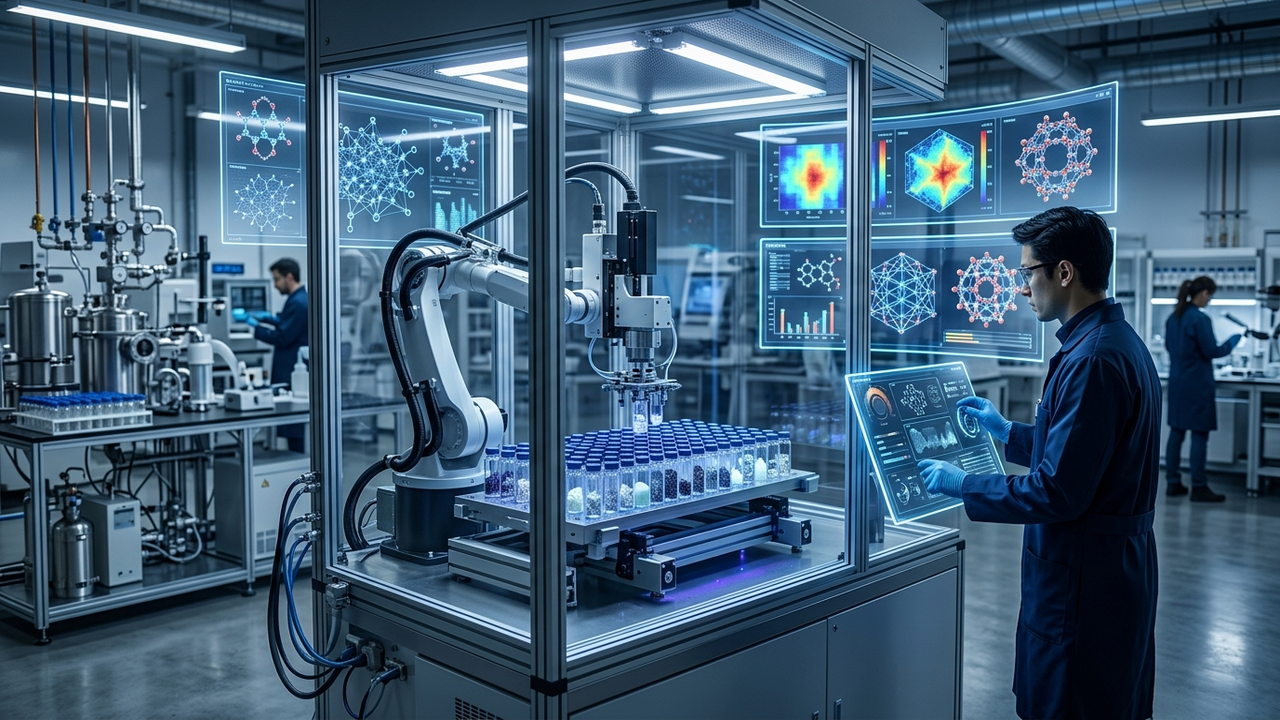
Through a collaboration between Google DeepMind and MOFGen, the largest synthesized set of AI-designed materials to date has been realized. The MOFGen AI agent system autonomously proposes new compositions for Metal-Organic Frameworks (MOFs), constructs their structures at the atomic level, thoroughly confirms their physical properties, and evaluates their synthesizability. A particularly noteworthy achievement is the successful generation of hundreds of thousands of synthesizable MOFs, atom by atom, from crystal structures using diffusion models. This outcome represents a pioneering advance that dramatically accelerates the process from new material discovery to synthesis.
Technical / Clinical Details
The MOFGen system is a composite framework integrating multiple AI agents and computational tools. First, a generative AI model, trained on MOF structure and property information from extensive databases, proposes new MOF compositions with specific functions (e.g., gas storage capacity, catalytic activity). Next, atomic simulations and quantum mechanical calculations are used to predict the stability and physical properties of the proposed structures, passing them through a synthesizability filter. Here, diffusion models, co-developed with Google DeepMind, play a crucial role. These models learn structural patterns of existing MOFs and use this knowledge to “build” new MOF structures atom by atom, creating hundreds of thousands of unique, synthesizable MOFs. Finally, from these promising candidates, MOFs that are easiest to synthesize in the laboratory and possess the desired properties are selected, physically synthesized, and validated. This entire process has the potential to reduce traditional manual exploration and synthesis, which can span years to decades, to just weeks or months.
Background & Context
Metal-Organic Frameworks (MOFs), with their porous structures and customizable properties, are groundbreaking materials expected to find wide-ranging applications in gas storage, separation, catalysis, sensors, and drug delivery. However, their compositional space is incredibly vast, with hundreds of millions or even trillions of possible combinations, making the manual discovery and synthesis of optimal MOFs virtually impossible. The introduction of AI has been recognized as a powerful means to efficiently navigate this vast search space and overcome bottlenecks in MOF development. This achievement demonstrates that AI is not just a predictive tool but can actually “design” synthesizable materials, opening a new era in MOF research.
Strategic Significance & Outlook
This collaboration between Google DeepMind and MOFGen establishes a new standard in AI-driven material design and synthesis. The discovery of hundreds of thousands of synthesizable MOFs has the potential to contribute to solving global challenges such as clean energy technologies, CO2 capture, and hydrogen storage. This AI-driven approach is extensible not only to MOFs but also to the design and synthesis of other types of high-performance materials (e.g., catalysts, battery materials, semiconductors), and is expected to dramatically accelerate the pace of innovation in materials science. In the future, we are one step closer to realizing “materials on demand,” where humans simply input desired functionalities, and AI autonomously designs, synthesizes, and tests the materials.
Get our weekly technology intelligence — free
Receive an infographic that lets you judge at a glance whether each field’s analysis report is worth reading.
Subscribe Free — Weekly Tech Intelligence
By subscribing, you’ll receive Troy-Technical’s weekly technology intelligence newsletter.
- Your email and selected fields are used only to deliver the newsletter.
- We never share your information with third parties.
- You can unsubscribe anytime via the link in each email.
See our Privacy Policy for details.
Takes about a minute · Unsubscribe anytime








Comments