Key Findings
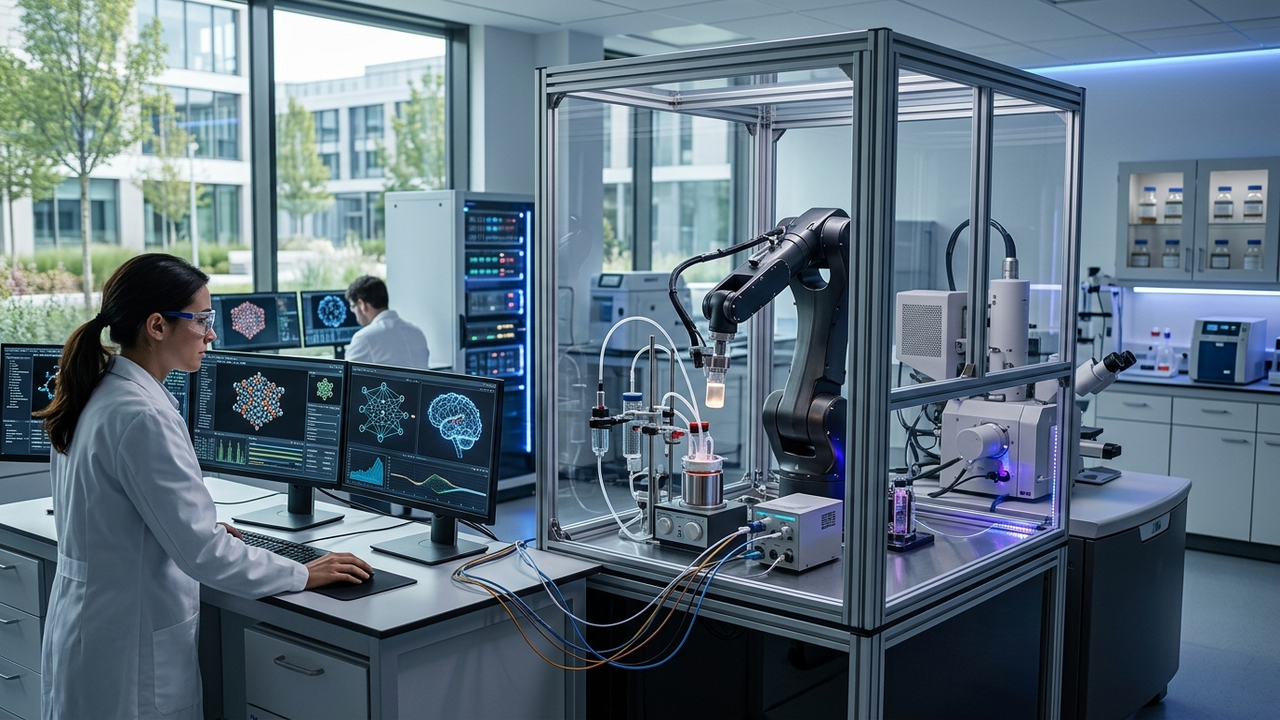
A comprehensive review published by The Royal Society of Chemistry deeply explores how the integration of Artificial Intelligence (AI) into nanomaterials science is fundamentally transforming the processes of material discovery, design, synthesis, and characterization. The review emphasizes that machine learning (ML), deep learning (DL), generative models, and physics-informed AI approaches are accelerating property prediction accuracy, efficient material exploration through inverse design, synthesis condition optimization, and advanced analysis of complex microscopy and spectroscopic data. Notably, the advancements in closed-loop experimentation and autonomous lab platforms highlight AI’s immense potential to reduce the cost and time of experimental exploration and significantly improve the synthesis efficiency of nanomaterials.
Technical / Clinical Details
AI plays a critical role in designing nanomaterials by predicting structures with specific functions (e.g., optical, electronic, catalytic properties). Generative AI models learn from existing nanomaterial databases to propose novel nanostructures and compositions with targeted properties. Graph Neural Networks (GNNs), by capturing interatomic interactions and bonding patterns, predict the stability and reactivity of nanoparticles with high accuracy. Inverse design algorithms work backward from desired macro-scale properties to identify appropriate nanoscale structural elements. Furthermore, AI collaborates with high-throughput synthesis robots to enable self-optimizing, closed-loop experiments. In this system, AI proposes the next experimental conditions, robots synthesize and measure nanomaterials, and AI analyzes the results to update its learning. For example, exploring and optimizing parameter spaces, such as quantum dot size control or catalytic nanoparticle active site optimization, which are difficult manually, can be performed thousands of times faster.
Background & Context
Nanomaterials, with their unique physical and chemical properties, are expected to have transformative applications across diverse fields including electronics, medicine, energy, and environmental technologies. However, material design and synthesis at the nanoscale have been extremely challenging, time-consuming, and costly due to the vast parameter space and complex phenomena involved. Traditional trial-and-error approaches make efficient discovery of optimal nanomaterials nearly impossible. The introduction of AI has emerged as a powerful solution to overcome this challenge and resolve bottlenecks in nanomaterial research and development.
Strategic Significance & Outlook
The advancement of AI-driven nanomaterials science will fundamentally change the landscape of science and technology in the coming decades. This approach will accelerate the development of innovative products and technologies previously unimaginable, such as more efficient solar cells, high-performance sensors, targeted drug delivery systems, and next-generation catalysts. The fusion of autonomous labs and AI is expected to create an environment where humans can focus on more strategic problem-solving, dramatically improving the speed and depth of scientific discovery. This holds the potential to generate new solutions for global challenges such as environmental problems, medical issues, and the energy crisis.
Get our weekly technology intelligence — free
Receive an infographic that lets you judge at a glance whether each field’s analysis report is worth reading.
Subscribe Free — Weekly Tech Intelligence
By subscribing, you’ll receive Troy-Technical’s weekly technology intelligence newsletter.
- Your email and selected fields are used only to deliver the newsletter.
- We never share your information with third parties.
- You can unsubscribe anytime via the link in each email.
See our Privacy Policy for details.
Takes about a minute · Unsubscribe anytime








Comments