Background
Tandem solar cells, which combine two different solar cell materials to capture a broader spectrum of sunlight, are a key strategy for pushing photovoltaic efficiencies beyond the limits of single-junction devices. Perovskite-organic tandems are particularly promising due to their tunable bandgaps and low-cost processing, but achieving high efficiencies with good stability remains a significant challenge.
Key Findings
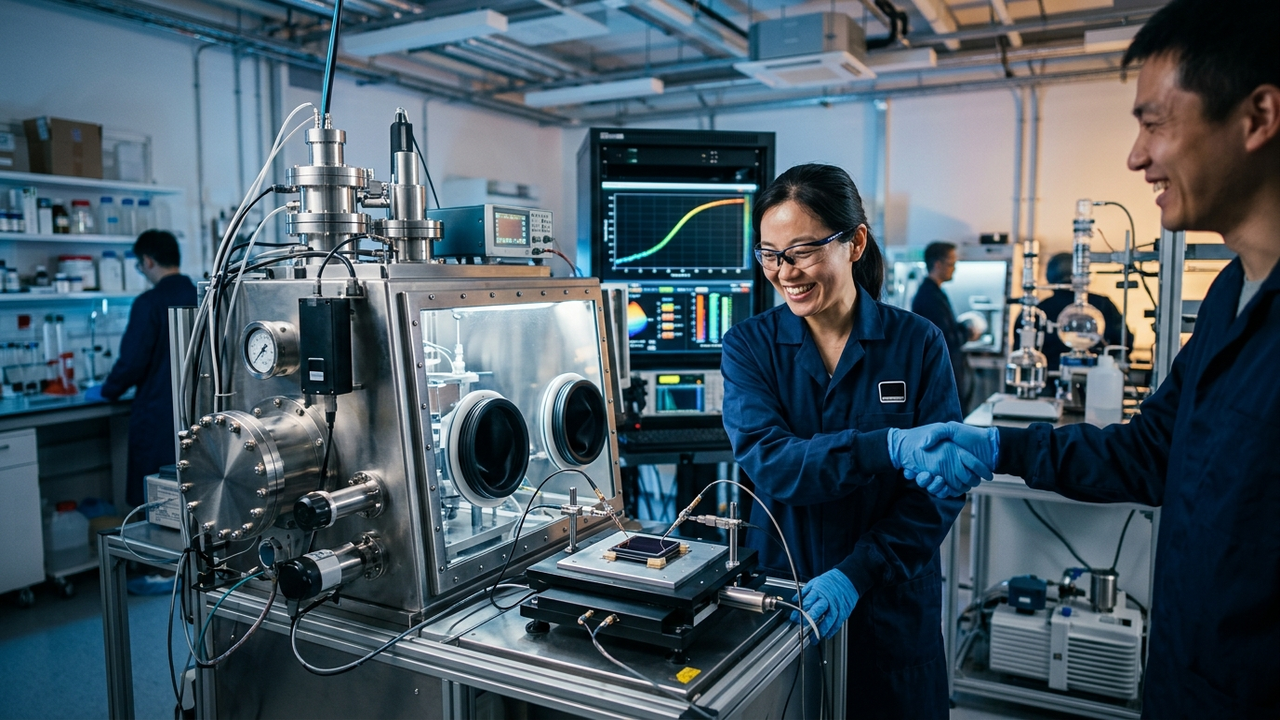
A team of scientists at Nanjing University in China has announced a major breakthrough in tandem solar cell technology. They have developed a perovskite-organic tandem solar cell that achieved a certified power conversion efficiency of 27.35%. This figure represents a new world record for this specific type of tandem architecture, pushing the boundaries of what is possible with organic and perovskite materials. The key to this record-breaking performance lies in the ingenious utilization of a novel low-bandgap acceptor material. This material significantly enhances the harvesting of near-infrared light, a spectral region often underutilized by conventional solar cells. Moreover, the design effectively optimized photocurrent matching between the two sub-cells, a crucial factor for maximizing tandem efficiency. Beyond efficiency, the device also exhibited promising operational stability, maintaining 80% of its initial performance after an impressive 744 hours of continuous illumination, addressing a common concern with new solar materials.
Significance & Outlook
This achievement, published in the journal Joule, has profound implications for the future of solar energy. The record 27.35% efficiency demonstrates the immense potential of perovskite-organic tandem cells to surpass the performance of established silicon technologies. The improved near-infrared light harvesting is particularly important for increasing energy yield under real-world conditions, while the enhanced stability offers a clear path towards commercialization. This breakthrough could accelerate the development of next-generation solar panels that are not only more efficient but also potentially more cost-effective and versatile for various applications, contributing significantly to global renewable energy targets.
Get our weekly technology intelligence — free
Receive an infographic that lets you judge at a glance whether each field’s analysis report is worth reading.
Subscribe Free — Weekly Tech Intelligence
By subscribing, you’ll receive Troy-Technical’s weekly technology intelligence newsletter.
- Your email and selected fields are used only to deliver the newsletter.
- We never share your information with third parties.
- You can unsubscribe anytime via the link in each email.
See our Privacy Policy for details.
Takes about a minute · Unsubscribe anytime







Comments