Background
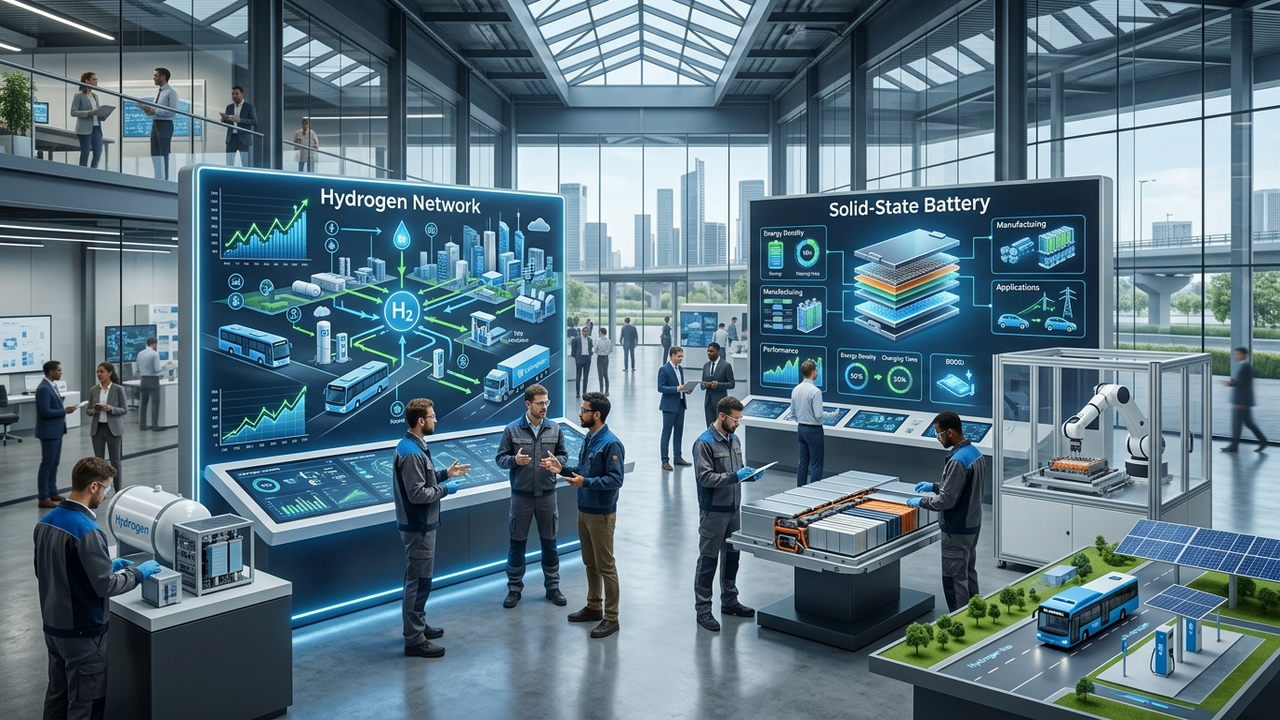
Global concerns over climate change and energy security are accelerating national strategies to expand renewable energy integration and reduce reliance on fossil fuels. This has made highly efficient energy storage systems, crucial for stabilizing power grids and mitigating fluctuations from renewable sources, indispensable infrastructure. Fuel cells, utilizing hydrogen as a clean energy carrier, contribute significantly to CO2 emission reduction and offer flexibility for diverse power demands. Meanwhile, all-solid-state batteries are emerging as a transformative solution to conventional battery limitations, promising higher performance for everything from small electronics to grid-scale applications, with widespread adoption particularly anticipated in the electric vehicle (EV) market.
Key Findings
The Japan External Trade Organization (JETRO) has published “Outlook for the Fuel Cell and Storage Battery Market (Part 2),” a detailed report analyzing market trends for fuel cells and storage batteries amidst rising global electricity demand and accelerated decarbonization. While its primary focus is on fuel cells such as Polymer Electrolyte Fuel Cells (PEFC/PEMFC) and Solid Oxide Fuel Cells (SOFC), the report also offers a broad perspective on various next-generation energy storage solutions, including all-solid-state batteries, highlighting significant governmental backing in Western nations.
Technical Details
The report elaborates on the technological evolution of fuel cells, particularly advancements in Polymer Electrolyte Fuel Cells (PEFC/PEMFC) and Solid Oxide Fuel Cells (SOFC) for industrial and mobility applications. These technologies enable highly efficient, direct power generation from hydrogen, positioning them as vital power sources for a decarbonized future. Simultaneously, innovative storage battery technologies like all-solid-state batteries are presented as critical solutions for the increasing demand for higher energy density, enhanced safety, and extended lifespan in electric vehicles (EVs) and stationary energy storage systems. Governments across Europe and the United States are providing substantial policy support and funding to develop extensive hydrogen supply networks, expand transportation infrastructure, and establish regional hydrogen hubs, collectively accelerating the emergence of a robust hydrogen economy.
Strategic Significance & Outlook
JETRO’s analysis indicates that fuel cells and advanced storage batteries, especially next-generation technologies such as all-solid-state batteries, are set to become pivotal in the global energy transition over the coming decades. Substantial investments in hydrogen-related infrastructure across Western countries are anticipated to catalyze the full-scale launch of the hydrogen economy, significantly boosting demand for fuel cell technologies. Moreover, as all-solid-state batteries near commercialization, they are expected to dramatically enhance EV performance and render stationary storage systems more economical and safer, further accelerating renewable energy integration. The integrated and widespread deployment of these advanced technologies will be a critical force in achieving global decarbonization targets.
Source: https://www.jetro.go.jp/biz/areareports/2026/8c672840b9e462a8.html
Get our weekly technology intelligence — free
Receive an infographic that lets you judge at a glance whether each field’s analysis report is worth reading.
Subscribe Free — Weekly Tech Intelligence
By subscribing, you’ll receive Troy-Technical’s weekly technology intelligence newsletter.
- Your email and selected fields are used only to deliver the newsletter.
- We never share your information with third parties.
- You can unsubscribe anytime via the link in each email.
See our Privacy Policy for details.
Takes about a minute · Unsubscribe anytime






Comments