Key Findings
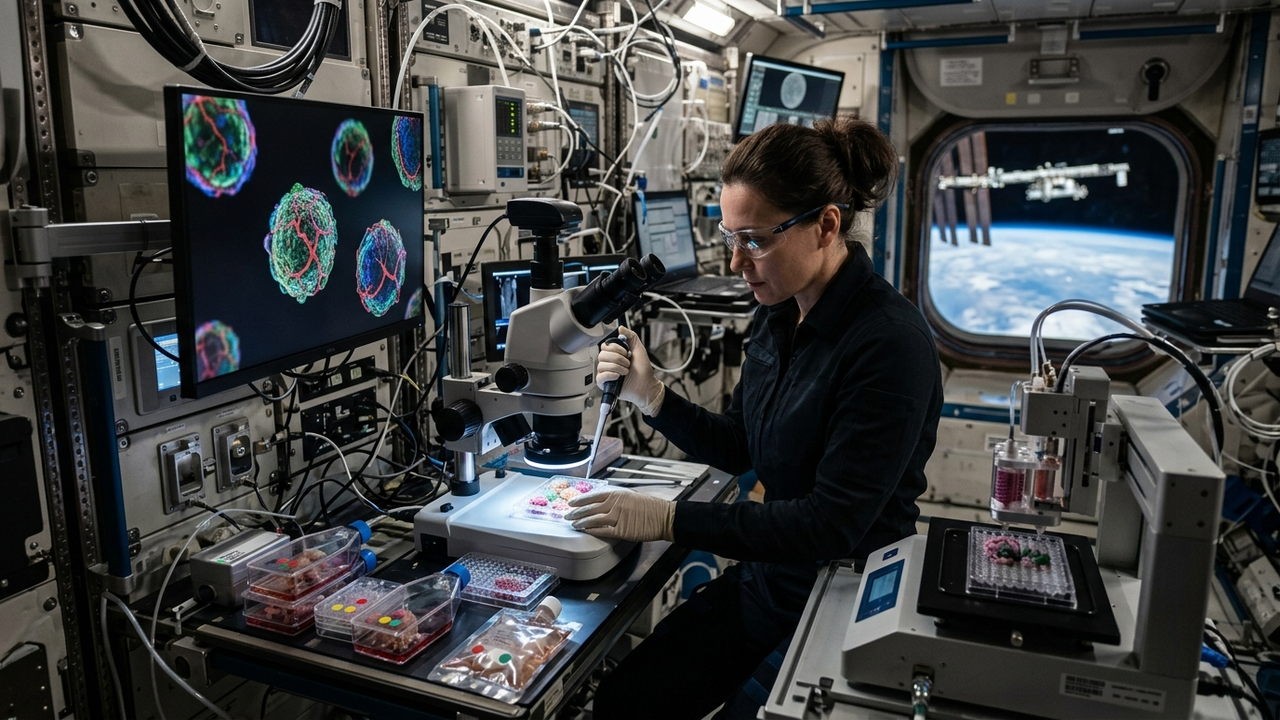
Research aboard the International Space Station (ISS) is delivering significant breakthroughs in cancer treatment. Scientists have found that microgravity enables the cultivation of 3D cancer cell cultures that more accurately replicate in-vivo behavior, thereby accelerating the development of novel screening tests and therapeutic approaches, including artificial organ-based cancer testing pioneered by Wake Forest University. Additionally, NASA is actively refining clinical-grade stem cell manufacturing processes in microgravity, while pharmaceutical companies project the orbital production of complex biologics by 2026, anticipating enhanced stability and efficacy.
Technical & Clinical Details
The ability to culture cancer cells in 3D configurations offers a more precise evaluation of drug responses and tumor progression. This method effectively replicates intricate cell-to-cell interactions and microenvironmental cues often absent in conventional 2D cultures, significantly increasing the potential for identifying potent anti-cancer compounds. Wake Forest University’s advanced artificial organ testing methodologies are poised to deliver crucial data for crafting personalized treatment strategies. Furthermore, stem cells propagated in microgravity are expected to exhibit superior uniformity and quality compared to their Earth-grown counterparts, opening new avenues for regenerative medicine and disease therapy. Enhanced stability of orbital-manufactured biologics could translate to longer shelf lives and potentially fewer side effects, ultimately improving patient accessibility.
Background & Context
The microgravity environment presents distinct advantages for a range of biological processes, encompassing cell culture, tissue engineering, and crystal growth. Terrestrial gravity inherently affects cell morphology, proliferation, and differentiation, making it difficult to achieve highly uniform biological samples. Orbital platforms such as the ISS offer an optimal environment to circumvent these challenges. Consequently, pharmaceutical and biotechnology sectors are increasingly investing in space-based research and development to uncover novel insights and create products previously unattainable on Earth. Collaborative efforts involving NASA and leading academic institutions are further accelerating innovation in this burgeoning domain.
Strategic Significance & Outlook
ISS microgravity research is projected to contribute significantly to the advancement of diagnostic and therapeutic modalities across a broad spectrum of diseases, extending beyond oncology. Looking ahead, in-orbit pharmaceutical manufacturing could become a routine practice, facilitating the production of customized medications tailored for specific patient conditions. Moreover, the integration with advanced 3D bioprinting technologies could enable the creation of transplantable artificial organs, leveraging uniformly cultured biological tissues cultivated in microgravity. These converging technologies possess the profound potential to revolutionize human health and reshape the future of medicine, positioning space not merely as a realm of exploration but as a pivotal hub for medical innovation.
Get our weekly technology intelligence — free
Receive an infographic that lets you judge at a glance whether each field’s analysis report is worth reading.
Subscribe Free — Weekly Tech Intelligence
By subscribing, you’ll receive Troy-Technical’s weekly technology intelligence newsletter.
- Your email and selected fields are used only to deliver the newsletter.
- We never share your information with third parties.
- You can unsubscribe anytime via the link in each email.
See our Privacy Policy for details.
Takes about a minute · Unsubscribe anytime







Comments