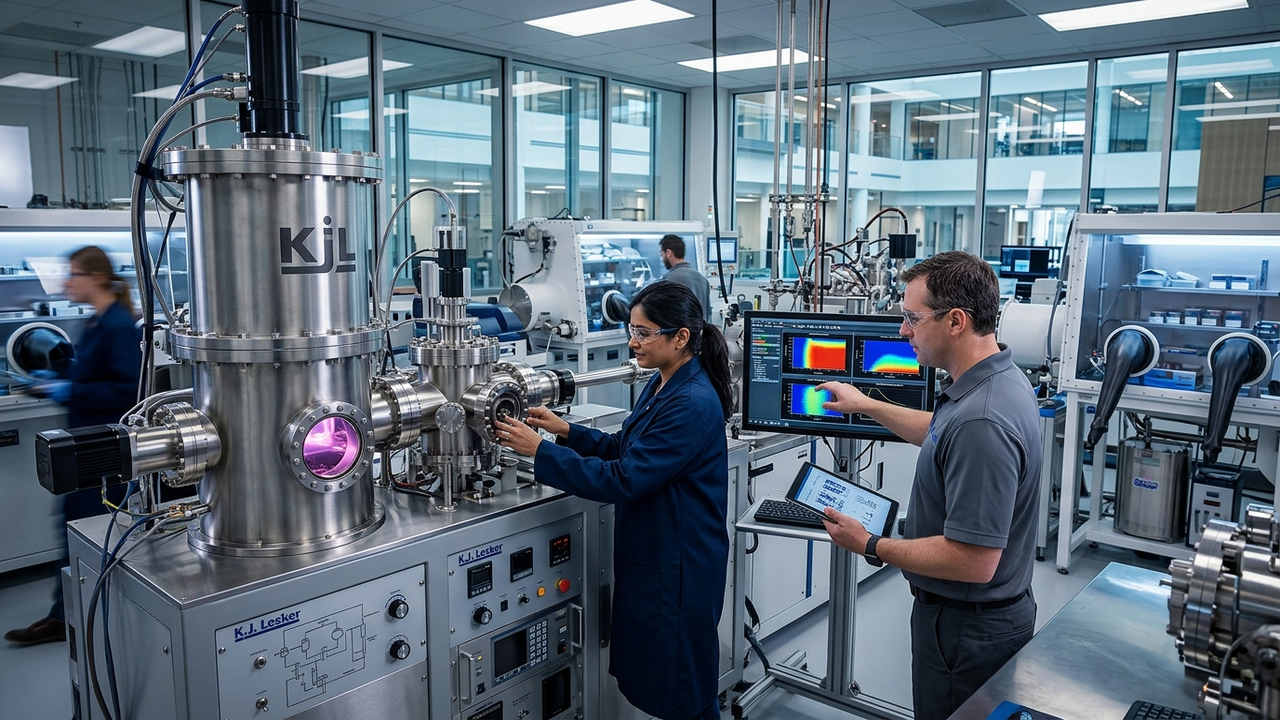
The rapid advancements in cutting-edge technological fields such as semiconductors, quantum computing, and photonics demand precise control of materials at the atomic scale. To meet this need, Penn State University and Kurt J. Lesker Company (KJLC), a leading provider of vacuum technology and materials solutions, have formed a strategic partnership to establish the ASPIRE (Advanced Scalable Processing & Integration for Reliable Electronics) Center of Excellence.
Key Findings
- Penn State University and Kurt J. Lesker Company established a strategic partnership for the ASPIRE Center of Excellence.
- Focuses on developing atomic-scale processing technologies for manufacturing specialized next-generation materials.
- Accelerates innovation in semiconductors, advanced packaging, quantum, and photonics.
- Strengthens the bridge from fundamental research to practical application through academic-industry collaboration.
Technical & Research Details
The ASPIRE Center will concentrate on state-of-the-art atomic-scale processing technologies such as Atomic Layer Deposition (ALD), Molecular Beam Epitaxy (MBE), and Chemical Vapor Deposition (CVD). These techniques enable precise control of material composition, thickness, and structure at the single-atom layer level, providing the foundation for developing next-generation semiconductor devices (e.g., 2D material-based transistors), advanced packaging (e.g., 3D stacking technologies), superconducting materials for quantum computing, and high-efficiency photonic devices. KJLC will supply the high-quality vacuum equipment, materials, and components necessary for these processes, while Penn State researchers will utilize these tools to develop new material synthesis methods and device structures and characterize their properties. The center’s goal is to deepen fundamental scientific understanding while simultaneously developing scalable manufacturing processes, thereby bridging discoveries from the lab to industrial production levels.
Background & Context
The modern electronics industry is facing the limits of Moore’s Law, and performance improvements are becoming increasingly difficult with conventional silicon-based technologies alone. Consequently, materials scientists are focusing on new specialized materials such as 2D materials like graphene and molybdenum disulfide, perovskites, and topological insulators. These materials possess unique electronic, optical, and quantum properties, but realizing their full potential requires precise control at the atomic level. Furthermore, the rise of quantum technologies is accelerating the development of error-tolerant qubits and highly sensitive sensors, which also rely on atomic-scale materials engineering. The Penn State and KJLC partnership aims to provide rapid and effective solutions to these technological challenges by merging academic and industrial expertise.
Strategic Significance & Outlook
The establishment of the ASPIRE Center will be a crucial catalyst in the advancement of next-generation electronics and quantum technologies. The atomic-scale processing technologies emerging from this center will enable the realization of smaller, higher-performance, and more energy-efficient devices. Specifically, by breaking through the miniaturization limits in semiconductor manufacturing and integrating materials with novel functionalities, it is expected to contribute to the development of AI chips, high-speed communication devices, high-precision sensors, and practical quantum computers. This partnership serves as an excellent example of the impact of materials science research on industry and holds significant meaning for strengthening America’s technological leadership. Future research outcomes and technology transfer are highly anticipated.
Get our weekly technology intelligence — free
Receive an infographic that lets you judge at a glance whether each field’s analysis report is worth reading.
Subscribe Free — Weekly Tech Intelligence
By subscribing, you’ll receive Troy-Technical’s weekly technology intelligence newsletter.
- Your email and selected fields are used only to deliver the newsletter.
- We never share your information with third parties.
- You can unsubscribe anytime via the link in each email.
See our Privacy Policy for details.
Takes about a minute · Unsubscribe anytime









Comments