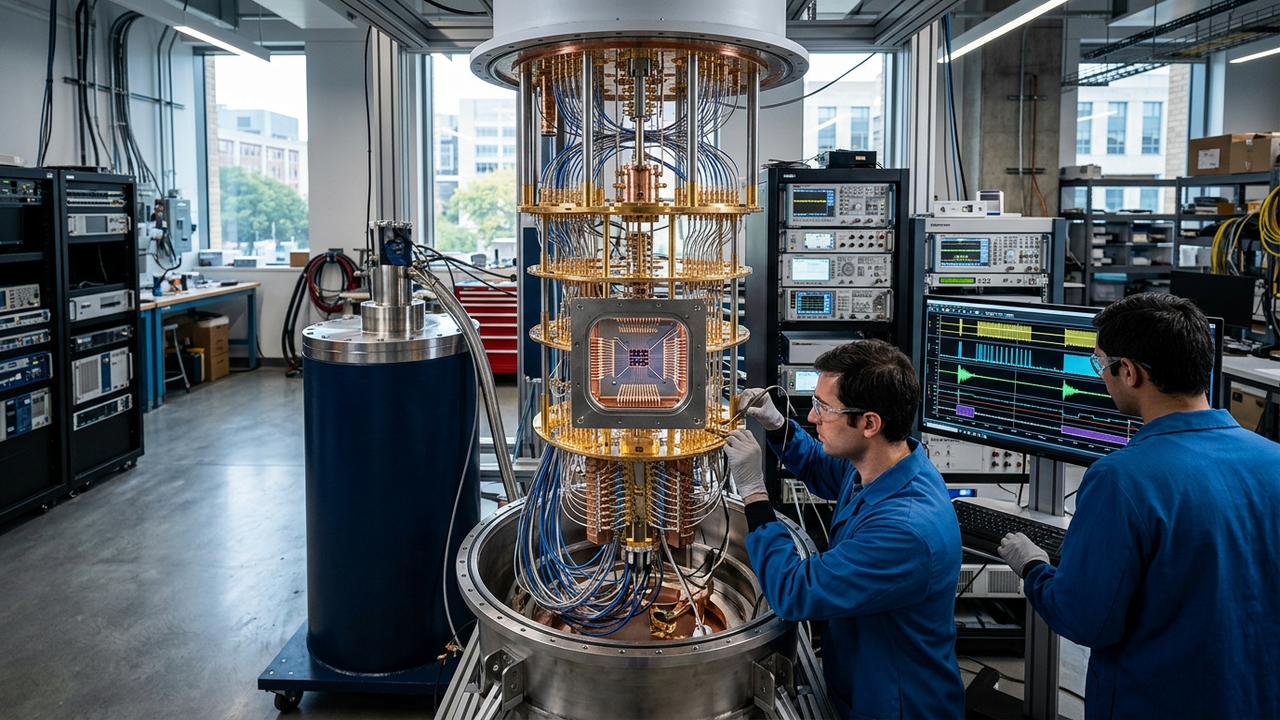
Key Findings
Researchers from MIT have engineered a novel superconducting qubit architecture, referred to as the ‘arm qubit,’ which simulations reveal enables qubits to interact with greater speed while maintaining extended periods of quantum stability. This innovative design surpasses existing architectures by achieving state-of-the-art coherence times, significantly faster operational speeds, and enhanced readout fidelity, representing a major step forward in quantum hardware performance.
Technical / Clinical Details
The ‘arm qubit’ architecture is meticulously designed to optimize the physical geometry and arrangement of superconducting circuits, thereby improving the efficiency of operations via microwave pulses. Simulation results indicate that this design not only achieves state-of-the-art coherence times compared to current superconducting qubits but also facilitates faster quantum gate operations and higher fidelity readout of quantum states. Specifically, the design fosters stronger coupling between qubits while minimizing susceptibility to external noise through a carefully engineered structure. This reduction in inter-qubit crosstalk and unwanted interference strengthens the foundational capabilities for executing complex quantum circuits with high fidelity, paving the way for more robust quantum computations.
Background & Context
Superconducting qubits are a leading platform in the pursuit of quantum computing, yet achieving scalability and fault tolerance critically depends on improving individual qubit coherence times, gate fidelity, and operational speeds. Existing architectures often face challenges in simultaneously optimizing these characteristics, which has historically presented a bottleneck in the construction of large-scale, fault-tolerant quantum computers. The ‘arm qubit’ from MIT offers a fresh approach to these challenges, potentially pushing the boundaries of quantum hardware performance beyond current limitations and addressing key obstacles to advanced quantum systems.
Strategic Significance & Outlook
This breakthrough in ‘arm qubit’ architecture is profoundly significant for accelerating the efficient implementation of quantum error correction technologies. Faster and more accurate qubit operations are fundamental to performing large-scale quantum computations with a higher degree of reliability and fewer errors, even with an increasing number of qubits. The research team’s next crucial step involves fabricating these novel arm qubits to empirically validate their simulated theoretical performance. Successful validation would mark a substantial advancement towards realizing large-scale, fault-tolerant quantum computers, which are anticipated to revolutionize diverse fields such as medicine, materials science, and artificial intelligence through their capacity to execute complex algorithms with unprecedented accuracy.
Source: https://news.mit.edu/2026/new-qubit-architecture-enables-faster-more-accurate-operations-0903
Get our weekly technology intelligence — free
Receive an infographic that lets you judge at a glance whether each field’s analysis report is worth reading.
Subscribe Free — Weekly Tech Intelligence
By subscribing, you’ll receive Troy-Technical’s weekly technology intelligence newsletter.
- Your email and selected fields are used only to deliver the newsletter.
- We never share your information with third parties.
- You can unsubscribe anytime via the link in each email.
See our Privacy Policy for details.
Takes about a minute · Unsubscribe anytime









Comments