Background: Challenges in Manufacturing High-Performance Polyimide Fibers
Polyimide (PI) is a high-performance polymer renowned for its excellent heat resistance, mechanical strength, and electrical insulation properties, finding use in advanced applications across aerospace, electronics, filtration, and medical fields. Processing PI into fine fiber membranes creates materials with high surface area, porosity, and lightweight characteristics. However, producing high-quality, bead-free (uniform, non-granular) polyimide fiber membranes traditionally required high-concentration polymer solutions for electrospinning, leading to processing limitations due to high viscosity and challenges with solvent recovery and disposal costs. While manufacturing from low-concentration solutions could improve processability and reduce costs, it often resulted in insufficient fiber formation and bead defects.
Key Findings: Nonsolvent-Assisted Electrospinning Strategy
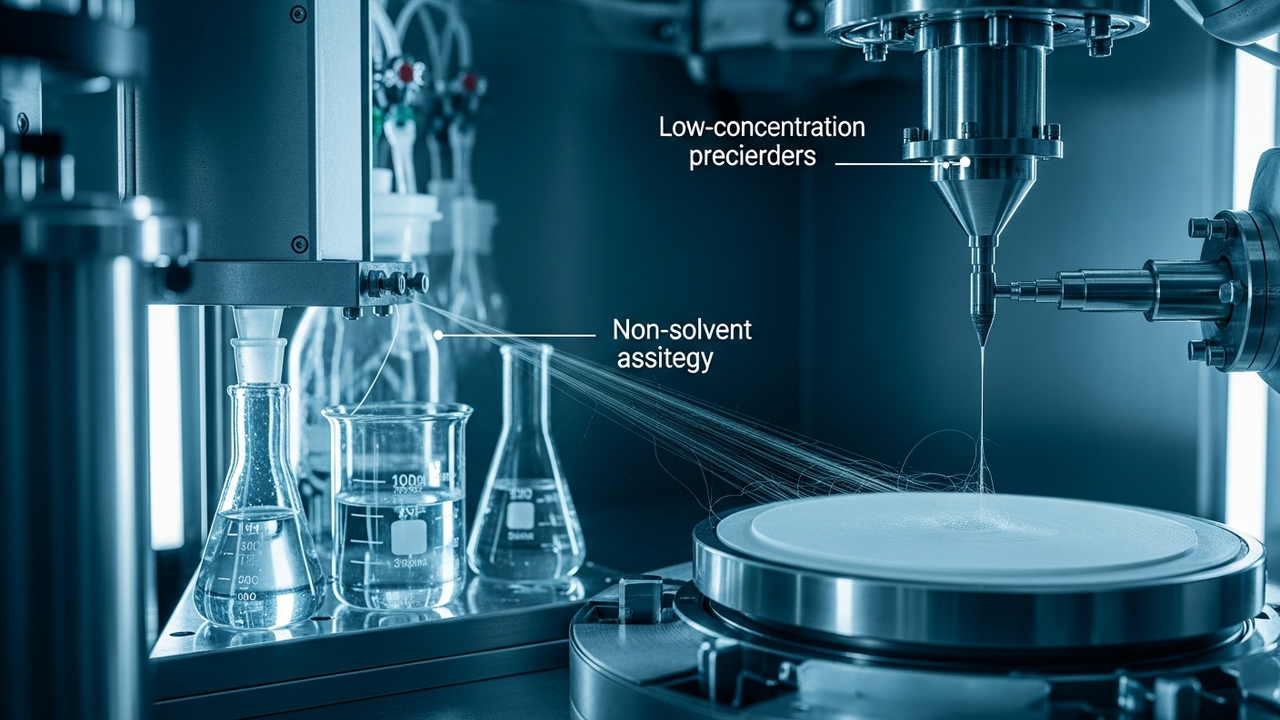
The “Nonsolvent-Assisted Electrospinning Strategy” developed in this research enables the efficient production of high-toughness, high-quality polyimide fiber membranes from low-concentration polyimide precursor solutions. The core innovation of this approach lies in introducing a “nonsolvent” during the electrospinning process:
- Effect of Nonsolvent Introduction: By introducing nonsolvent vapor into the ambient atmosphere during electrospinning jet extrusion, or adding a small amount to the spinning solution, phase separation of the polymer solution is induced. This promotes polymer chain entanglement, allowing the formation of a robust fiber network from low-concentration solutions, which typically only high-concentration solutions could achieve.
- Achieving Bead-Free Fiber Membranes: Adequate polymer chain entanglement is crucial for forming continuous, uniform, and bead-free fibers during electrospinning, preventing fiber breakage. This strategy significantly improves the morphological uniformity of the fiber membrane.
- Realizing High Toughness: The uniform fiber structure and densely entangled polymer chains impart excellent mechanical toughness to the final polyimide fiber membrane. This enhances performance in practical applications, such as durability for filters or flexibility for wearable sensors.
- Improved Processability and Cost Reduction: The ability to use low-concentration precursors reduces solution viscosity, improves electrospinning process stability, and increases productivity. It also contributes to manufacturing cost reduction by decreasing the usage of expensive solvents and easing the burden of solvent recovery.
This technology involves preparing polyimide precursors as a uniform polymer solution, electrostatically drawing it in the presence of a nonsolvent to form nano- to micro-scale highly oriented fibers. Subsequent thermal imidization then yields the final high-toughness polyimide fiber membrane.
Technical Significance & Outlook: Applications in Multifunctional High-Performance Materials
This nonsolvent-assisted electrospinning strategy is poised to revolutionize the manufacturing process of polyimide fiber membranes, significantly expanding their range of applications. Specific contributions are expected in fields such as:
- High-Performance Filters: Development of highly efficient filters capable of trapping extremely fine particles.
- Advanced Sensors: Substrates for lightweight, flexible wearable sensors and highly sensitive chemical sensors.
- Medical Devices: Biocompatible implant materials and drug delivery systems.
- Electronic Components: Flexible printed circuit boards and dielectric materials for high-temperature environments.
This technology is applicable not only to polyimide but also to other high-performance polymers for fiber membrane manufacturing, potentially establishing a new paradigm for electrospinning technology in materials science. Improved processability and cost reduction will accelerate the commercialization of these high-performance materials, driving technological innovation towards a sustainable society.






Comments