Key Findings
Researchers at Harvard University have demonstrated a groundbreaking method to extend the coherence time of diamond-based qubits by approximately threefold. This was achieved by continuously surrounding the qubits with nanoscale mechanical vibrations, essentially tiny sound waves or phonons. This advancement holds significant promise for dramatically improving the stability and reliability of quantum computers.
Technical / Clinical Details
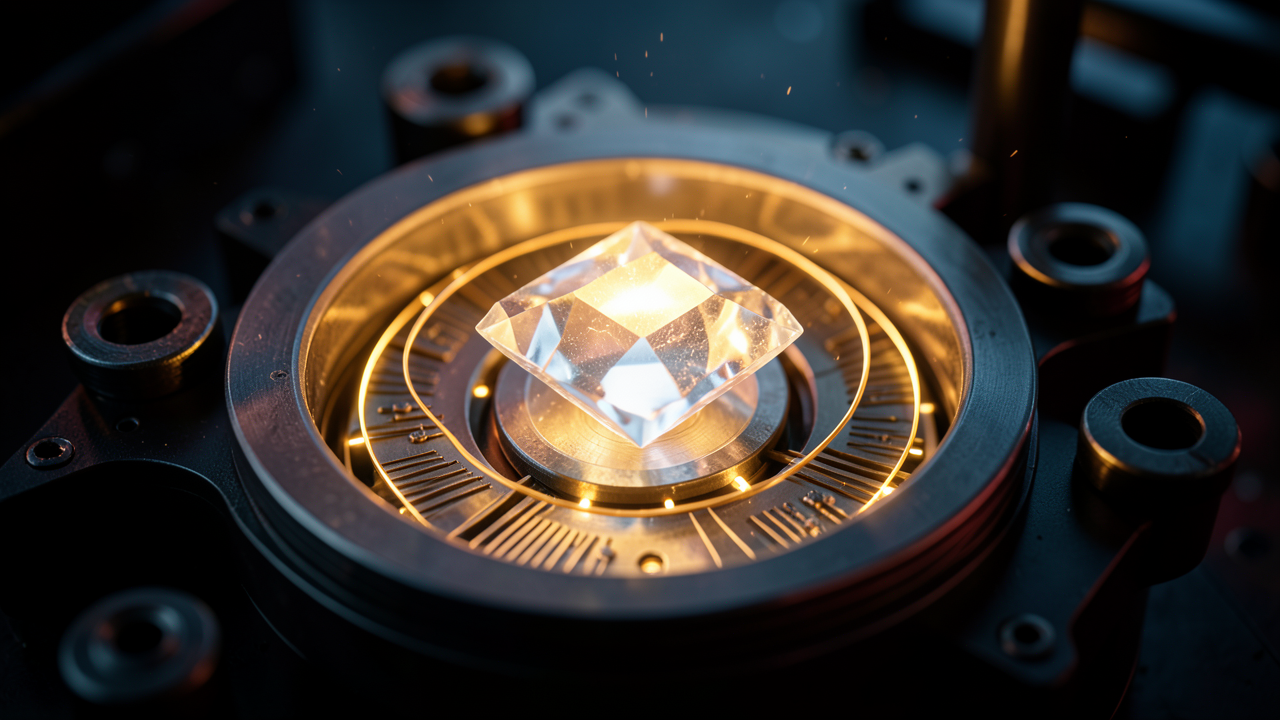
The research team utilized electron spins within diamond crystals containing nitrogen-vacancy (NV) centers as their qubits. NV centers are considered promising candidates for quantum sensing and computing due to their ability to maintain relatively stable quantum states even at room temperature.
Their novel approach is based on the following mechanism:
- Phonon ‘Dressing’ Effect: Qubits are continuously ‘dressed’ by sound waves (phonons) in the hundreds of GHz range. This continuous interaction effectively isolates the qubits from external noise, thereby suppressing decoherence—the collapse of fragile quantum states.
- Threefold Coherence Time Extension: This technique resulted in an approximate threefold extension of the qubit’s coherence time compared to when sound waves were not applied. This means the qubits can retain quantum information for much longer periods, enabling more complex quantum operations.
- Publication in Nature Physics: The findings were published in Nature Physics, a leading journal in the field, underscoring the scientific significance and impact of this work.
This discovery suggests the potential to utilize the same phonons for both transmitting and protecting quantum information, marking a crucial step towards realizing compact, on-chip acoustic quantum networks in the future.
Background & Context
One of the primary obstacles to the practical realization of quantum computers is qubit decoherence. Even slight disturbances from the external environment can cause these fragile quantum states to collapse, leading to computational errors. Extending coherence time is essential for executing a larger number of accurate quantum operations and is a vital research direction for achieving fault-tolerant quantum computers. While previous research has mainly focused on extending coherence times under stringent conditions such as cryogenic temperatures or vacuum environments, the use of sound waves presents a novel and promising avenue.
Strategic Significance & Outlook
This Harvard research significantly broadens the potential applications of acoustic technology in quantum computing. Acoustic-based quantum networks could offer more compact integration on chips compared to optical networks, contributing to the development of scalable quantum computers and quantum internet. The future integration of room-temperature operable qubits with sound-wave-based error control techniques has the potential to accelerate the realization of more practical quantum devices.
Source: https://www.sciencedaily.com/releases/2026/09/260911214245.htm
Get our weekly technology intelligence — free
Receive an infographic that lets you judge at a glance whether each field’s analysis report is worth reading.
Subscribe Free — Weekly Tech Intelligence
By subscribing, you’ll receive Troy-Technical’s weekly technology intelligence newsletter.
- Your email and selected fields are used only to deliver the newsletter.
- We never share your information with third parties.
- You can unsubscribe anytime via the link in each email.
See our Privacy Policy for details.
Takes about a minute · Unsubscribe anytime







Comments