Key Findings
Sekisui Chemical Co., Ltd. commenced the full-scale market introduction of ‘Solafil,’ Japan’s first film-type perovskite solar cell, in March 2026. This innovative solar cell, characterized by its flexibility, thinness, and lightweight nature, enables solar power generation in novel locations that were physically challenging for conventional heavy and rigid silicon solar cells. These include building facades, curved roofs, or structures with limited load-bearing capacity. Sekisui Chemical aims to establish an annual mass production line with a capacity of 100 megawatts (MW) by 2027, targeting a power conversion efficiency of 20% and a 20-year service life, expecting to bring significant transformation to Japan’s renewable energy market.
Technical Details
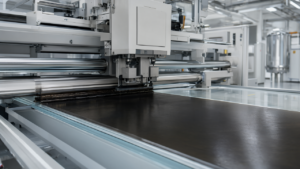
‘Solafil’ integrates proprietary high-performance perovskite materials with Sekisui Chemical’s extensive expertise in polymer film technology. This film-type solar cell is extremely lightweight, approximately 0.1mm thick and weighing about 1kg/m², minimizing additional load on existing structures. The manufacturing process adopts a roll-to-roll method, enabling cost-efficient mass production. A 20% power conversion efficiency is a high standard for single-junction perovskite solar cells, comparable to conventional silicon solar cells. Crucially, the target of a 20-year long-term service life addresses a major stability challenge for perovskite solar cells, suggesting significant advancements in encapsulation and material degradation suppression technologies. This not only increases installation flexibility but also contributes to long-term operational cost reductions.
Background & Context
Japan faces unique challenges in expanding solar power adoption due to its limited land area and constraints from existing buildings. Sekisui Chemical’s ‘Solafil’ is anticipated as a solution to these challenges, significantly broadening the possible installation sites for solar power. This aligns with government support, such as the Green Innovation Fund program led by the Ministry of Economy, Trade and Industry, and regulatory reforms aimed at promoting perovskite solar cells. Specifically, government initiatives like the review of area calculation standards for photovoltaic equipment under the Factory Location Act and clarification of building code/electricity business act rules for BIPV (Building-Integrated Photovoltaics) will strongly support the market expansion of products like Solafil. Sekisui Chemical’s venture is seen as playing an indispensable role in achieving Japan’s decarbonization goals and strengthening its energy security.
Strategic Significance & Outlook
Through the full-scale sales of ‘Solafil,’ Sekisui Chemical plans to initially focus on installations on roofs and facades of commercial facilities, factories, and public buildings within Japan. In the future, the company envisions broader applications in the residential market, as well as in areas like automobiles and IoT devices. The operation of the 100MW mass production line by 2027 will ensure stable supply to the market and further drive down costs. Widespread adoption of this film-type perovskite solar cell could dramatically increase renewable energy generation in urban areas while harmonizing with urban landscapes. Sekisui Chemical aims to expand this technology into global markets, contributing to the world’s energy transition.
Source: #