Background
Perovskite solar cells are celebrated for their remarkable power conversion efficiencies, yet the prevalence of lead in the most high-performing formulations presents significant environmental and health concerns, impeding their broad commercialization. Lead-free tin-perovskite variants offer a promising non-toxic alternative, but their inherent environmental instability—particularly tin’s susceptibility to oxidation by oxygen and hydrolysis by water—has historically hindered practical applications. Addressing this fundamental vulnerability is crucial for the widespread adoption of next-generation solar technologies.
Key Findings
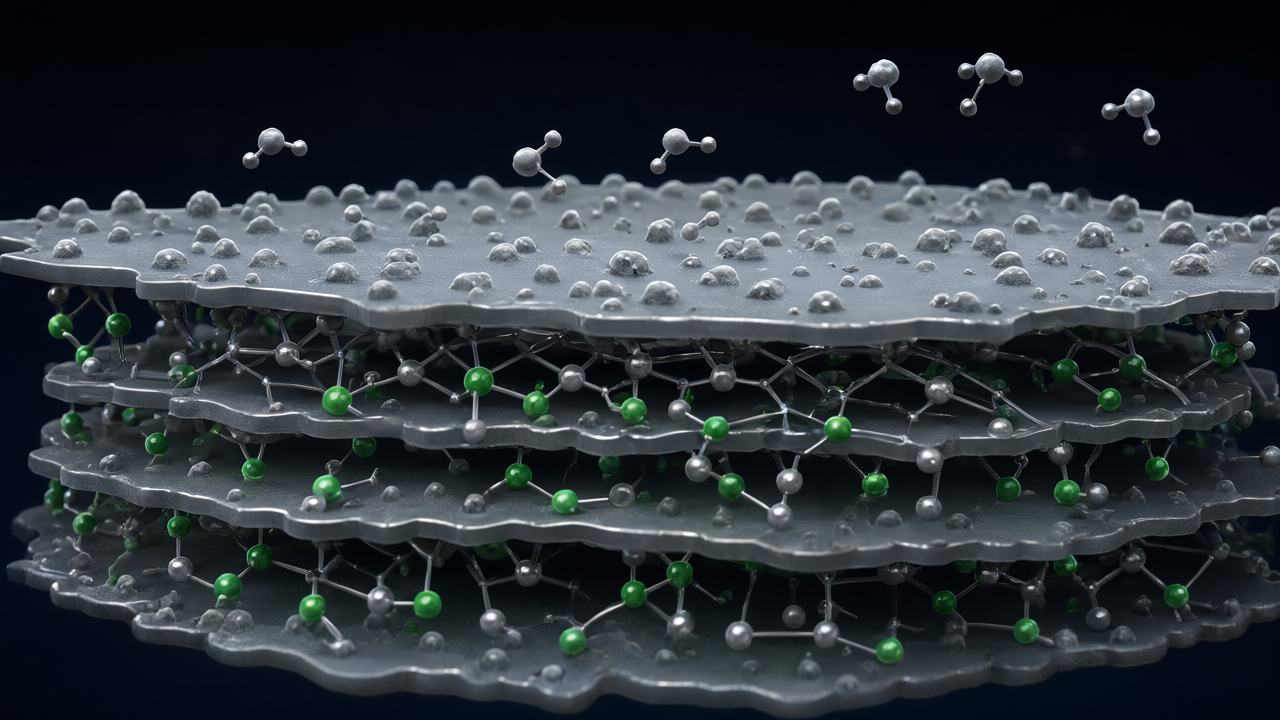
In a significant advance published in Nature Materials, researchers at the University of Toledo have demonstrated a crucial breakthrough in enhancing the stability of lead-free tin-perovskite solar cells. Their innovative approach involves incorporating specific chlorinated ‘spacer’ molecules directly into the layered tin-iodide frameworks. This molecular engineering strategy successfully and substantially slows the ingress of ambient oxygen and water, directly mitigating the primary degradation pathways that have plagued these environmentally benign perovskites.
Engineering Details
The core of this research centers on enhancing the intrinsic stability of tin-based perovskite solar cells. The team precisely engineered the introduction of specific chlorinated organic molecules, acting as ‘spacers,’ directly into the layered tin-iodide perovskite framework. Functioning as molecular barriers, these spacers effectively separate the perovskite layers, drastically impeding the diffusion pathways for detrimental oxygen and water molecules from the external environment. This elegant structural modification rigorously suppresses the oxidation and decomposition processes of the tin perovskite, yielding a dramatic improvement in long-term device stability. Crucially, this enhanced robustness is achieved without compromising the material’s essential optoelectronic properties, underscoring the sophistication of this molecular engineering approach to environmental robustness.
Implications and Outlook
This research marks a pivotal stride toward the widespread commercialization of lead-free tin-perovskite solar cells. By dramatically bolstering their resistance to oxygen and water, these devices can sustain high performance even under challenging outdoor conditions, opening avenues for long-term deployment in various environments. The strategic focus moving forward will involve further optimizing this innovative spacer molecule incorporation technique and scaling its integration into manufacturing processes. Such advancements will accelerate the development and market entry of high-performance, environmentally responsible solar cells, transforming the prospect of sustainable and safe perovskite solar energy into a more tangible reality.
Get our weekly technology intelligence — free
Receive an infographic that lets you judge at a glance whether each field’s analysis report is worth reading.
Subscribe Free — Weekly Tech Intelligence
By subscribing, you’ll receive Troy-Technical’s weekly technology intelligence newsletter.
- Your email and selected fields are used only to deliver the newsletter.
- We never share your information with third parties.
- You can unsubscribe anytime via the link in each email.
See our Privacy Policy for details.
Takes about a minute · Unsubscribe anytime





Comments