Key Findings
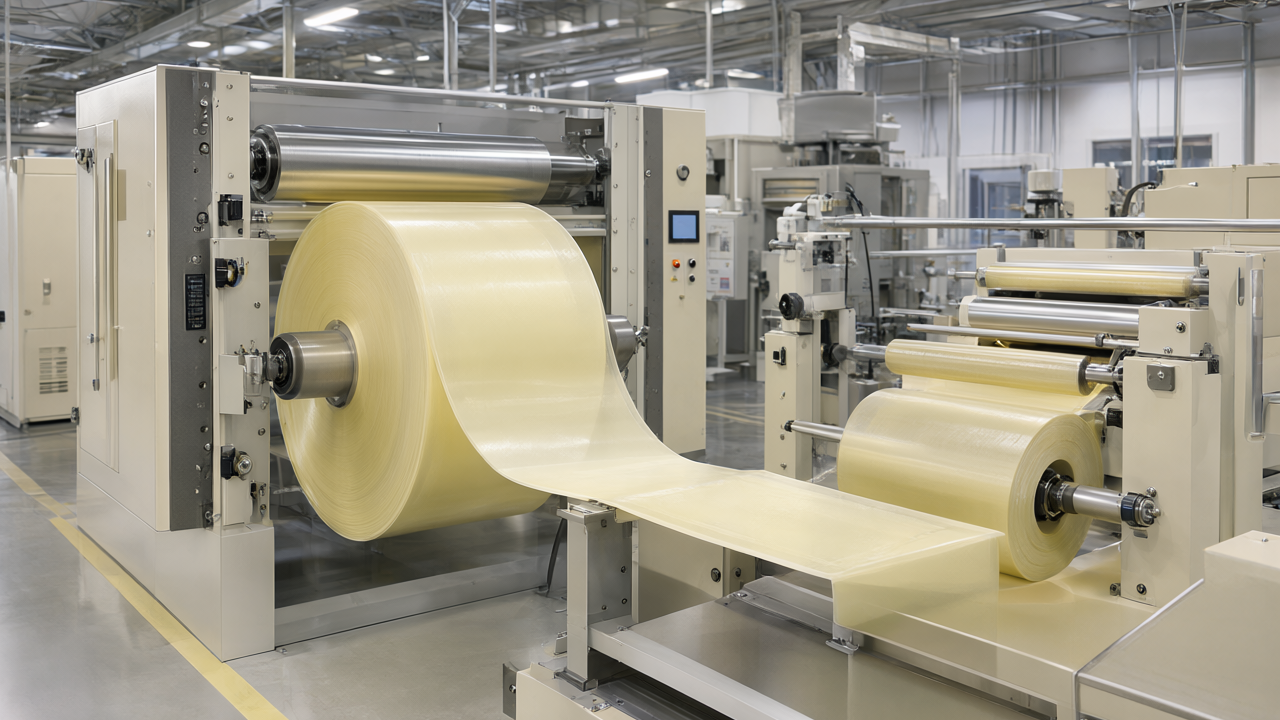
Schumpeter reports a groundbreaking advancement in all-solid-state battery manufacturing: the ‘quasi-dry sulfide film’ technology now enables the application of roll-to-roll manufacturing processes. This novel technique allows for the production of freestanding electrolyte films that are 28 micrometers (μm) thin, possess high ionic conductivity, and span decimeter-scale areas, while also achieving excellent pouch cell performance for over a thousand cycles. This represents a significant step towards overcoming a major challenge in the mass production of all-solid-state batteries.
Technical Details
Traditional solid electrolyte manufacturing processes, particularly for sulfide-based electrolytes, often require complex wet processes or high-temperature sintering, which have been bottlenecks for manufacturing costs and scalability. However, the newly developed quasi-dry sulfide film technology employs a process that minimizes solvent usage while directly forming thin films of sulfide solid electrolytes. This significantly simplifies the manufacturing process, reduces costs, and enhances the uniformity and quality of the electrolyte films.
- Film Thickness and Conductivity: The developed electrolyte film is exceptionally thin at 28μm, contributing to increased battery energy density. Simultaneously, it maintains high ionic conductivity, indicating efficient lithium-ion transport.
- Scale and Morphology: The ability to manufacture at a decimeter scale (tens of centimeters) suggests potential applicability to relatively large battery cells. Being a freestanding film, it also offers versatility for flexible designs.
- Cycle Performance: Prototype pouch cells demonstrated high capacity retention over more than a thousand charge-discharge cycles, indicating long-term durability. This is a crucial reliability metric for practical application.
Background & Context
All-solid-state batteries are considered essential next-generation technology for extending the range of electric vehicles (EVs), shortening charging times, and enhancing safety. However, their high cost and complex manufacturing processes have been long-standing challenges. Specifically, the formation of the solid electrolyte layer has presented a significant barrier in terms of throughput and cost, necessitating the establishment of continuous production technologies like roll-to-roll. This quasi-dry sulfide film technology provides a direct solution to precisely this manufacturing challenge.
Strategic Significance & Outlook
This technology is expected to significantly reduce the manufacturing cost of all-solid-state batteries and pave the way for large-scale production, thereby accelerating the adoption of all-solid-state batteries in the electric vehicle market. Furthermore, the thin film structure and high cycle performance also enable applications in more compact and higher-performance portable devices. Future efforts are anticipated to focus on further optimization of this technology and its integration into existing battery manufacturing lines. This breakthrough marks a critical milestone towards the commercialization of next-generation battery technology.
Source: https://schumpeter.substack.com/p/quasi-dry-sulfide-films-turn-solid
Get our weekly technology intelligence — free
Receive an infographic that lets you judge at a glance whether each field’s analysis report is worth reading.
Subscribe Free — Weekly Tech Intelligence
By subscribing, you’ll receive Troy-Technical’s weekly technology intelligence newsletter.
- Your email and selected fields are used only to deliver the newsletter.
- We never share your information with third parties.
- You can unsubscribe anytime via the link in each email.
See our Privacy Policy for details.
Takes about a minute · Unsubscribe anytime








Comments