Key Findings
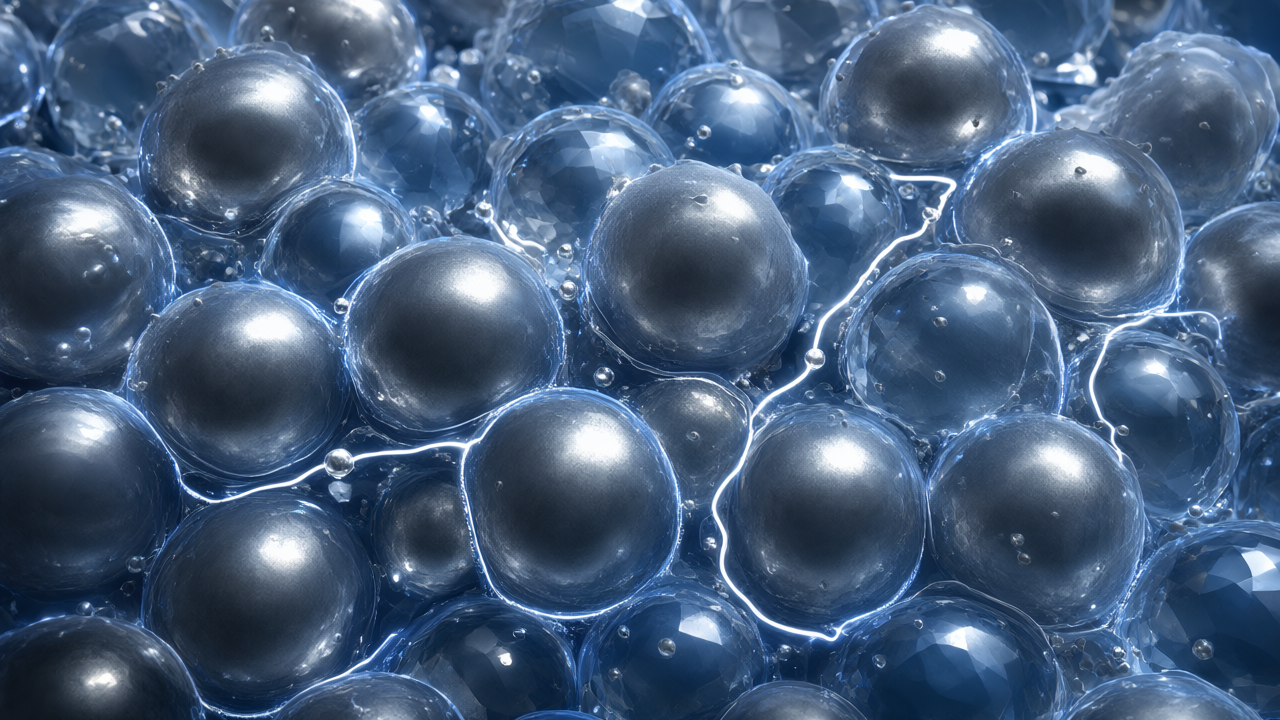
A recent review comprehensively details the challenges and advancements in hybrid cathodes for sulfide-based all-solid-state lithium-ion batteries (ASSBs). The study highlights that composite cathodes, comprising active materials like NCM, sulfide solid electrolytes, and conductive carbon, suffer from severe issues such as interfacial side reactions, high interfacial resistance, and insufficient Li⁺ diffusion pathways. A significant breakthrough involves in-situ or gradient coating techniques, demonstrating that converting residual lithium compounds on NCM811 surfaces into functional Li-Ta-O-F electrolyte layers or Li₃VO₄ (LVO) coatings effectively passivates the interface and suppresses solid electrolyte degradation.
Technical Details
The primary hurdle for high-performance ASSBs lies in stabilizing the cathode-electrolyte interface. Nickel-rich active materials like NCM811, in particular, exacerbate this issue due to residual lithium compounds on their surface, which react detrimentally with sulfide solid electrolytes. The proposed solutions involve precise surface engineering, where these reactive compounds are transformed into stable, ionically conductive layers. These engineered interfaces act as protective barriers, mitigating parasitic reactions while maintaining efficient Li-ion transport. Sulfide-based solid electrolytes are particularly promising owing to their high room-temperature ionic conductivity, exceeding 10⁻³ S cm⁻¹, and superior mechanical properties, which are crucial for durable and high-performing solid-state cells.
Background & Context
All-solid-state batteries are poised to revolutionize the electric vehicle (EV) and grid-scale energy storage sectors by offering enhanced energy density, improved safety, and extended cycle life over conventional lithium-ion batteries. Sulfide-based ASSBs are especially attractive for their high ionic conductivity, which promises rapid charging capabilities. Addressing the long-standing interfacial stability issues in composite cathodes is paramount for their commercial viability. The advancements in interface coating technologies represent a critical step towards realizing high-performance, mass-producible ASSBs.
Strategic Significance & Outlook
The continued optimization of interfacial stabilization techniques and the development of cost-effective, scalable manufacturing processes are crucial for future ASSB deployment. Further research is expected to focus on enhancing the uniformity of functional coating layers and exploring novel coating materials with even higher ionic conductivity. These technological advancements will enable sulfide-based all-solid-state batteries to significantly extend EV range, reduce charging times, and potentially establish a new benchmark for energy storage solutions globally.
Get our weekly technology intelligence — free
Receive an infographic that lets you judge at a glance whether each field’s analysis report is worth reading.
Subscribe Free — Weekly Tech Intelligence
By subscribing, you’ll receive Troy-Technical’s weekly technology intelligence newsletter.
- Your email and selected fields are used only to deliver the newsletter.
- We never share your information with third parties.
- You can unsubscribe anytime via the link in each email.
See our Privacy Policy for details.
Takes about a minute · Unsubscribe anytime




Comments