Key Findings
Intel and IBM are reportedly intensifying efforts to accelerate the commercialization timeline for quantum computing, aiming for widespread deployment within three years. Their focus is on addressing critical bottlenecks in quantum error correction and developing scalable cryogenic infrastructure. IBM has notably validated an error detection and mitigation technique on its quantum processors, demonstrating the ability to filter out up to 65% of errors, a significant step towards practical fault tolerance.
Technical / Clinical Details
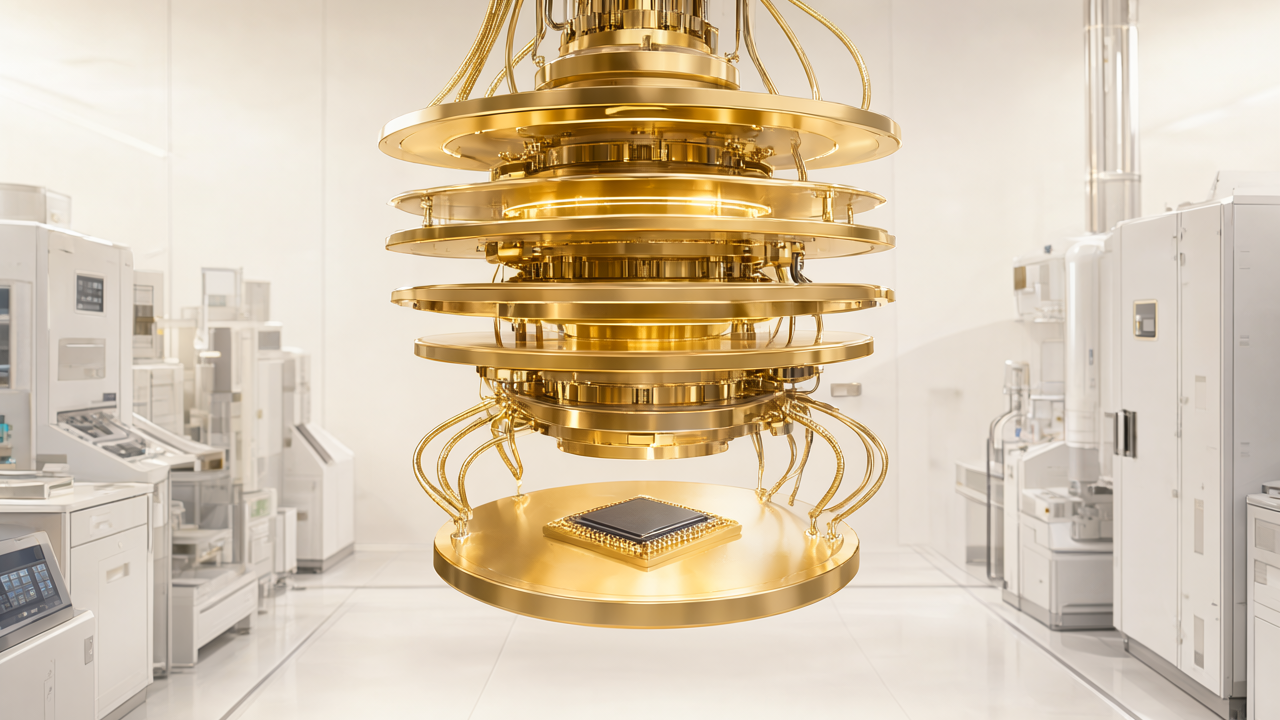
IBM’s breakthrough in error mitigation represents a crucial advancement in quantum fidelity, significantly reducing the impact of environmental noise and decoherence on quantum bits. This improvement is vital for enabling the execution of larger and more complex quantum algorithms with higher reliability. Concurrently, IBM has introduced a modular cryogenic architecture designed to provide a more efficient and scalable cooling solution for quantum processors. This modularity is a departure from current custom-built cryogenic systems, offering a more adaptable and cost-effective path to scaling quantum hardware. Leveraging these technological advancements, IBM has set an ambitious target to deliver large-scale fault-tolerant quantum computers to commercial clients by 2029. This initiative is substantially supported by a $1 billion award under the U.S. CHIPS Act and additional investment from IBM, directed towards establishing a state-of-the-art 300mm quantum wafer production line in Albany, New York.
Background & Context
The journey toward practical quantum computing has been hampered by fundamental technical challenges, including the inherent fragility of qubits, the complexity of error correction, and the demanding requirements for cryogenic operating environments. The concentrated efforts by technology giants like Intel and IBM to overcome these hurdles are indispensable for the quantum field’s maturation. The significant government funding via the CHIPS Act underscores a national strategic imperative for the U.S. to secure leadership in quantum technology development and manufacturing.
Strategic Significance & Outlook
IBM’s aggressive target of delivering fault-tolerant quantum computers to commercial customers by 2029 signals a potential inflection point where quantum technology transitions from research to industrial application within a few years. Progress in error correction and scalable cryogenic infrastructure will unlock quantum computing’s potential in diverse sectors such as drug discovery, materials science, financial modeling, and artificial intelligence. The establishment of a 300mm quantum wafer production line is particularly significant, as it signifies a move towards industrial-scale manufacturing of quantum chips, which is a fundamental requirement for widespread commercialization and deployment.
Source: https://finance.biggo.com/news/e571eb59-942c-4a5b-9294-ddcb4d5f1451
Get our weekly technology intelligence — free
Receive an infographic that lets you judge at a glance whether each field’s analysis report is worth reading.
Subscribe Free — Weekly Tech Intelligence
By subscribing, you’ll receive Troy-Technical’s weekly technology intelligence newsletter.
- Your email and selected fields are used only to deliver the newsletter.
- We never share your information with third parties.
- You can unsubscribe anytime via the link in each email.
See our Privacy Policy for details.
Takes about a minute · Unsubscribe anytime









Comments