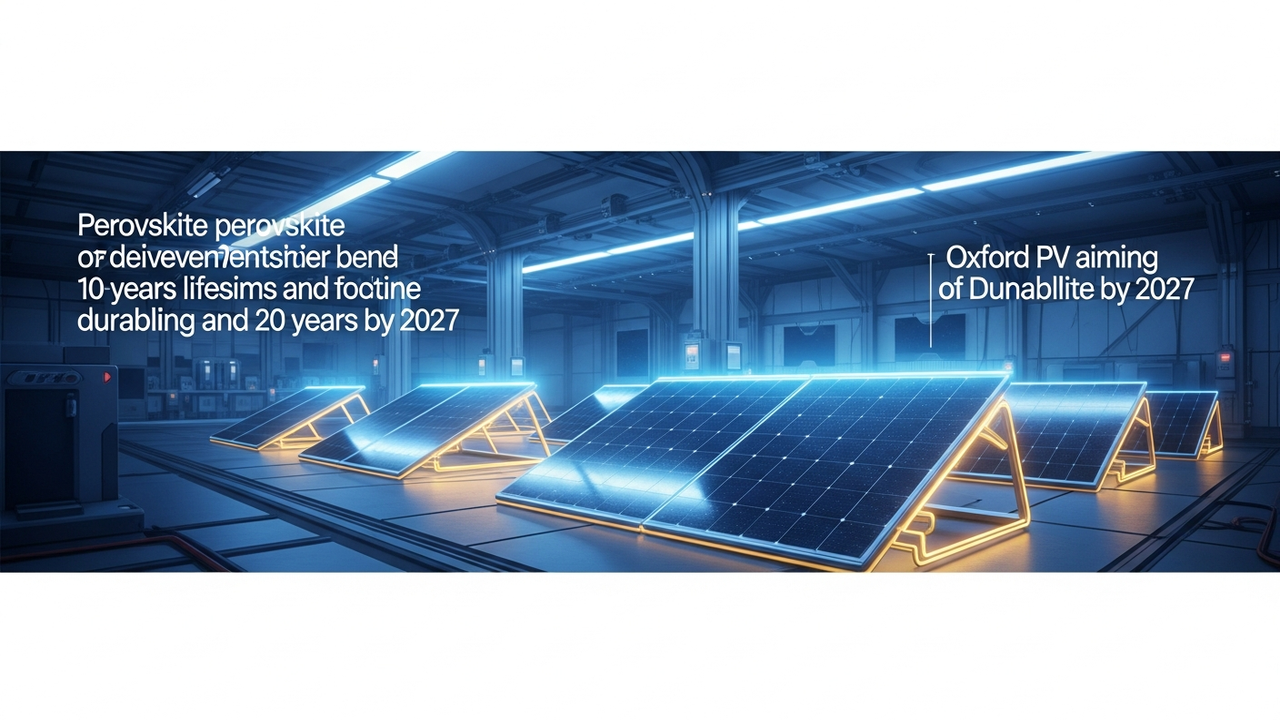
Perovskite Solar Cells: Achieving 30.6% Efficiency While Facing the 10-Year Durability Challenge, with Oxford PV Targeting 20 Years by 2027
Sunsave has published an article providing a detailed analysis of the current status and commercialization prospects of perovskite solar cells, a technology garnering significant attention as a next-generation photovoltaic solution. The article highlights the remarkable efficiency records achieved by perovskite technology while simultaneously focusing on the critical challenge of long-term durability that still needs to be overcome.
Key Achievements and Technical Challenges
- Record-Breaking Efficiency:
- Trina Solar has achieved a record power conversion efficiency of 30.6% for perovskite solar cells as of June 2025.
- Oxford PV’s residential perovskite-on-silicon tandem panels recorded an efficiency of 26.9% in 2024, demonstrating tangible progress towards practical application.
- Superiority of Tandem Cells: Tandem solar cells, which combine perovskites with silicon, possess the potential to achieve efficiencies beyond the Shockley-Queisser limit (approximately 29%)—the theoretical maximum for single-junction silicon solar cells. This capability is considered one of the most compelling advantages of perovskite technology.
- Durability Concerns: The most significant challenge lies in the lifespan and stability of the panels. The expected lifespan of current commercial perovskite-silicon tandem panels from Oxford PV is only 10 years, starkly contrasting with the 25–40 year warranties offered by conventional silicon panels. While Oxford PV aims to extend this lifespan to 20 years by 2027, further improvements are essential to establish market trust and widespread adoption.
Background and Industry Context
The solar energy market is central to the global transition to sustainable energy, but with the maturation of silicon technology, there is a growing demand for more efficient and cost-effective alternatives. Perovskite solar cells have emerged as a promising candidate to meet this need due, to their excellent light absorption properties, ease of manufacturing via solution processes, and potential for low cost. However, stability issues, particularly their vulnerability to moisture, heat, and UV light, have been obstacles to large-scale commercial deployment. While recent advances in materials science and device architecture have led to significant efficiency gains, extending lifespan remains the paramount challenge.
Future Outlook
The commercial success of perovskite solar cells depends heavily not only on their efficiency but also on their long-term reliability and durability. The proactive efforts by leading companies like Oxford PV to extend product lifespan are positive indicators for the entire industry. Over the coming years, advancements in material stability, evolution of encapsulation technologies, and optimization of manufacturing processes are expected to enable perovskite solar cells to achieve a lifespan and cost-performance comparable to, or even surpassing, conventional silicon panels, thereby revolutionizing the energy market.
Source: https://www.sunsave.energy/solar-panels-advice/solar-technology/perovskite