Key Findings
Self-healing concrete technologies are rapidly moving from academic research laboratories to practical commercial and infrastructure deployment. This innovative material promises to significantly mitigate the billions of dollars annually spent on the maintenance and repair of concrete infrastructure worldwide.
Technical / Clinical Details
The article outlines three primary approaches to developing self-healing concrete:
- Bacteria-based Systems: These systems integrate dormant bacteria and a nutrient source within the concrete matrix. Upon crack formation and water ingress, the bacteria activate, producing calcium carbonate which precipitates to seal the cracks. Basilisk technology, a prominent example, has demonstrated impressive effectiveness, achieving 90-95% crack closure for cracks up to 0.03 inches (approximately 0.76 mm).
- Microcapsule and Polymer Systems: This method involves embedding microcapsules containing healing agents (e.g., polymers or epoxy resins) within the concrete. When a crack propagates through a microcapsule, it ruptures, releasing the healing agent into the crack to effect repair.
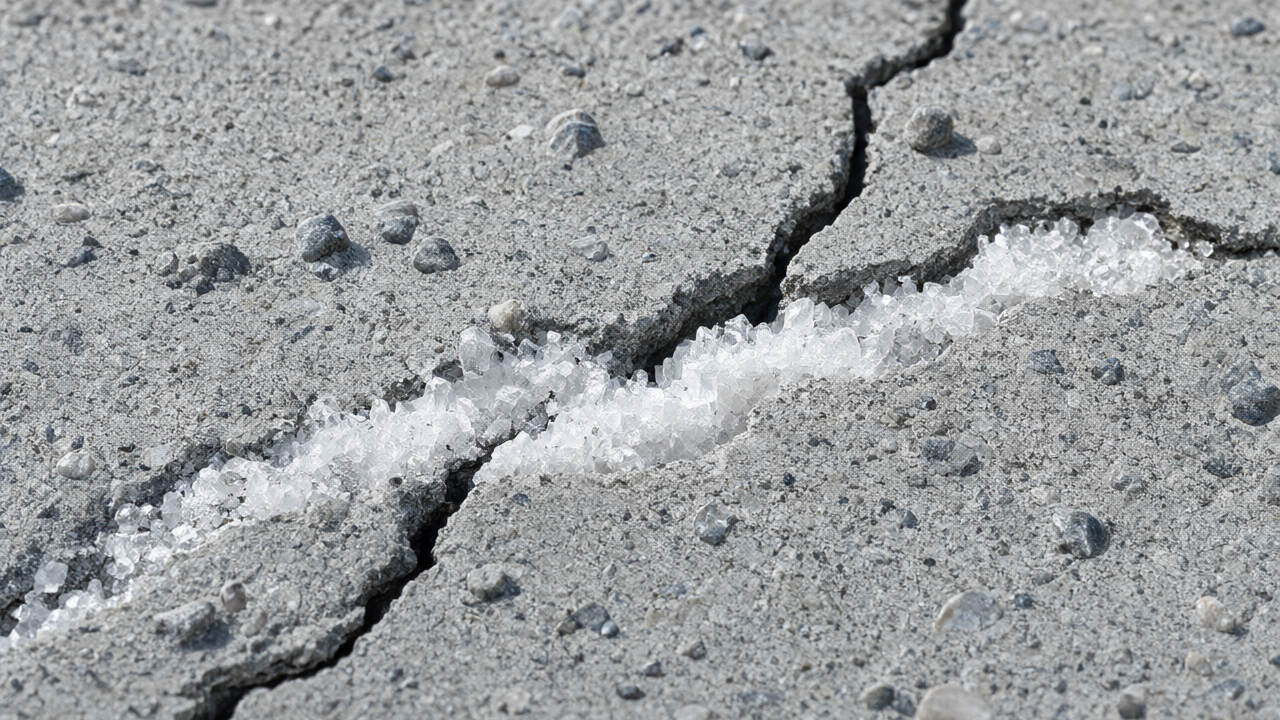
- Crystalline and Mineral Admixture Systems: These are considered the most commercially mature and readily integrable solutions. Special crystalline additives or mineral admixtures are blended into the concrete mix. When these come into contact with water due to cracking, they react to form insoluble crystals that fill and seal the cracks and pores, preventing further deterioration.
While self-healing concrete systems often entail a higher initial material cost compared to conventional concrete, their ability to self-repair fine to moderate cracks leads to substantial reductions in long-term lifecycle costs, including inspection, repair, and replacement expenses. European countries, in particular, have a longer history and greater adoption of these technologies.
Background & Context
Concrete is the most widely used construction material globally, yet its inherent susceptibility to cracking remains a significant challenge. Cracks facilitate the ingress of water and aggressive substances, leading to rebar corrosion, structural degradation, and necessitating costly repairs or premature replacement. This degradation results in billions of dollars in economic losses and considerable resource consumption each year. Research into self-healing concrete has actively sought to address these issues for decades, aiming to create more sustainable and resilient infrastructure that can autonomously mitigate damage.
Strategic Significance & Outlook
The commercial adoption of self-healing concrete is poised to revolutionize the construction industry. Its contributions to extending the service life and reducing maintenance costs are particularly critical for essential infrastructure such as bridges, roads, tunnels, underground structures, and nuclear power plants. By enabling early and automatic crack repair, these materials prevent minor damage from escalating into major structural failures, thereby enhancing the safety and reliability of infrastructure assets. This advancement transcends the limitations of traditional concrete, paving the way for more sustainable and durable construction solutions for the future. The ability to automatically respond to damage reduces human intervention and operational expenditures, making infrastructure more resilient against environmental stressors and long-term wear.
Source: https://mcsmag.com/the-facts-about-self-healing-concrete/
Get our weekly technology intelligence — free
Receive an infographic that lets you judge at a glance whether each field’s analysis report is worth reading.
Subscribe Free — Weekly Tech Intelligence
By subscribing, you’ll receive Troy-Technical’s weekly technology intelligence newsletter.
- Your email and selected fields are used only to deliver the newsletter.
- We never share your information with third parties.
- You can unsubscribe anytime via the link in each email.
See our Privacy Policy for details.
Takes about a minute · Unsubscribe anytime