
Key Findings
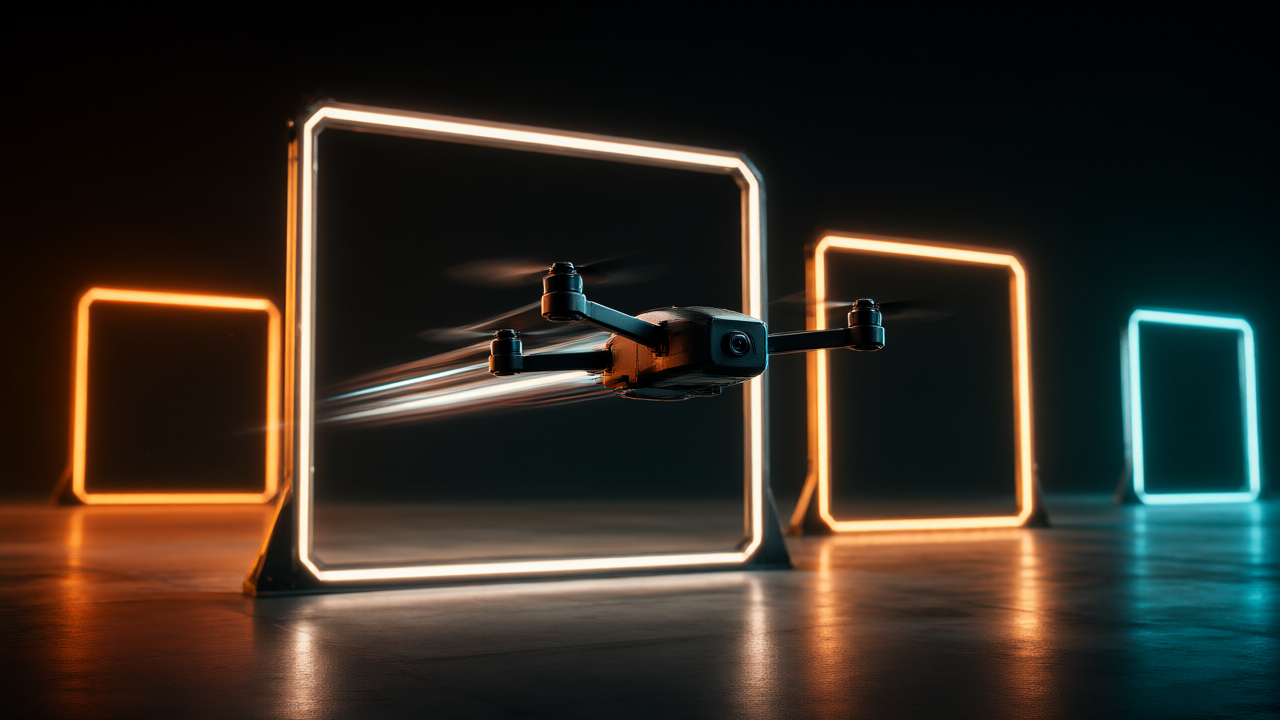
The MonoRace autonomous flight system has achieved a maximum flight speed of 100 km/h. During the 2025 Abu Dhabi Autonomous Drone Racing competition, the system successfully defeated all other autonomous racing teams and three human pilots who had previously won world championships. The system demonstrated its ability to adapt to unfamiliar hardware and environments provided by the event organizers.
Technical Details
MonoRace addresses the challenges of high-speed flight—such as reduced reaction time and image blurring—through a streamlined control architecture. Unlike previous systems, MonoRace does not rely on GPS or external motion tracking. Instead, it utilizes the following components:
- Sensing: A single forward-facing camera for track gate recognition, combined with an inertial measurement unit (IMU) and a drone model to estimate position and motion.
- Control: A small neural network that bypasses traditional multi-stage planning to generate motor commands directly.
- Hardware: A micro-onboard computing chip known as a “flight controller” that executes the neural network, issuing 500 control commands per second.
- Training: The network was developed using reinforcement learning to optimize maneuvers while respecting the physical performance limits of the drone.
Background and Context
High-speed autonomous flight is technically demanding because the window for identifying tracks and adjusting direction narrows as velocity increases. Any latency in control instructions can lead to missed gates or collisions with obstacles. MonoRace was designed to overcome these constraints using limited sensor and computing resources.
Significance and Outlook
The research demonstrates that high-performance autonomous control can be achieved without heavy computational overhead. The developers suggest that this lightweight AI approach could be extended to other autonomous systems to optimize efficiency and safety. Potential applications include smoother and more energy-efficient operation for robotic vacuum cleaners and the control of large ship-to-shore cranes.
Source: https://www.stdaily.com/web/gdxw/2026-10/15/content_596259.html
Get our weekly technology intelligence — free
Receive an infographic that lets you judge at a glance whether each field’s analysis report is worth reading.
Subscribe Free — Weekly Tech Intelligence
By subscribing, you’ll receive Troy-Technical’s weekly technology intelligence newsletter.
- Your email and selected fields are used only to deliver the newsletter.
- We never share your information with third parties.
- You can unsubscribe anytime via the link in each email.
See our Privacy Policy for details.
Takes about a minute · Unsubscribe anytime