


Key Findings
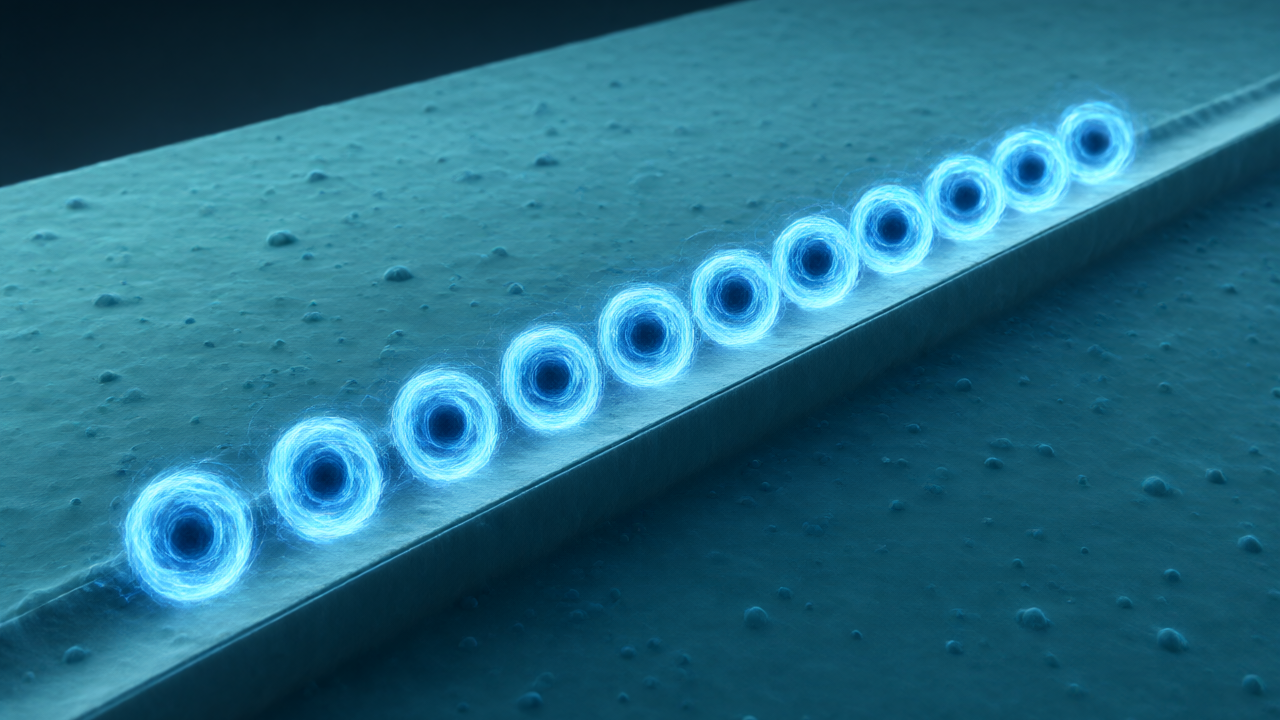
Researchers at the Research Center for Materials Nanoarchitectonics (MANA), part of the National Institute for Materials Science (NIMS), have demonstrated that atomic-scale steps can act as microscopic rails to guide the movement of quantum vortices in ultrathin superconductors. Using four-terminal resistance measurements, the team found that vortices moved more than 1,000 times more easily along these steps than across them when exposed to intermediate magnetic fields.
Technical Details
The study, led by Takashi Uchihashi, utilized scanning tunneling microscopy to image surfaces at the atomic level, confirming that the atomic steps ran parallel to one another and that vortices were positioned along them. The researchers identified several distinct behaviors based on environmental conditions:
- Tuning: The guiding effect can be adjusted by changing the temperature or the magnetic field.
- Pinning-Free Flow: In magnetic fields ranging from approximately 0.10 to 0.20 T, vortices exhibited one-dimensional pinning-free vortex flow, moving freely along the steps without being trapped by material imperfections.
- Quantum Tunneling: At the lowest temperatures, vortex motion was governed by quantum tunneling, allowing objects to pass through energy barriers that would typically block movement under classical physics.
Background & Context
Superconductors carry electricity without resistance below a critical temperature, but they are susceptible to the formation of vortices—small regions of circulating electrical currents created where magnetic fields penetrate the material. The movement of these vortices can generate electrical resistance, which degrades the performance of the superconductor. Controlling this movement has been particularly challenging in two-dimensional, ultrathin superconductors.
Significance & Outlook
The ability to use surface features only one atom high to precisely control vortex motion provides a new method for managing quantum behavior. While practical applications require further development, this approach could allow engineers to manage both heat flow and vortex movement, potentially enabling superconducting devices that process information more efficiently while consuming less power.
Source: https://www.sciencedaily.com/releases/2026/10/261014072018.htm
Get our weekly technology intelligence — free
Receive an infographic that lets you judge at a glance whether each field’s analysis report is worth reading.
Subscribe Free — Weekly Tech Intelligence
By subscribing, you’ll receive Troy-Technical’s weekly technology intelligence newsletter.
- Your email and selected fields are used only to deliver the newsletter.
- We never share your information with third parties.
- You can unsubscribe anytime via the link in each email.
See our Privacy Policy for details.
Takes about a minute · Unsubscribe anytime