

Key Findings
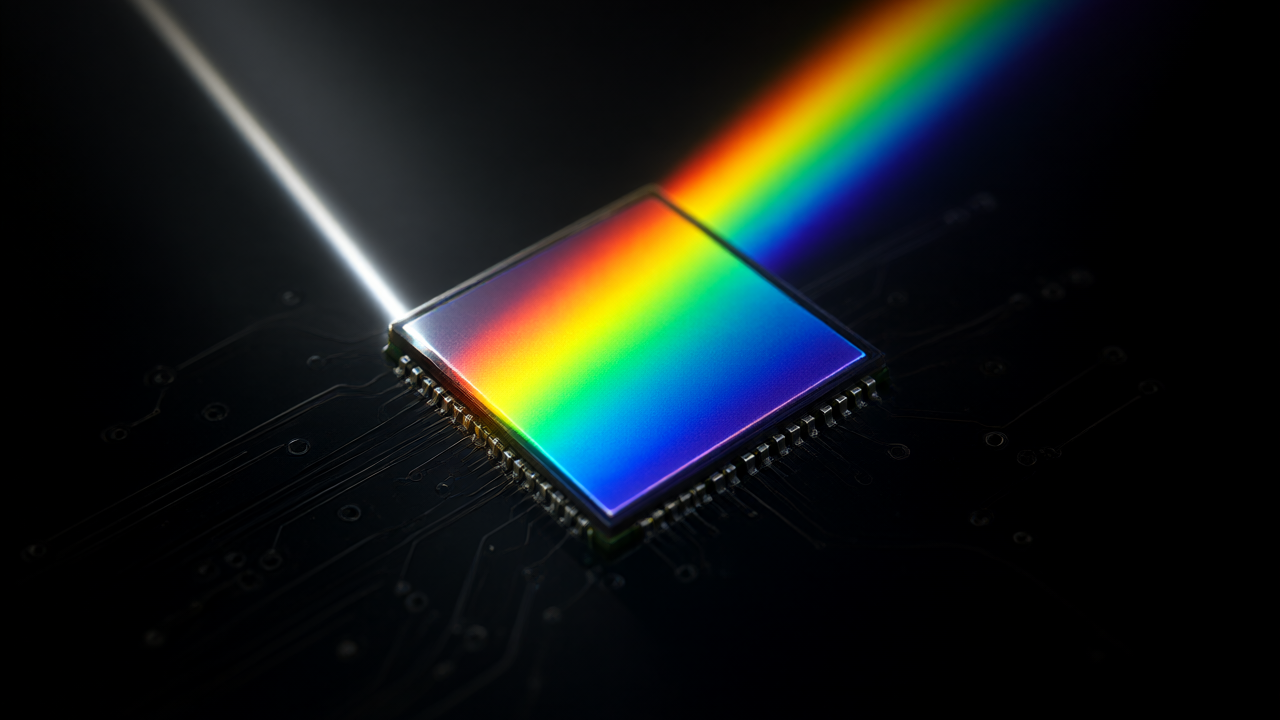
The developed convolutional spectrometer achieves a 100% classification success rate when identifying pharmaceuticals, plastics, coffee, flour, and tea. In liquid analysis, the sensor measured concentrations in organic and water-based solutions with approximately 0.01% accuracy, surpassing the performance of some commercial benchtop spectrometers. In biomedical tests, the device accurately measured blood glucose, blood lactate, blood alcohol, and skin moisture, including a demonstration of noninvasive glucose tracking in one participant.
Technical Details
The sensor is built on a silicon nitride photonic platform integrated with onboard electronics, operating across near-infrared wavelengths from 1200 to 1700 nm. Unlike traditional spectrometers that separate wavelengths or use complex reconstruction, this device applies the convolution theorem directly in the optical domain. The architecture utilizes a sequence of optical components with repeating spectral responses, such as micro-ring resonators or unbalanced Mach-Zehnder interferometers. Fast Fourier transforms are then employed to recover the light spectrum.
- Processing Speed: Measurements are collected and processed in less than one second.
- Scalability: Spectral bandwidth can be extended theoretically without limit, and resolution can be increased exponentially by adding sequential optical components.
- Environmental Tolerance: The system operates reliably across a temperature range of -20°C to 80°C.
Background & Context
Miniaturizing spectrometers typically involves a trade-off where reduced size leads to lower resolution, limited measurement ranges, or decreased accuracy. This often restricts compact devices to simple substance identification rather than precise quantification. The convolutional approach aims to eliminate these limitations by reducing computational overhead and increasing noise tolerance.
Significance & Outlook
The combination of a $10 price point and high technical readiness suggests a path toward practical deployment in wearable health monitors, food testing, and industrial quality control. By enabling high-precision sensing without the need for needles or large laboratory equipment, the technology could transform real-time health monitoring and environmental sensing.
Source: https://www.sciencedaily.com/releases/2026/10/261022081312.htm
Get our weekly technology intelligence — free
Receive an infographic that lets you judge at a glance whether each field’s analysis report is worth reading.
Subscribe Free — Weekly Tech Intelligence
By subscribing, you’ll receive Troy-Technical’s weekly technology intelligence newsletter.
- Your email and selected fields are used only to deliver the newsletter.
- We never share your information with third parties.
- You can unsubscribe anytime via the link in each email.
See our Privacy Policy for details.
Takes about a minute · Unsubscribe anytime