


Key Findings
The review highlights the development of wearable sensors capable of simultaneous VOC and humidity detection, a critical requirement since water vapor often distorts chemical signals in exhaled breath. Notable performance benchmarks include a graphene/PANI hybrid on polypropylene masks that achieved a 250 percent response at 50 ppm ammonia with a 100 ppb detection limit, maintaining stability across 20 to 100 percent relative humidity (RH). Additionally, an organic field-effect transistor sensor using oleylamine-functionalized graphene oxide reached a 9.19 ppb detection limit and remained stable up to 95 percent RH.
Technical Details
The sensors utilize 2D materials—including graphene derivatives, MXenes, and transition metal dichalcogenides (TMDs)—integrated onto various substrates:
- Polymers: PDMS, PET, PI, and TPU provide elasticity and skin conformity.
- Textiles: Offer high porosity for analyte adsorption, though they remain an emerging research frontier.
- Paper: A low-cost, biodegradable medium ideal for disposable point-of-care devices.
Most devices operate on a chemiresistive principle where VOCs or water molecules donate or accept electrons relative to the material’s Fermi level. Performance is further enhanced through heterostructures (e.g., WS2 on MoS2), which create built-in electric fields to magnify resistance changes, and the use of AC complex impedance to decouple humidity artifacts.
Background & Context
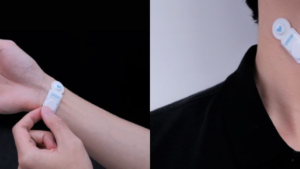
VOCs such as ammonia, acetone, ethanol, and nitrogen dioxide serve as critical biomarkers; for instance, ammonia levels rise in chronic kidney disease, while acetone tracks lipid metabolism. Because these compounds are often linked to respiratory disorders and neurological damage, there is a significant need for continuous, non-invasive monitoring to replace clinic visits and blood draws.
Significance & Outlook
By combining tunable surface chemistry with mechanical flexibility, these sensors transition exotic nanomaterials into practical health tools. The integration of conductive polymers and metal-organic frameworks (MOFs) allows for the creation of multifunctional devices, such as rGO/polypyrrole composite fabrics that function as both ammonia detectors and wearable Joule heaters.
Source: https://bioengineer.org/atom-thin-sensors-turn-breath-and-sweat-into-real-time-health-data/
Get our weekly technology intelligence — free
Receive an infographic that lets you judge at a glance whether each field’s analysis report is worth reading.
Subscribe Free — Weekly Tech Intelligence
By subscribing, you’ll receive Troy-Technical’s weekly technology intelligence newsletter.
- Your email and selected fields are used only to deliver the newsletter.
- We never share your information with third parties.
- You can unsubscribe anytime via the link in each email.
See our Privacy Policy for details.
Takes about a minute · Unsubscribe anytime