

Key Findings
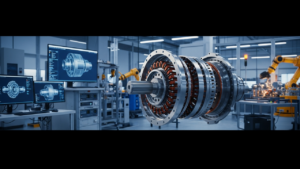
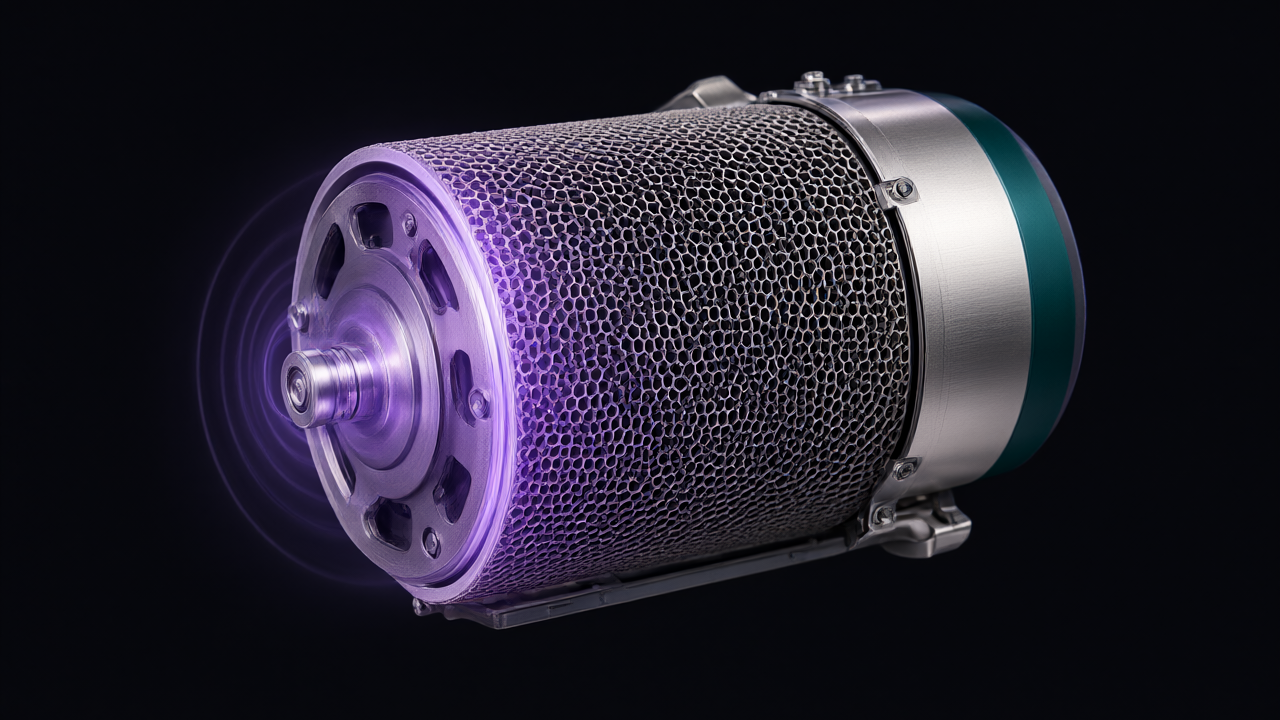
A research team has developed the MRPAM-AP, an acoustic metamaterial package that reduces measured electric motor noise by up to 11.2 decibels. The system specifically targets broadband noise concentrated below 2000 Hz, providing a lightweight alternative to conventional sound barriers that typically require prohibitive mass to block low-frequency sound.
Technical Details
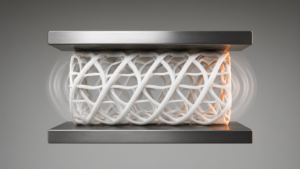
The MRPAM-AP utilizes multi-frequency resonant coupling to achieve broadband attenuation. The design consists of a thin thermoplastic polyurethane plate featuring three distinct resonator types (A, B, and C), each with unique radii, heights, and characteristic lengths. These resonators are arranged in a rotating pattern, allowing their individual resonance bands to overlap and interact, which prevents the narrow-notch limitation of single-resonance metamaterials.
The assembly includes:
- A structural resonant plate made of thermoplastic polyurethane, selected for its damping and suitability for injection molding.
- A fifteen-millimeter polyurethane foam layer that provides complementary absorption based on specific porosity, flow resistivity, and tortuosity.
- A square cover designed to fit within the tight volume constraints of an EV motor housing.
To optimize the design, the team used an artificial evolution algorithm and a dynamic model based on Kirchhoff-Love plate theory. This model treats the system as a multi-degree-of-freedom system, accounting for the mass, stiffness, and displacement response of each discrete resonator relative to the main structure.
Background & Context
Conventional acoustic insulation follows the “mass law,” where transmission loss increases by roughly six decibels for each doubling of mass or frequency. While adequate for combustion engines, this law makes blocking low-frequency electric motor noise impractical due to the extreme weight required. Acoustic metamaterials bypass this by using local resonance to create negative dynamic mass and negative stiffness, allowing thin panels to reflect or absorb wavelengths far longer than the panel’s own thickness.
Significance & Outlook
The MRPAM-AP demonstrates a viable path for EV powertrain engineers to reduce high-pitched whine and low-frequency hum without adding excessive weight. By integrating AI-driven geometric tuning with mass-production-ready materials, the research addresses the nonlinear complexities of metamaterial design to achieve practical, broadband noise suppression.
Source: https://bioengineer.org/ai-tuned-acoustic-metamaterial-silences-electric-motor-noise-below-2000-hz/
Get our weekly technology intelligence — free
Receive an infographic that lets you judge at a glance whether each field’s analysis report is worth reading.
Subscribe Free — Weekly Tech Intelligence
By subscribing, you’ll receive Troy-Technical’s weekly technology intelligence newsletter.
- Your email and selected fields are used only to deliver the newsletter.
- We never share your information with third parties.
- You can unsubscribe anytime via the link in each email.
See our Privacy Policy for details.
Takes about a minute · Unsubscribe anytime