


Key Findings
The Battery Manufacturing Accelerator (BattMan) is a national consortium led by the Pacific Northwest National Laboratory and Oak Ridge National Laboratory (ORNL) designed to accelerate the commercialization of advanced battery chemistries. The primary objective is to eliminate critical barriers in the production pipeline to lower manufacturing costs and shorten development timelines for applications in electric mobility, data centers, the electric grid, and national security.
Technical Details
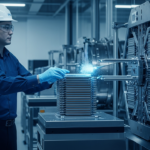
The technical framework centers on “Super Intelligence” (SI)-driven smart manufacturing. Unlike traditional fixed processes, BattMan embeds real-time monitoring and automated feedback directly into production lines. Specifically, electrode manufacturing machines will utilize visual, temperature, and pressure sensors linked to an SI-enhanced analysis platform to correct errors during operation.
A major target is the reduction of material waste. Currently, up to 40% of materials, including lithium and cobalt, can become scrap during electrode manufacturing; BattMan aims to reduce this figure to less than 5%. To achieve this, the consortium is developing:
- Autonomous Pilot Lines: Integrating sensing and intelligent control to prove manufacturing readiness and reduce variability.
- Digital Twins: Virtual replicas linked to physical systems to model performance improvements safely.
- Smart Test Beds: Vertically integrated systems at ORNL’s Battery Manufacturing Facility for real-time data analysis and autonomous parameter adjustment.
Background & Context
The consortium includes Argonne National Laboratory, the National Laboratory of the Rockies, and several universities, including the University of Washington, Binghamton University, the University of Alabama, Arizona State University, and the University of Michigan-Dearborn. The effort is supported by the DOE’s Advanced Materials and Manufacturing Technologies Office within the Office of Critical Minerals and Energy.
Significance & Outlook
The SI-based platform is designed for adaptability across various technologies, including conventional lithium-ion, solid-state, and flow batteries. Beyond process efficiency, BattMan seeks to strengthen the US supply chain by advancing battery materials derived from abundant domestic elements, thereby reducing reliance on geographically concentrated raw materials.
Get our weekly technology intelligence — free
Receive an infographic that lets you judge at a glance whether each field’s analysis report is worth reading.
Subscribe Free — Weekly Tech Intelligence
By subscribing, you’ll receive Troy-Technical’s weekly technology intelligence newsletter.
- Your email and selected fields are used only to deliver the newsletter.
- We never share your information with third parties.
- You can unsubscribe anytime via the link in each email.
See our Privacy Policy for details.
Takes about a minute · Unsubscribe anytime