


Key Findings
Research published in the Journal of Materials Science demonstrates that the spatial arrangement of phases in a dual-phase AlCoCrFeNi(CuTiZr) high-entropy alloy (HEA) significantly impacts oxidation rates. At 850 °C, the as-cast material exhibited a parabolic rate constant of 27.0 × 10⁻¹³ g2 cm−4 s−1, while the annealed material recorded 102.0 × 10⁻¹³ g2 cm−4 s−1—a difference of 3.8 times. However, at 1050 °C, the system entered a spallation-dominated regime where mass loss was similar for both conditions, with cumulative changes of −51.26 mg/cm2 for as-cast and −55.46 mg/cm2 for annealed samples after 50 hours.
Technical Details
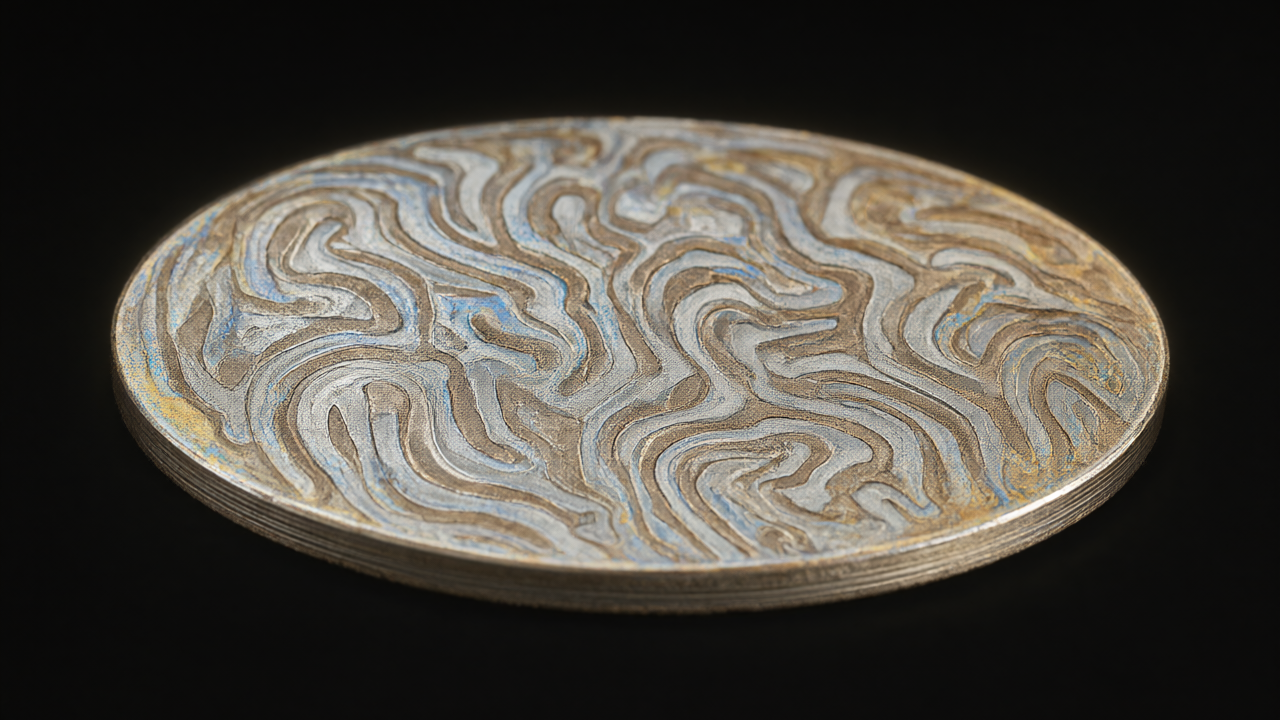
The study compared as-cast samples with samples annealed at 1100 °C for 50 hours and water quenched. Both shared identical compositions and phase fractions, consisting of a Cr–Co–Fe-rich FCC phase and a Ni–Al–Ti-rich B2 phase (the latter including coherent Cr-rich BCC domains). The annealing process coarsened the lamellar interior structure, creating a more spatially uniform distribution.
- Oxidation Architecture: All samples developed a three-layer structure: an outer oxide, an inner oxide, and a metallic FCC transition layer.
- Oxide Composition: Surfaces were dominated by spinel-structured and Cr2O3 oxides, with minor Al2O3 and monoclinic ZrO2.
- Titanium Behavior: At 850 °C, TiO2 rutile peaks were prominent in the outer oxide, promoting adhesion. At 1050 °C, rutile peaks were suppressed as titanium was consumed within the inner oxide.
- Subsurface Voids: At 1050 °C, voids extended 100–200 μm in as-cast samples and 500–600 μm in annealed samples, linked to a Kirkendall-type mechanism.
Background & Context
AlCoCrFeNi alloys combine the strength of ordered B2 phases with the ductility of FCC phases. While they tolerate higher Al and Cr concentrations than conventional alloys, maintaining a dense, adherent scale above 800 °C is difficult. Chromia (Cr2O3) becomes volatile as CrO3 near 1000 °C, limiting its effectiveness.
Significance & Outlook
By isolating phase morphology from chemistry and phase fraction, this work identifies spatial arrangement as an independent design parameter. The results indicate that while chromium provides a morphology-independent scaffold, the redistribution of other elements like titanium is temperature-gated, affecting the overall stability of the protective scale.
Get our weekly technology intelligence — free
Receive an infographic that lets you judge at a glance whether each field’s analysis report is worth reading.
Subscribe Free — Weekly Tech Intelligence
By subscribing, you’ll receive Troy-Technical’s weekly technology intelligence newsletter.
- Your email and selected fields are used only to deliver the newsletter.
- We never share your information with third parties.
- You can unsubscribe anytime via the link in each email.
See our Privacy Policy for details.
Takes about a minute · Unsubscribe anytime