


Key Findings
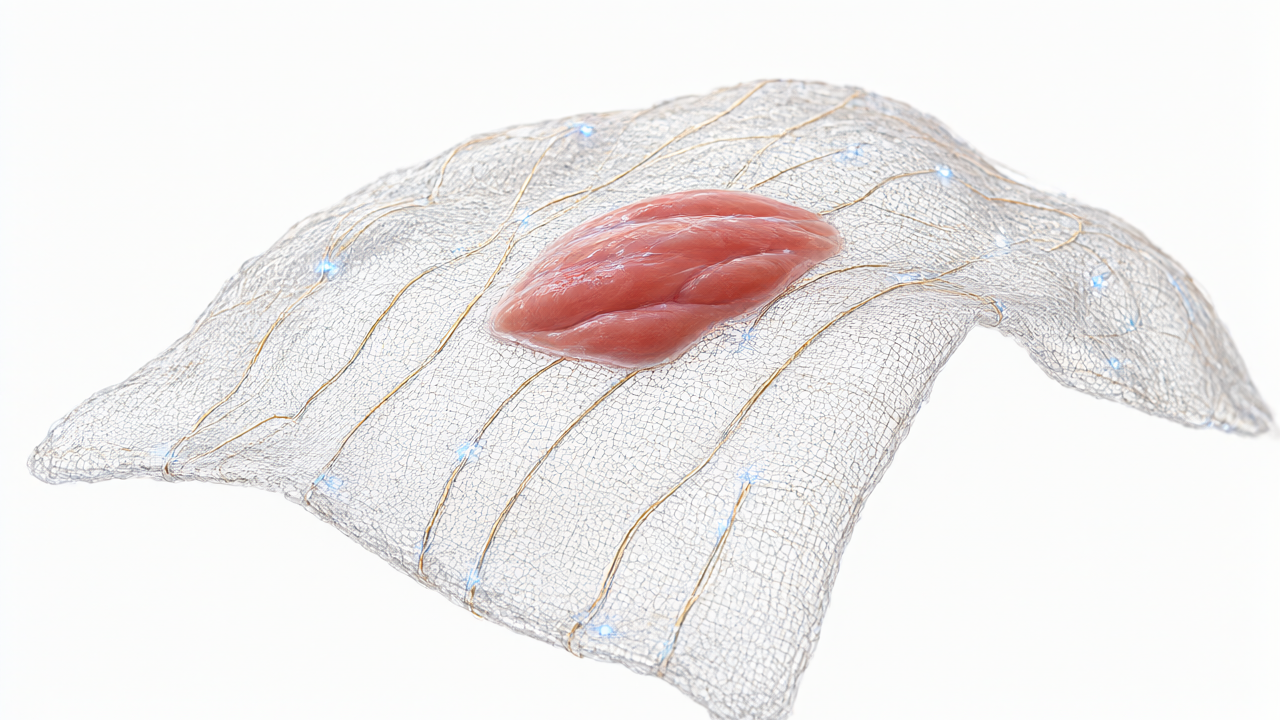
The research team developed a biohybrid mesh harvester that integrates piezoelectric elements directly into cardiac tissue. Unlike conventional surface-mounted generators, this mesh allows cardiomyocytes to grow through and around the device, transmitting cell contraction directly into the bending of piezoelectric elements. This structural redesign increases power generation efficiency by reducing the volume of non-contributing substrate and improving the transmission of deformation from within the tissue.
Technical Details
The device consists of a porous, net-like structure measuring 7 mm by 8 mm. It features 16 rows by 4 columns of lead zirconate titanate (PZT) ribbons, with each element measuring approximately 50 μm wide and 470 μm long. Four neighboring elements are connected in series to form a generation unit. The wiring ribbons are 3.7 μm thick, comprising a 1.5 μm polyimide (PI) bottom layer, a platinum (Pt) thin-film wiring layer, and a 2 μm SU-8 insulating protective layer.
- Bending Stiffness: Approximately 3.42 × 10⁻¹³ N ⋅ m².
- PZT Poling: DC electric field of 150 kV/cm at 150°C.
- Mechanical Performance: In buckling tests with 0.1% strain, PZT elements produced average open-circuit voltage pulses of 0.49 ± 0.011 V.
To ensure biological integration, the mesh was released from a silicon substrate via a germanium sacrificial layer and treated with poly-D-lysine and Matrigel to facilitate the adhesion of human embryonic stem cell-derived cardiomyocytes (hESC-CMs).
Background & Context
Current implantable devices, such as pacemakers, rely on chemical batteries that require surgical replacement. While energy harvesting from heartbeats has been studied, conventional piezoelectric patches often suffer from stiffness mismatches with soft biological tissue, which hinders natural movement and limits power extraction.
Significance & Outlook
This work provides an in vitro proof of concept demonstrating that a flexible, embedded structure can reconcile flexibility with power-generation performance. However, the researchers noted that the device has not yet been demonstrated inside a living body, nor has it been proven to replace a pacemaker battery.
Source: https://xenospectrum.com/en/biohybrid-mesh-piezoelectric-harvester-umass/
Get our weekly technology intelligence — free
Receive an infographic that lets you judge at a glance whether each field’s analysis report is worth reading.
Subscribe Free — Weekly Tech Intelligence
By subscribing, you’ll receive Troy-Technical’s weekly technology intelligence newsletter.
- Your email and selected fields are used only to deliver the newsletter.
- We never share your information with third parties.
- You can unsubscribe anytime via the link in each email.
See our Privacy Policy for details.
Takes about a minute · Unsubscribe anytime