


Key Findings
The optimized perovskite/silicon tandem solar cell achieves a certified stabilized power conversion efficiency (PCE) of 35.1% and a fill factor (FF) of 85%. In terms of durability, the device retains more than 94% of its initial performance after 1,500 hours of ageing under the ISOS-L-1 protocol.
Technical Details
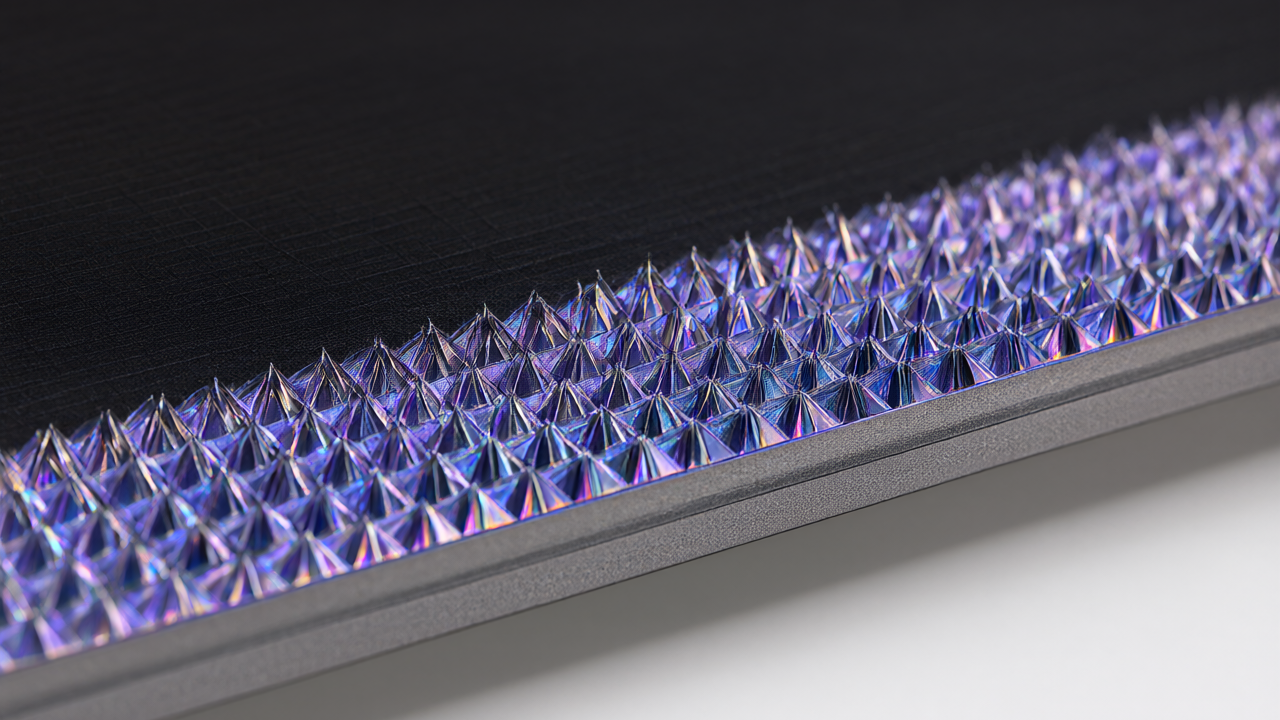
The performance gains are attributed to the use of rationally engineered molecular spatial conjugation within the self-assembled monolayer (SAM). The design incorporates tailored intramolecular distortion to suppress excess π–π stacking, which prevents unfavorable aggregation without reducing charge-transport efficiency. This steric regulation enables the formation of a highly ordered, conformal SAM across rough pyramidal textures.
This tailored interface provides several critical technical advantages:
- Optimized energy-level alignment for ultrafast charge extraction.
- Improved defect passivation through adaptive conformational adjustment.
- A robust template that supports the growth of high-quality perovskite films.
Background & Context
Current perovskite/silicon tandem solar cells utilizing rough textured substrates face a critical design trade-off regarding SAMs. While increasing molecular conjugation typically enhances conductivity, it often leads to aggregation that impairs the conformal coverage of the substrate. This limitation has historically hindered the ability to maintain both high conductivity and film uniformity on textured silicon.
Significance & Outlook
By reconciling molecular packing with interfacial coverage, this molecular engineering route provides a method to maximize the performance of tandem photovoltaics on textured silicon substrates. The ability to maintain high efficiency while ensuring long-term stability under ISOS-L-1 protocols represents a significant step in the development of high-performance tandem solar cells.
Source: https://www.nature.com/articles/s41586-026-11226-8
Get our weekly technology intelligence — free
Receive an infographic that lets you judge at a glance whether each field’s analysis report is worth reading.
Subscribe Free — Weekly Tech Intelligence
By subscribing, you’ll receive Troy-Technical’s weekly technology intelligence newsletter.
- Your email and selected fields are used only to deliver the newsletter.
- We never share your information with third parties.
- You can unsubscribe anytime via the link in each email.
See our Privacy Policy for details.
Takes about a minute · Unsubscribe anytime