

Key Findings
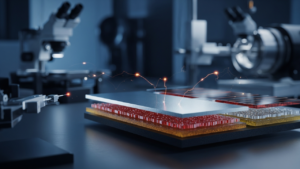
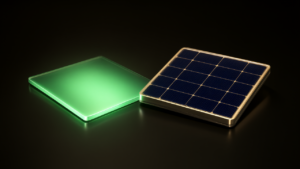
A research team led by Prof. YANG Guang of The Hong Kong Polytechnic University (PolyU), in collaboration with Zhejiang University, has discovered a hidden cause of aging in perovskite solar cells. The study reveals that photodegradation is driven not only by individual grain stability but by the interaction between neighboring grains with different crystal facets. By balancing charge losses at these boundaries, the team produced cells with a power conversion efficiency of 26.55% that retained over 90% of their initial efficiency after more than 2,200 hours of continuous operation under one-sun equivalent light.
Technical Details
The researchers focused on mixed-facet structures where grains with (100) and (111) facets sit side by side. They found that the (111) side of the grain boundary contains more defects, specifically vacancies where formamidinium (FA) ions are missing. This leads to an abnormal build-up of holes on the (111) side, which unexpectedly accelerates the degradation of these grains despite their natural resistance to light-induced aging.
To mitigate this, the team introduced 3-fluorophenylethylammonium bromide (m-F-PEABr). Because the molecules are too bulky to enter the grains, they collect at the grain boundaries. The positively charged end of the molecule fills the FA ion vacancies at the (111) boundaries, while the fluorine-containing segment secures the molecule in place. This repair balances charge losses across the boundaries, removing the focal points for degradation.
Background & Context
Perovskite solar cells are valued for being lightweight, low-cost, and efficient. However, photodegradation during long-term sunlight exposure has remained a primary barrier to large-scale commercialization. While previous research focused on reducing the overall number of defects, this study highlights the role of uneven charge losses between neighboring grains during operation.
Significance & Outlook
The findings, published in the journal Watt and commended by Prof. Nam-Gyu PARK of Sungkyunkwan University, provide a new framework for understanding cell aging. By shifting focus toward the interaction between grains, this approach offers a viable path toward developing more durable and commercially viable perovskite solar technology.
Source: https://www.miragenews.com/research-finds-hidden-cause-of-perovskite-solar-1771770/
Get our weekly technology intelligence — free
Receive an infographic that lets you judge at a glance whether each field’s analysis report is worth reading.
Subscribe Free — Weekly Tech Intelligence
By subscribing, you’ll receive Troy-Technical’s weekly technology intelligence newsletter.
- Your email and selected fields are used only to deliver the newsletter.
- We never share your information with third parties.
- You can unsubscribe anytime via the link in each email.
See our Privacy Policy for details.
Takes about a minute · Unsubscribe anytime