


Key Findings
The integration of a Br-containing grain boundary (GB) modifier into a 1.66-eV Cs(FA)PbI3 absorber has resulted in a perovskite/silicon tandem solar cell with a champion efficiency of 32.08% and a certified efficiency of 31.62%. Beyond efficiency, the device demonstrates high durability, retaining 95% of its initial performance after approximately 3,000 hours of maximum power point tracking. Additionally, it maintains 93% of its performance after 1,500 hours of damp-heat stressing at 85 °C and 85% relative humidity.
Technical Details
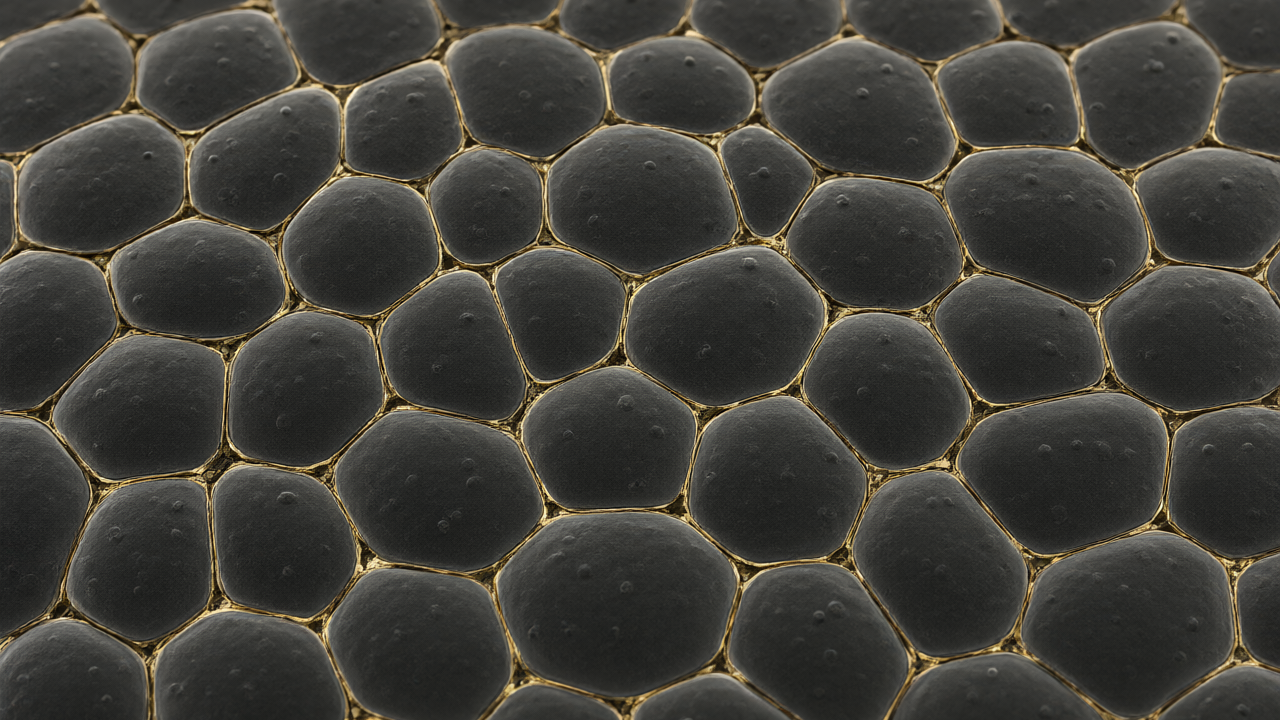
The study identifies that sparse doping of oversized formamidinium (FA) cations in caesium lead triiodide (Cs(FA)PbI3) causes severe grain boundary distortion, which leads to defect generation and performance loss. To resolve this, the researchers developed a Pb-based metallomesogen. This material forms a mesophase that combines solid-like and liquid-like properties, allowing it to distribute uniformly along the grain boundaries of the Cs(FA)PbI3 film.
This uniform distribution provides several structural benefits:
- Alleviation of grain boundary distortion.
- Relief of shear strain.
- Preservation of lattice integrity.
- Mitigation of defect formation.
Background & Context
Cs(FA)PbI3 is considered a promising front-cell absorber for tandem solar cells due to its inherent stability. However, producing high-quality films has remained a significant technical challenge. Previous research in the field has explored various methods to improve efficiency and stability, including interface engineering and the regulation of crystallization in wide-bandgap perovskites.
Significance & Outlook
By addressing the structural distortion caused by FA cation doping, this metallomesogen-based engineering approach provides a pathway to stabilize high-efficiency tandem cells. The ability to maintain high performance under both continuous operational tracking and extreme damp-heat conditions suggests a significant improvement in the commercial viability of perovskite/silicon tandem architectures.
Source: https://www.nature.com/articles/s41560-026-02161-z
Get our weekly technology intelligence — free
Receive an infographic that lets you judge at a glance whether each field’s analysis report is worth reading.
Subscribe Free — Weekly Tech Intelligence
By subscribing, you’ll receive Troy-Technical’s weekly technology intelligence newsletter.
- Your email and selected fields are used only to deliver the newsletter.
- We never share your information with third parties.
- You can unsubscribe anytime via the link in each email.
See our Privacy Policy for details.
Takes about a minute · Unsubscribe anytime