


Key Findings
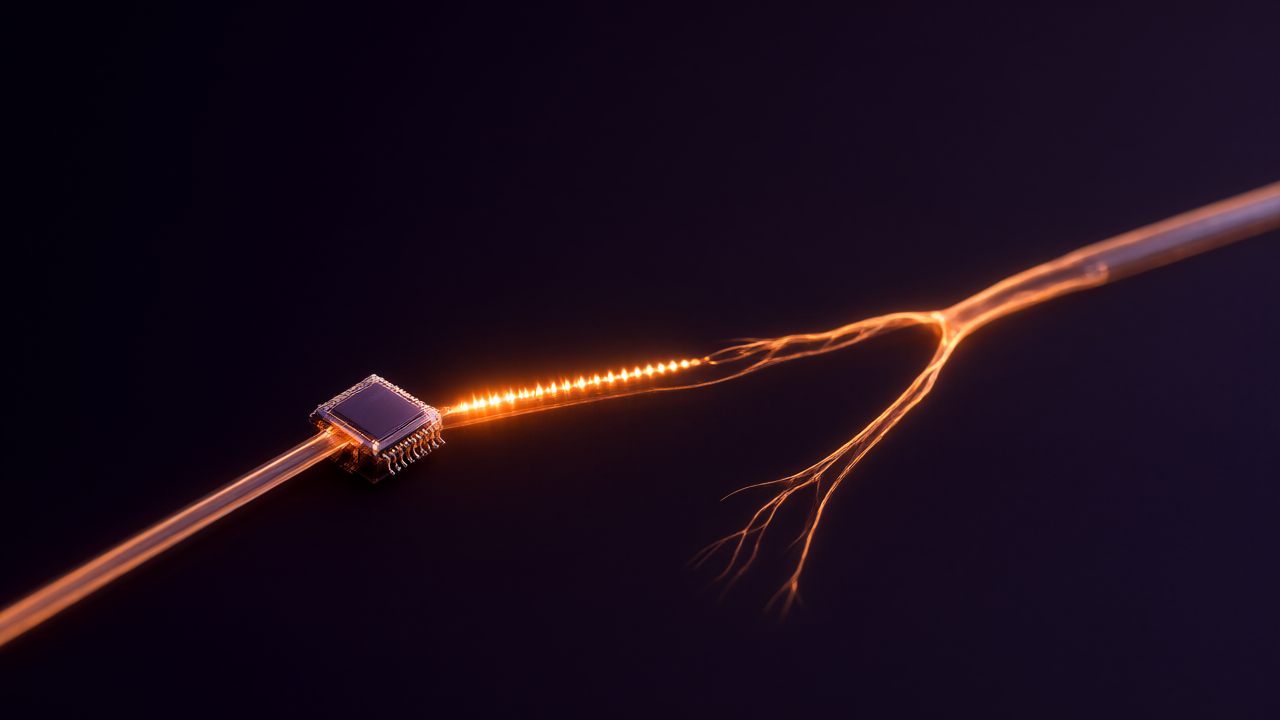
The developed all-optical spike encoder enables the conversion of analogue sensory signals into optical spike sequences with spike rates exceeding 2.0 GHz. Operating at the 1,550 nm telecommunication band, the system demonstrates approximately 5-bit encoding precision and consumes only 0.5 pJ of energy per spike. When integrated with digital spiking neural networks (SNNs), the system achieved a 94.1% classification accuracy for handwritten digit recognition using the MNIST dataset.
Technical Details
The encoder is based on optically injected Fabry–Perot (FP) laser neurons. Unlike previous binary-output devices, this setup establishes a steady monotonic correlation where stronger input optical intensity results in a higher spike firing rate. The team achieved amplitude-to-rate encoding by tuning the following parameters:
- Injection power
- Laser frequency detuning
- FP laser bias current
The architecture is scalable, supporting both time-division and wavelength-division multiplexing. Testing confirmed that spike encoding performance remains robust after transmission over 10 km of single-mode fiber.
Background & Context
Brain-inspired SNNs offer lower latency and energy consumption than conventional artificial neural networks by processing information via discrete spike pulses. However, a significant hurdle has been the efficient conversion of real-world analogue signals into reliable optical spikes. Existing electrical generators are limited by low spike rates, while previous optical devices often lacked stable linear mapping between input strength and firing frequency or compatibility with standard fiber-optic infrastructure.
Significance & Outlook
This research, published in Volume 5 of the Opto-Electronic Science journal on October 19, 2026, provides a practical route for merging photonic spike encoders with existing fiber networks. The team demonstrated proof-of-concept applications in intelligent healthcare diagnosis, including chest X-ray screening, electrocardiogram arrhythmia identification, and heart-sound classification. By translating continuous physiological and audio waveforms into ordered spike trains, the technology moves photonic neuromorphic computing toward practical, low-power communication and healthcare applications.
Source: https://www.miragenews.com/ultrafast-optical-encoder-enables-neuromorphic-1773271/
Get our weekly technology intelligence — free
Receive an infographic that lets you judge at a glance whether each field’s analysis report is worth reading.
Subscribe Free — Weekly Tech Intelligence
By subscribing, you’ll receive Troy-Technical’s weekly technology intelligence newsletter.
- Your email and selected fields are used only to deliver the newsletter.
- We never share your information with third parties.
- You can unsubscribe anytime via the link in each email.
See our Privacy Policy for details.
Takes about a minute · Unsubscribe anytime