

Key Findings
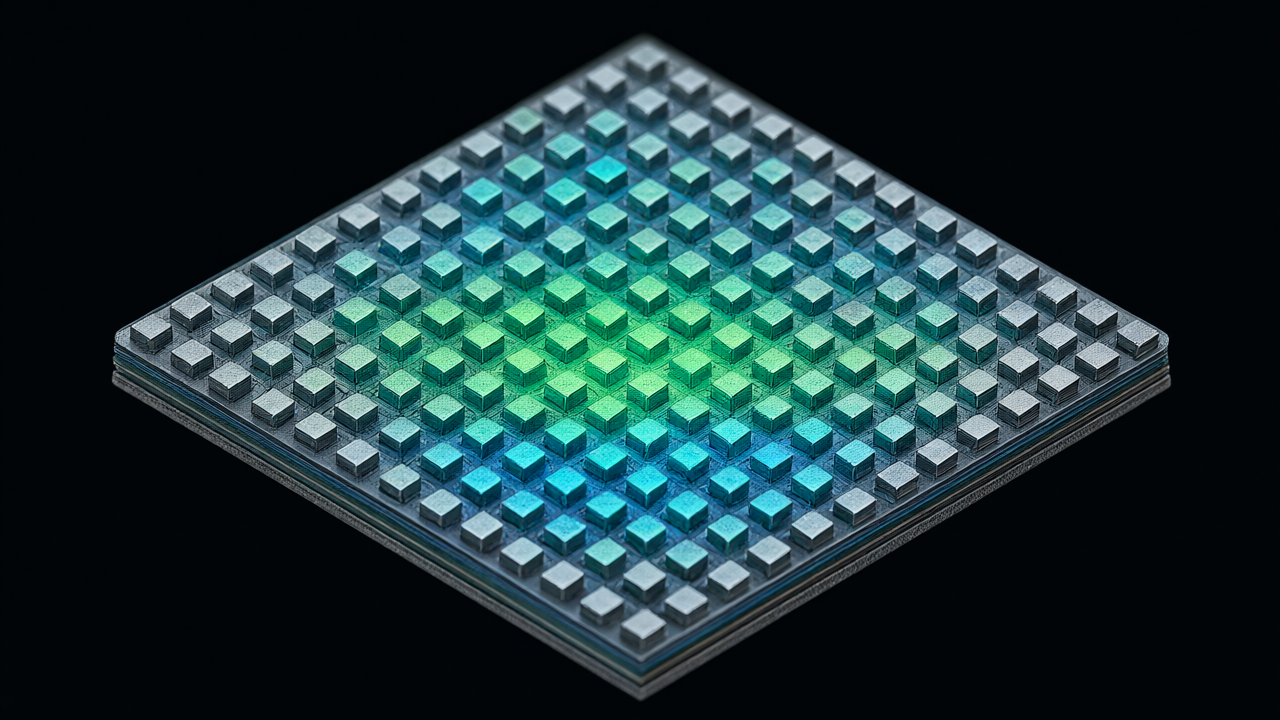
The study demonstrates that structuring bulk ReS2 into a C4-symmetric resonant metasurface reshapes its photonic band topology. This process splits the integer topological charge of quasi-bound states in the continuum (qBICs) into two half-integer polarization singularities, driving the formation of directional far-field flatbands. When tuned to resonance with the linearly polarized excitonic transitions of ReS2, these flatband states hybridize into distinct directionally polarized exciton-polaritons.
Technical Details
The system leverages the strong in-plane anisotropy of ReS2, which possesses a distorted triclinic 1T′ structure. Unlike MoS2 or WS2, ReS2 exhibits multiple linearly polarized excitonic resonances with axis-aligned transition dipoles that remain nearly independent of layer thickness. The metasurface consists of subwavelength resonator arrays that support qBICs—symmetry-protected states that are radiatively accessible due to controlled symmetry perturbations.
From a topological perspective, the researchers manipulated momentum-space singularities. While true BICs coincide with V points (where the far-field polarization vector winds around a singularity), reducing the rotational symmetry of the metasurface splits these singularities into multiple points, such as circularly polarized C points or half-integer Dirac points, while conserving the total topological charge. This allows for the engineering of flatbands—states with vanishing group velocity and quenched kinetic energy—without requiring the ultrasubwavelength reststrahlenband regime.
Background and Context
Anisotropic van der Waals materials are valued for their direction-dependent optical and electronic properties. In nanophotonics, this anisotropy allows for the tailoring of light-matter interactions. By fabricating the metasurface directly from the excitonic material, the photonic and excitonic components are co-localized. This self-hybridized strong coupling can routinely yield Rabi splittings exceeding 100 meV at room temperature.
Significance and Outlook
The ability to control polaritonic flatbands through topological transformations suggests several applications for scalable photonic integration, including:
- Polarization-resolved quantum emitters.
- Flatband-enhanced nonlinear optics.
- Low-threshold polariton devices.
Source: https://doi.org/10.1038/s41563-026-02776-3
Get our weekly technology intelligence — free
Receive an infographic that lets you judge at a glance whether each field’s analysis report is worth reading.
Subscribe Free — Weekly Tech Intelligence
By subscribing, you’ll receive Troy-Technical’s weekly technology intelligence newsletter.
- Your email and selected fields are used only to deliver the newsletter.
- We never share your information with third parties.
- You can unsubscribe anytime via the link in each email.
See our Privacy Policy for details.
Takes about a minute · Unsubscribe anytime