

Key Findings
A research team led by Professor Lin Yiheng from the Spin Magnetic Resonance Laboratory and Professor Zou Changling from the Quantum Information Laboratory at the University of Science and Technology of China (USTC) has successfully implemented multi-round autonomous quantum error correction. The study, published in Nature Physics, demonstrates that the coherence time of the logical qubit exceeds that of the best physical qubit in the system, officially surpassing the quantum error correction break-even point.
Technical Details
The team utilized a multi-level encoding logical qubit within a single ion. To avoid the experimental complexity of traditional QEC—which typically relies on error syndrome measurement and real-time feedback—the researchers employed an autonomous scheme based on dissipation engineering. The process operates as follows:
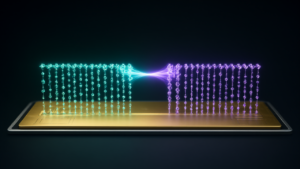
- Entropy Transfer: Using multi-frequency laser manipulation, the team transferred entropy introduced by noise from the quantum information to an auxiliary system (a shared vibration mode) via coherent control.
- State Recovery: This process restores the quantum state to the encoding space without affecting components already in the logical state.
- Sympathetic Cooling: The auxiliary system is reset to a low-entropy ground state through sympathetic cooling. By cooling the auxiliary ion, excess energy is removed from the shared vibration mode, preparing the system for the next correction cycle.
To validate the protection effect, the team tested the system against controllable low-frequency magnetic field noise and compared the coherence times of the best physical qubit, the uncorrected logical qubit, and the multi-round autonomous corrected logical qubit.
Significance and Outlook
This approach reduces the encoding resources and control overhead required for quantum error correction by combining multi-level encoding with autonomous dissipation. While the current implementation specifically addresses phase errors for a single logical qubit, it provides an experimental foundation for developing stable quantum storage units and fault-tolerant quantum computing in ion trap systems. Future research will focus on exploring quantum operations and error correction across multiple logical qubits.
Source: https://news.qq.com/rain/a/20261104A0CPW200
Get our weekly technology intelligence — free
Receive an infographic that lets you judge at a glance whether each field’s analysis report is worth reading.
Subscribe Free — Weekly Tech Intelligence
By subscribing, you’ll receive Troy-Technical’s weekly technology intelligence newsletter.
- Your email and selected fields are used only to deliver the newsletter.
- We never share your information with third parties.
- You can unsubscribe anytime via the link in each email.
See our Privacy Policy for details.
Takes about a minute · Unsubscribe anytime