

Key Findings
Akash V. Dixit and colleagues at the National Institute of Standards and Technology (NIST) in Boulder have demonstrated a novel resonator that reads the state of superconducting qubits with a fidelity exceeding 99 percent. The system operates using millimeter waves at 35 GHz, allowing it to handle significantly stronger measurement signals than conventional readout systems without inducing unwanted state transitions in the qubit.
Technical Details
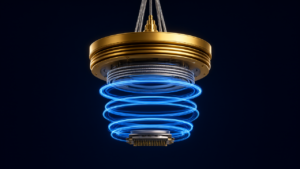
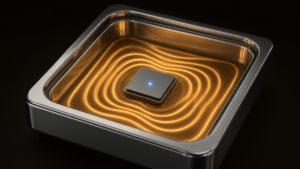
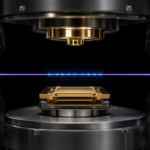
The experimental setup pairs a superconducting transmon—a type of qubit that assumes quantized states at extremely low temperatures—with an electromagnetic cavity resonator. The resonator acts as a measurement chamber where the qubit influences the resonance frequency; this shift is then detected to determine the qubit’s state.
- Frequency Architecture: The resonator frequency is positioned far above the qubit frequency. This large detuning reduces the probability that a strong measurement field will push the qubit into an unintended state via unwanted resonances.
- Signal Strength: The researchers drove the resonator with more than 100 photons. Despite this high excitation, the team recorded no resonant state transitions that would move the qubit out of its intended plane.
- Hardware Simplification: The readout was achieved without the use of a quantum-limited amplifier, a component typically required to boost weak signals with low noise but which adds complexity to cryogenic systems.
Background & Context
In standard superconducting processors, a physical conflict exists between signal clarity and state preservation. While stronger signals are easier to distinguish from background noise and speed up readout, too many photons in the resonator can trigger unintended transitions, corrupting the stored quantum information. Such errors are particularly critical in sequences of multiple operations, as they can invalidate subsequent calculation steps and complicate error correction.
Significance & Outlook
Reliable readout is a fundamental requirement for fault-tolerant quantum computing, as control circuits must regularly check for disturbances without destroying stored information. While this proof-of-concept was demonstrated on a single qubit rather than a full processor, the ability to maintain high fidelity with stronger signals and fewer amplifier components could facilitate the scaling of larger systems requiring parallel measurements and short readout times.
Get our weekly technology intelligence — free
Receive an infographic that lets you judge at a glance whether each field’s analysis report is worth reading.
Subscribe Free — Weekly Tech Intelligence
By subscribing, you’ll receive Troy-Technical’s weekly technology intelligence newsletter.
- Your email and selected fields are used only to deliver the newsletter.
- We never share your information with third parties.
- You can unsubscribe anytime via the link in each email.
See our Privacy Policy for details.
Takes about a minute · Unsubscribe anytime