

Key Findings
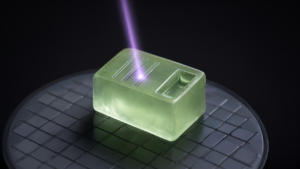
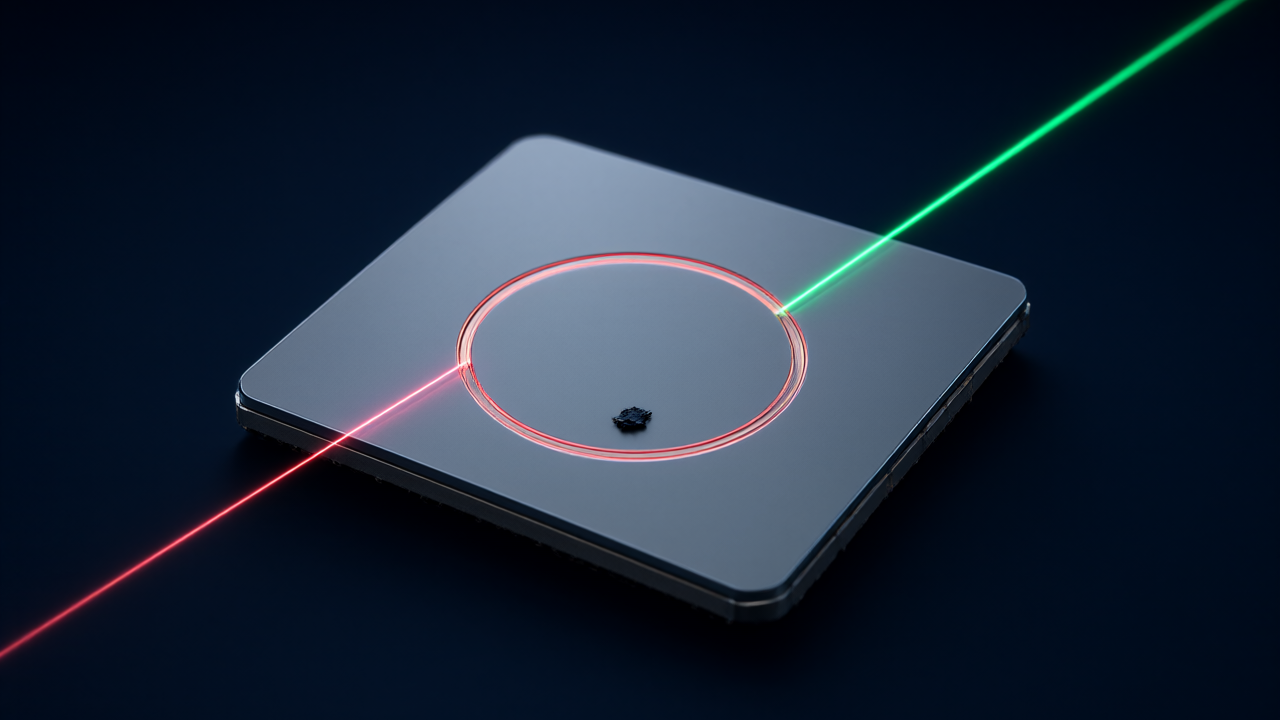
The integration of ferroelectric NbOBr2 films into a silicon nitride microring resonator has enabled the realization of electrically reconfigurable second-harmonic generation (SHG) on a photonic chip. The device achieves an SHG conversion efficiency of 158% W⁻¹ under continuous-wave excitation and a 53% electrical modulation depth. Furthermore, the system supports non-volatile control, as polarization states can be programmed over multiple levels and retained after switching.
Technical Details
The device utilizes NbOBr2 films with thicknesses ranging from 20 nm to 40 nm. The material combines strong second-order susceptibility, resulting from intrinsic inversion-symmetry breaking, with in-plane ferroelectric polarisation that is electrically switchable. Control is achieved by modulating the Schottky barrier at the NbOBr2–metal interface, which in turn regulates carrier injection, dispersion, and free carrier absorption to tune the cavity-enhanced nonlinear response.
Background and Context
Niobium oxide dihalide films are known for SHG efficiency that scales with thickness due to weak interlayer electronic coupling. However, their application in integrated nonlinear photonics has previously been limited by a lack of robust electrical tuneability. This research addresses that gap by leveraging the ferroelectric properties of NbOBr2 to provide a mechanism for active electrical reconfiguration.
Significance and Outlook
The ability to program and retain polarization states allows for the non-volatile manipulation of optical responses on-chip. To demonstrate the practical utility of this technology, the researchers used the fundamental and frequency-converted outputs as complementary channels to perform dual-channel edge detection. This development provides a pathway for more flexible and efficient integrated nonlinear photonic devices.
Source: https://doi.org/10.1038/s41565-026-02331-w
Get our weekly technology intelligence — free
Receive an infographic that lets you judge at a glance whether each field’s analysis report is worth reading.
Subscribe Free — Weekly Tech Intelligence
By subscribing, you’ll receive Troy-Technical’s weekly technology intelligence newsletter.
- Your email and selected fields are used only to deliver the newsletter.
- We never share your information with third parties.
- You can unsubscribe anytime via the link in each email.
See our Privacy Policy for details.
Takes about a minute · Unsubscribe anytime