


Key Findings
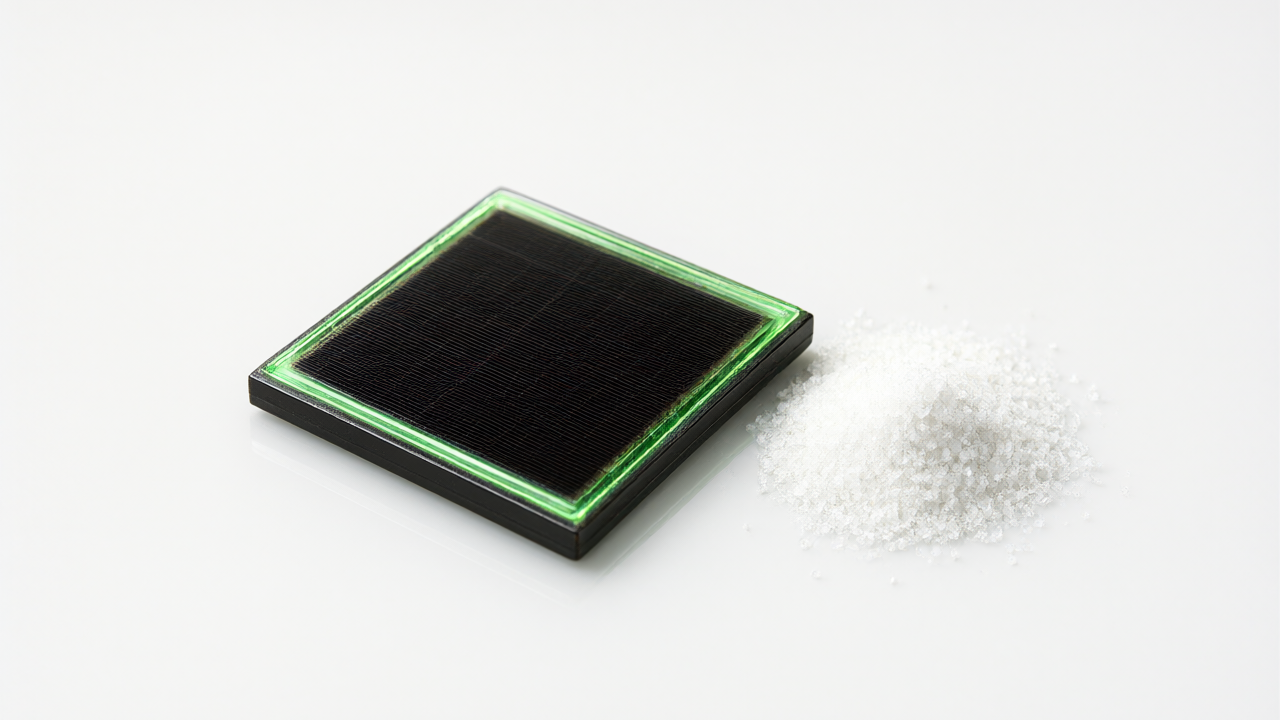
A joint research team from the Daegu Gyeongbuk Institute of Science and Technology (DGIST) and the Korea Institute of Science and Technology (KIST) Chonbuk Branch has successfully increased the operational stability of perovskite solar cells. The team identified the mechanism by which these cells self-destruct and developed a design to block this process using taurine. The results were published as a cover story in the journal Advanced Energy Materials on October 21.
Technical Details
The research focuses on the interface where the metal oxide layer meets the perovskite layer. During operation, the metal oxide layer generates superoxides (O2·-), a type of active oxygen that damages the crystal structure of the perovskite, leading to decomposition. By applying a thin antioxidant layer of taurine to this boundary, the team achieved the following:
- Degradation Suppression: Taurine continuously removes superoxides, inhibiting the decomposition of the perovskite structure.
- Structural Repair: Taurine acts as a “chemical bridge,” filling microscopic defects at the interface to facilitate smoother electron movement and improve overall efficiency.
- Stability Metrics: In operational stability tests, the T80 (the time taken for efficiency to drop to 80% of the initial value) increased from 23.6 hours to 130 hours, a more than five-fold improvement.
- Long-term Performance: Cells treated with taurine maintained over 95% of their initial efficiency after more than 500 hours of continuous light exposure.
Background and Significance
Perovskite solar cells are considered high-efficiency alternatives to traditional silicon cells. However, their susceptibility to decomposition when exposed to light and heat has been a primary barrier to commercialization. Professor Jong-min Choi of DGIST stated that clarifying the role of superoxides in the decomposition process and solving it via antioxidant interface design provides a core foundational technology to accelerate the commercialization of perovskite solar cells.
Source: https://www.dongascience.com/ko/news/80845
Get our weekly technology intelligence — free
Receive an infographic that lets you judge at a glance whether each field’s analysis report is worth reading.
Subscribe Free — Weekly Tech Intelligence
By subscribing, you’ll receive Troy-Technical’s weekly technology intelligence newsletter.
- Your email and selected fields are used only to deliver the newsletter.
- We never share your information with third parties.
- You can unsubscribe anytime via the link in each email.
See our Privacy Policy for details.
Takes about a minute · Unsubscribe anytime