Key Findings
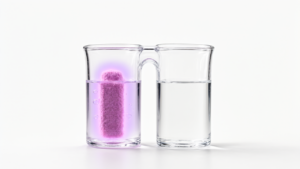
The study demonstrates that hydrogen (H₂) is produced through the water-driven oxidation of Fe(II) specifically when green rust (GR) precipitates. A critical discovery is that the presence of silica enables the compartmentalization necessary to maintain a pH between 6 and 7 and high concentrations of Fe²⁺ and Cl⁻, which are essential for GR stability. In contrast, experiments without silica resulted in the formation of amorphous Fe(OH)₂ without H₂ production.
Technical Details
The proposed reaction pathway identifies R3 as the key chemical equation: 4Fe²⁺ + 8H₂O + Cl⁻ = Fe(iii)Fe(ii)₃(OH)<0xE2><0x82><0x88>Cl + 7H⁺ + 0.5H₂. The process occurs in two primary segments:
- Segment A: Proton transfers across a membrane raise the internal pH from 4.5 to 6. While goethite is the stable phase, green rust precipitates first due to a lower critical supersaturation for nucleation (CSN), following Ostwald’s rule.
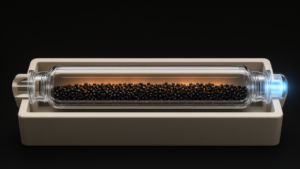
- Segment B: Once GR forms, H₂ activity increases by 14 orders of magnitude for every one-unit increase in pH within the tubular structure, driving massive H₂ production.
The researchers noted that H₂ production remained significant even when air was used as the headspace gas, indicating that water-driven oxidation to form GR can outcompete oxidation by O₂.
Background & Context
This mechanism provides an alternative to the Schikorr reaction, where Fe²⁺ forms Fe(OH)₂ before reacting with water to form magnetite (Fe₃O₄) and H₂. The oxidation of pure Fe(OH)₂ is extremely slow, even near 100°C. The study suggests that previous observations of H₂ production involving salts like NaCl or Na₂CO₃ may actually be attributed to the precipitation of green rust, as these salts act as counterions in GR structures.
Significance & Outlook
Understanding this oxidation route is critical for predicting H₂ production in high-risk environments, such as central boilers and radioactive waste containers, where gas accumulation can cause severe structural damage. Additionally, the results support the theory that green rust and H₂ production played a significant role in the chemistry of the early ocean.
Source: https://doi.org/10.21203/rs.3.rs-11432397/v1
Get our weekly technology intelligence — free
Receive an infographic that lets you judge at a glance whether each field’s analysis report is worth reading.
Subscribe Free — Weekly Tech Intelligence
By subscribing, you’ll receive Troy-Technical’s weekly technology intelligence newsletter.
- Your email and selected fields are used only to deliver the newsletter.
- We never share your information with third parties.
- You can unsubscribe anytime via the link in each email.
See our Privacy Policy for details.
Takes about a minute · Unsubscribe anytime