Key Findings
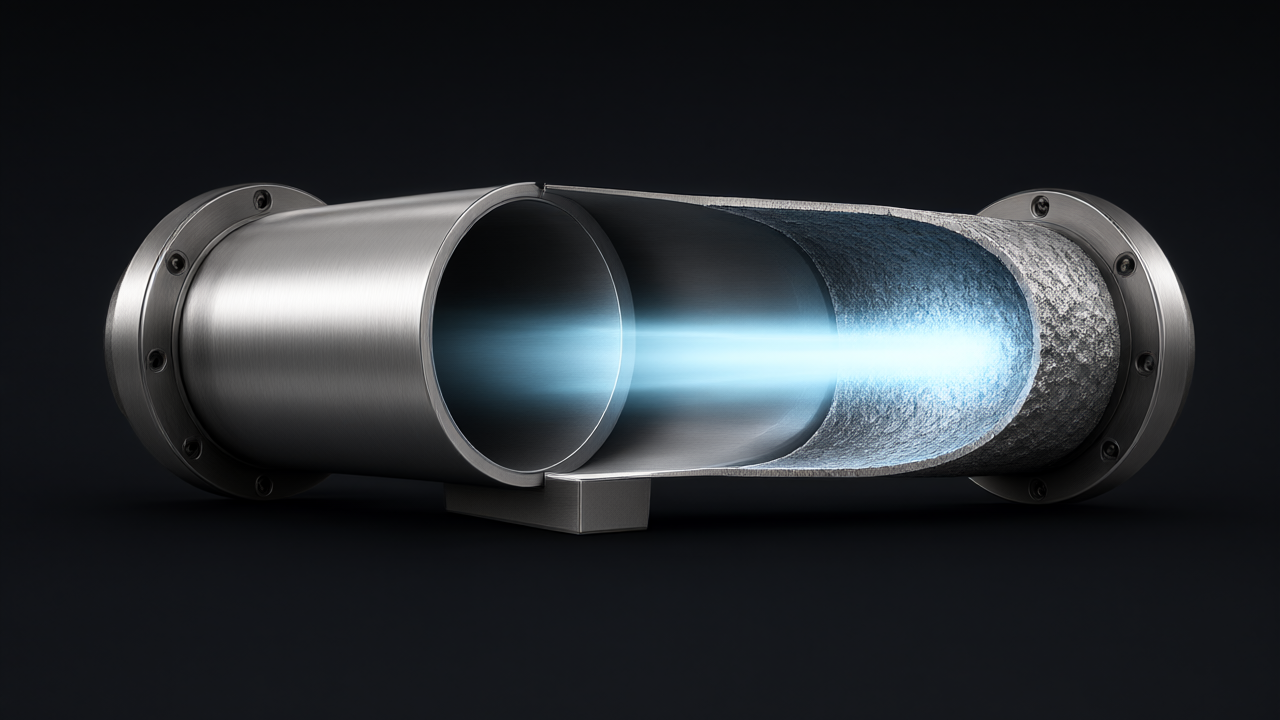
Wall roughness significantly alters the ignition dynamics of pressurized hydrogen released into a tube, most notably by elevating the critical burst pressure threshold required for spontaneous ignition from 3.2 MPa to 3.5 MPa. The research indicates that higher roughness scales lead to the dissipation of the central reaction zone by suppressing the radial expansion and central coalescence of the flame front.
Technical Details
The investigation utilized Large Eddy Simulation (LES) combined with a mixture averaged transport model and an Improved Partially Stirred Reactor (PaSR) combustion model. The study compared an absolutely smooth boundary condition (Ra = 0 mm) against varying equivalent sand-grain wall roughness (Ra) levels of 0.1, 0.5, and 1.0 mm. Technical observations include:
- Flame Evolution: Roughness-induced localized vortices drastically intensify combustion within the boundary layer.
- Shock Wave Dynamics: Wall roughness introduces a non-linear suppression of leading shock wave velocities.
- Energy Dissipation: The increase in the ignition threshold is driven by intense thermal and near-wall momentum dissipation.
Background & Context
While the general understanding of spontaneous ignition during accidental pressurized hydrogen releases has advanced, the specific aerodynamic effects of tube surface conditions have remained critically underexplored. This numerical study addresses this gap by evaluating how different surface textures influence non-premixed flame evolution and shock wave propagation.
Significance & Outlook
These results offer critical theoretical foundations for the quantitative risk assessment of hydrogen infrastructure. By quantifying the relationship between wall roughness and ignition thresholds, the data serves to inform future iterations of tube safety standards to better prevent accidental ignitions in industrial environments.
Source: https://doi.org/10.21203/rs.3.rs-11370052/v1
Get our weekly technology intelligence — free
Receive an infographic that lets you judge at a glance whether each field’s analysis report is worth reading.
Subscribe Free — Weekly Tech Intelligence
By subscribing, you’ll receive Troy-Technical’s weekly technology intelligence newsletter.
- Your email and selected fields are used only to deliver the newsletter.
- We never share your information with third parties.
- You can unsubscribe anytime via the link in each email.
See our Privacy Policy for details.
Takes about a minute · Unsubscribe anytime