


Key Findings
LLNL has successfully implemented two-photon polymerization (2PP) to fabricate compound parabolic concentrators (CPCs) for NIF targets, reducing production time from ten days to one. Unlike previous additive manufacturing attempts that struggled with feature size and surface roughness, 2PP allows the CPC to be printed as a single assembly without requiring a gold coating. A 2PP-printed CPC was first fielded in April 2026 for diagnostic calibration and later used in a September 2026 Discovery Science campaign on ion fast ignition.
Technical Details
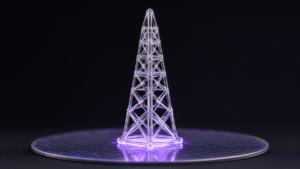
The CPC is a critical component that guides X-ray sources onto fuel capsules for diagnostic measurements; its narrow end measures 20 microns across, and the overall part is approximately 1.5 millimeters in size. The traditional fabrication process involved diamond turning a copper mandrel, coating it with gold and plastic, machining the final form, dissolving the mandrel, and attaching the cone to a support structure.
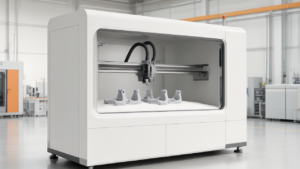
In contrast, 2PP utilizes a high-intensity laser focused to a spot smaller than one micron to enable simultaneous absorption of two photons. This precision allowed the team to create a CPC with an outer profile tailored to fit inside a gold cone via guide rails and glue. Additionally, 2PP was used to print a re-entrant cone with off-axis geometry that would have been difficult to produce via diamond turning, specifically to prevent laser backscatter into beamlines.
Background and Context
NIF components must undergo rigorous testing at the Jupiter Laser Facility and the University of Rochester’s Laboratory for Laser Energetics to ensure they do not damage optics or compromise national security data. Parallel research by the Italian National Agency for New Technologies, Energy and Sustainable Economic Development (ENEA) and Vilnius University also utilized 2PP to create 500 µm-wide log-pile lattices with 14 µm struts to study ablation speeds and laser-scattering in inertial confinement fusion (ICF) designs.
Significance and Outlook
The adoption of 2PP removes a significant fabrication bottleneck for micron-scale fusion target components. LLNL engineers are now exploring the production of other parts, including fuel capsules featuring lattice structures to hold wetted foams for new fuel layer formation approaches.
Get our weekly technology intelligence — free
Receive an infographic that lets you judge at a glance whether each field’s analysis report is worth reading.
Subscribe Free — Weekly Tech Intelligence
By subscribing, you’ll receive Troy-Technical’s weekly technology intelligence newsletter.
- Your email and selected fields are used only to deliver the newsletter.
- We never share your information with third parties.
- You can unsubscribe anytime via the link in each email.
See our Privacy Policy for details.
Takes about a minute · Unsubscribe anytime