


Key Findings
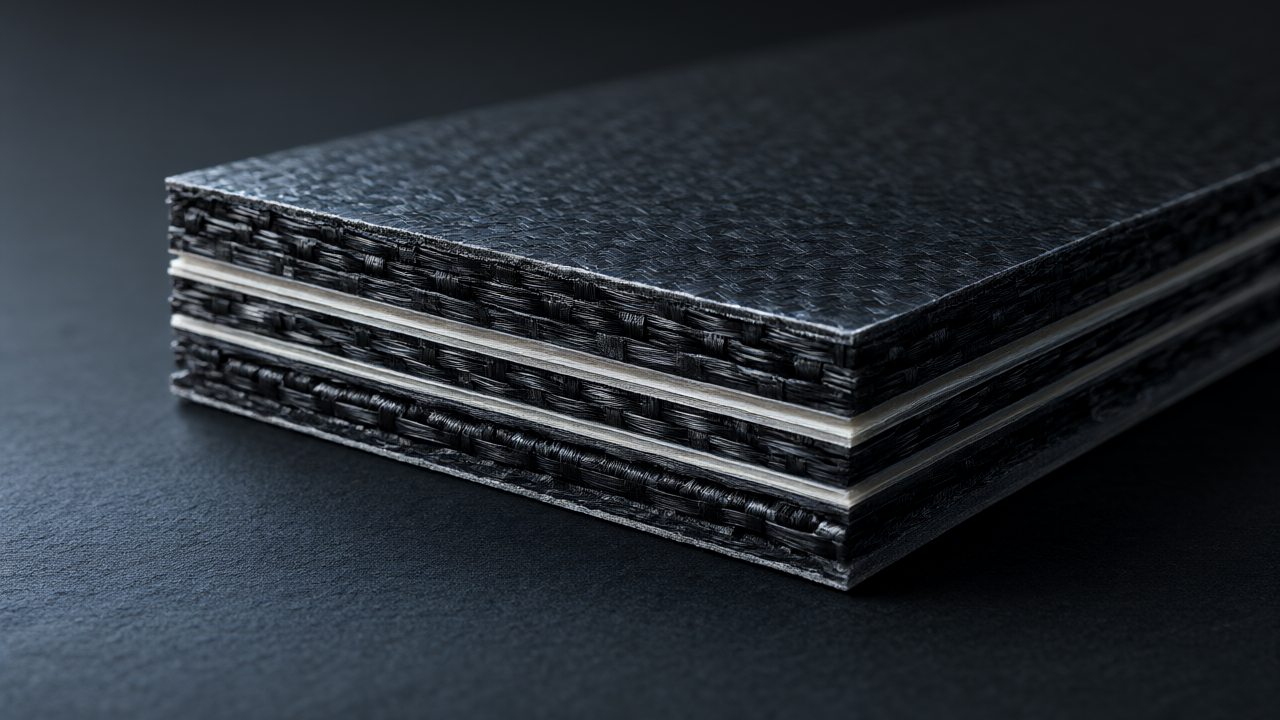
The research team, led by Professor Eun Jong-hyun, has successfully eliminated the traditional trade-off between toughness and strength in CFRPs. Composites molded at 180°C demonstrated a maximum increase of 296% in interlaminar fracture toughness compared to conventional CFRPs produced at the same temperature. Simultaneously, flexural strength increased by 20% and interlaminar shear strength improved by 29%. For composites molded at 120°C, flexural strength increased by 23%.
Technical Details
The team utilized low-melting temperature polyamide (LMPA) with a melting point between 133°C and 152°C. The process involved:
- Electrospinning: LMPA was dissolved in ethanol and applied via high voltage to create nano-fiber webs with a thickness of 6–29 μm directly onto carbon fiber fabrics.
- Eco-friendly Processing: Ethanol was used as a solvent instead of toxic alternatives to improve environmental sustainability.
- Temperature Control: The team compared interlaminar structures by varying molding temperatures—specifically 120°C (below the melting point) and 180°C (above the melting point)—while minimizing additive amounts to prevent strength degradation.
Background & Context
CFRPs are widely used in aircraft fuselages, automotive parts, and high-pressure hydrogen tanks due to their lightweight and high-strength properties. However, the epoxy resins used to bond layers are brittle, making the material susceptible to “interlaminar delamination” under impact or repeated loads. Previous attempts to insert thermoplastic materials to increase toughness often resulted in a decrease in overall strength.
Significance & Outlook
This study provides a simplified design direction for enhancing both toughness and strength by controlling molding temperatures and adding small amounts of nano-fibers. The findings were published in Composites Part B: Engineering on November 3 and were recognized with an “Outstanding Poster Award” at the 18th Asian Textile Conference (ATC-18). The technology is expected to be applied to lightweight structural materials for aerospace, automotive, and hydrogen storage applications.
Source: https://www.dailydgnews.com/news/article.html?no=269636
Get our weekly technology intelligence — free
Receive an infographic that lets you judge at a glance whether each field’s analysis report is worth reading.
Subscribe Free — Weekly Tech Intelligence
By subscribing, you’ll receive Troy-Technical’s weekly technology intelligence newsletter.
- Your email and selected fields are used only to deliver the newsletter.
- We never share your information with third parties.
- You can unsubscribe anytime via the link in each email.
See our Privacy Policy for details.
Takes about a minute · Unsubscribe anytime