


Key Findings
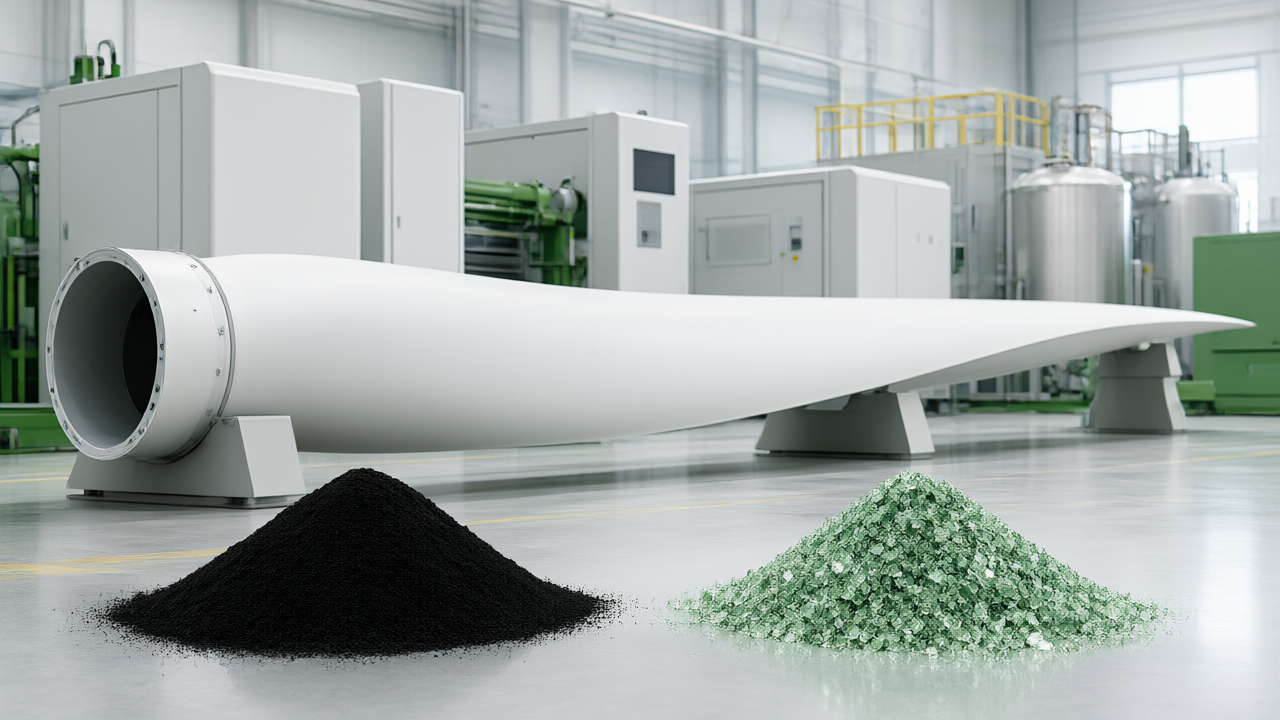
A new recycling method converts discarded wind turbine blades into high-value silicon carbide (SiC) and graphene. This process significantly reduces environmental impact, cutting greenhouse gas (GHG) emissions by 83-92% when compared to chemical dissolution and pyrolysis. Furthermore, the recovered materials can be integrated into new resins to enhance mechanical and thermal properties: a 0.3% weight addition increases stiffness and strength, improving resistance to deformation by 27% under tension and 9% when bent, while a 0.1% weight concentration increases thermal diffusivity by 41%.
Technical Details
The process leverages the existing chemical composition of turbine blades, which typically consist of carbon-rich polymer resin and silica-containing fiberglass. Using a technique called flash Joule heating, the waste materials are subjected to a brief burst of intense heat, reaching approximately 2000°C within seconds. At this temperature, carbon reacts with silica to produce SiC, a heat-resistant and hard material, while remaining carbon reorganizes into graphene, known for its electrical and thermal conductivity.
Background & Context
Conventional recycling strategies for composite blades are often costly and energy-intensive. Pyrolysis, which breaks polymers into oil and gas, costs approximately $460/ton, while chemical dissolution, which uses solvents to separate resin from glass fibers, costs about $1,800/ton. In contrast, lead author Hao Bi of Tsinghua University notes that the flash Joule heating method could turn a profit of about $80/ton due to the market value of the recovered SiC and graphene.
Significance & Outlook
The research, published in the journal Chem Circularity, suggests a more sustainable and profitable path for composite waste management. The team is currently seeking industry partners to scale the process. Beyond wind energy, the researchers indicate that this method could be adapted for other durable materials used in construction, electronics packaging, automotive manufacturing, and aerospace.
Source: https://www.compositesworld.com/news/researchers-turn-eol-turbine-blades-into-sic-graphene-
Get our weekly technology intelligence — free
Receive an infographic that lets you judge at a glance whether each field’s analysis report is worth reading.
Subscribe Free — Weekly Tech Intelligence
By subscribing, you’ll receive Troy-Technical’s weekly technology intelligence newsletter.
- Your email and selected fields are used only to deliver the newsletter.
- We never share your information with third parties.
- You can unsubscribe anytime via the link in each email.
See our Privacy Policy for details.
Takes about a minute · Unsubscribe anytime