


Key Findings
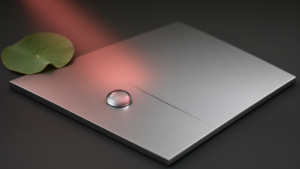
The developed coating for 7075 aluminium alloy demonstrates a water contact angle of 163.4° and a sliding angle of 2.1°. It provides a corrosion protection efficiency of 99.86%, with charge-transfer resistance increasing from 33.76 to 2.34 × 10⁴ Ω·cm² after 100 h of immersion in 3.5 wt.% NaCl solution. Additionally, the coating reduces ice adhesion strength from 142 kPa to 34 kPa and extends freezing time at –20 °C from 181 s to 857 s.
Technical Details
The coating process utilizes a multi-step strategy to ensure durability and hydrophobicity without using fluorine:
- Surface Texturing: Femtosecond laser texturing creates a biomimetic cauliflower-like hierarchical interface to maintain the Cassie-Baxter wetting state.
- Interfacial Anchoring: An Al-O-Si layer is formed using γ-aminopropyltriethoxysilane (KH550).
- Reinforcement: A spot-like reinforced skeleton is constructed using KH570-modified zinc oxide combined with low-solid-content E44 epoxy resin, which prevents the backfilling of micro/nanostructures.
- Outer Layer: Octadecyltrimethoxysilane (OTMS) is applied to provide a low-surface-energy finish.
Background and Context
Commercial adoption of superhydrophobic coatings for aluminium alloys has been limited by three primary factors: the regulatory scrutiny of fluorinated modifiers, weak interfacial adhesion, and the degradation of performance caused by the backfilling of micro/nanostructures. This research addresses these limitations by replacing fluorinated chemistry with a reinforced organic-inorganic structure.
Significance and Outlook
The coating exhibits high stability across various stress tests, including 240 abrasion cycles, 200 tape-peeling cycles, UV irradiation, thermal ageing, and 480 h immersion in wide-pH solutions. It also maintains low-adhesion wetting behaviour after 80 icing/de-icing cycles. Due to its durability in harsh environments, the authors suggest potential applications in the transport, marine, and aerospace sectors.
Get our weekly technology intelligence — free
Receive an infographic that lets you judge at a glance whether each field’s analysis report is worth reading.
Subscribe Free — Weekly Tech Intelligence
By subscribing, you’ll receive Troy-Technical’s weekly technology intelligence newsletter.
- Your email and selected fields are used only to deliver the newsletter.
- We never share your information with third parties.
- You can unsubscribe anytime via the link in each email.
See our Privacy Policy for details.
Takes about a minute · Unsubscribe anytime