Key Findings
The developed transparent coating achieves a surface temperature of 86.5 °C under 1 sun illumination, representing an apparent photothermal conversion efficiency of 42.6% while maintaining visible light transmittance above 83%. In winter conditions at –20 °C without illumination, the coating demonstrates an icing delay of 121 s and an ice adhesion strength of 56.8 kPa. Under 1 kW/m² simulated solar irradiation, the ice-melting time on the CsₓWO₃-20/PSO coating is 46.4% shorter than on bare glass.
Technical Details
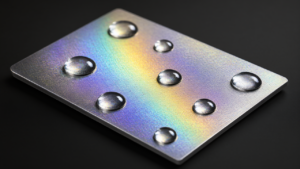
The coating is based on a phenyl/methylsiloxane cross-linked network combined with free polydimethylsiloxane (PDMS) segments, creating a liquid-lubricant-free solid slippery surface with a sliding angle of 16°. Cesium tungsten bronze (CsₓWO₃) nanoparticles serve as a spectrally selective filler, providing strong absorption in the near-infrared region and relatively weak absorption in the visible range.
Beyond de-icing, the near-infrared-selective absorption of CsₓWO₃ allows the coating to act as a solar heat shield. In tests using a model house, the coating reduced indoor temperatures by 19.9 °C. Durability tests show the hybrid structure maintains stable performance after 1,000 abrasion cycles and prolonged chemical exposure.
Background & Context
Ice accumulation on outdoor optical windows is a critical challenge for UAV optoelectronic pods, automotive autonomous driving sensors, and building-integrated photovoltaic (BIPV) facades. Previous passive solutions, such as superhydrophobic surfaces and slippery liquid-infused porous surfaces (SLIPS), often fail due to lubricant depletion or wetting-state transitions. Conversely, active photothermal coatings using carbon-based materials or MXenes typically lack the necessary optical clarity for these applications.
Significance & Outlook
This material is one of the few reported transparent anti-icing coatings to simultaneously integrate liquid-lubricant-free solid slipperiness, low ice adhesion, near-infrared-selective photothermal de-icing, and summer thermal management. It offers a durable, all-weather solution for protecting and managing the temperature of transparent outdoor optical components.
Get our weekly technology intelligence — free
Receive an infographic that lets you judge at a glance whether each field’s analysis report is worth reading.
Subscribe Free — Weekly Tech Intelligence
By subscribing, you’ll receive Troy-Technical’s weekly technology intelligence newsletter.
- Your email and selected fields are used only to deliver the newsletter.
- We never share your information with third parties.
- You can unsubscribe anytime via the link in each email.
See our Privacy Policy for details.
Takes about a minute · Unsubscribe anytime