Background and Challenges in Industrial Displays
TFT LCD displays used across various sectors such as industrial, automotive, medical, and aerospace demand high reliability and performance under harsh environmental conditions. A major challenge has been poor sunlight readability, where internal reflections significantly impair visibility in outdoor or brightly lit environments. Furthermore, in high-humidity settings, condensation within the air gap between the display cell and cover glass can cause screen fogging and degrade display quality. Beyond these, robustness against physical stresses like vibration, shock, and drops is essential for industrial displays, a requirement that traditional non-bonded structures struggled to meet effectively.
Key Findings and Technical Advantages of Optical Bonding
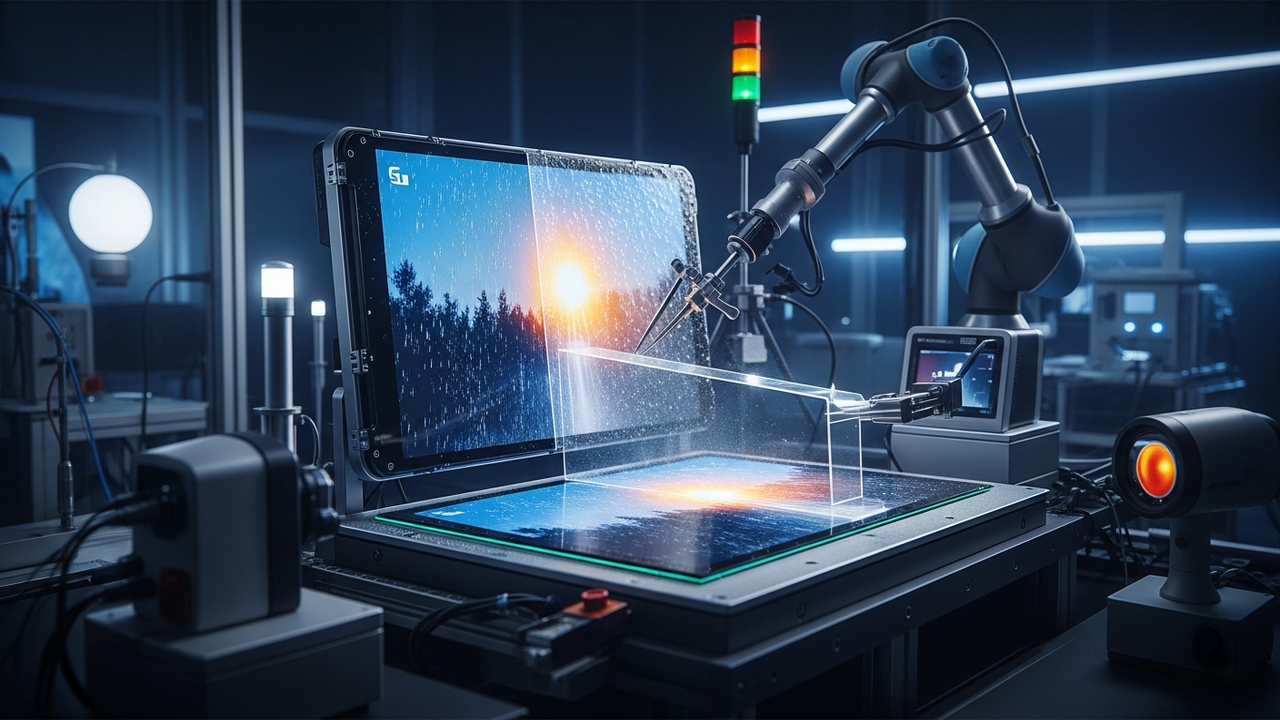
Optical bonding has emerged as an innovative and widely adopted technology to overcome these challenges. This technique involves filling the air gap between the LCD panel (TFT LCD cell) and the front cover glass (or touch panel) of a display module with a specialized, optically clear adhesive. This provides several significant advantages:
- Improved Readability (Sunlight Readability): One of the most prominent benefits is the dramatic improvement in readability under direct sunlight. By eliminating the air gap, light refraction and reflection within the display are suppressed, leading to an enhanced contrast ratio. This ensures that screen content remains clear and visible even in outdoor or bright ambient conditions.
- Enhanced Durability: The absence of an internal air gap significantly boosts the display’s resistance to external impacts and vibrations. The adhesive layer acts as a shock absorber, reducing the risk of glass breakage. It also prevents the ingress of foreign particles and dust.
- Improved Moisture and Anti-Fogging Properties: As the adhesive completely seals the air gap, it prevents moisture from penetrating the display interior and causing condensation. This ensures stable display quality even in high-temperature and high-humidity environments.
- Better Thermal Dissipation: The adhesive, by becoming part of the thermal conduction path, also helps to efficiently transfer heat from the display to the cover glass, facilitating heat dissipation.
The article primarily discusses two main bonding methods: Optically Clear Adhesive (LOCA) and Optically Clear Resin (OCR). LOCA, being liquid, is suitable for large and curved displays, while OCR, available as gels or sheets, is better suited for high-volume production. Silicone-based OCRs are noted for their high flexibility, and acrylic-based OCRs for their superior adhesive strength.
Technical Significance and Outlook
Optical bonding technology is becoming indispensable in the industrial display market. Its adoption is accelerating in sectors where reliability and visibility are paramount, such as construction machinery, marine vessels, aircraft, medical devices, POS systems, and military applications. This technology enables displays to be more robust, user-friendly, and to have longer operational lifespans. In the future, new applications are anticipated in smart city outdoor signage, advanced automotive Human-Machine Interfaces (HMIs), and optical systems for AR/VR devices. Optical bonding clearly demonstrates the critical role of adhesive technology in pushing the boundaries of display performance and fundamentally improving the user experience.