Key Findings
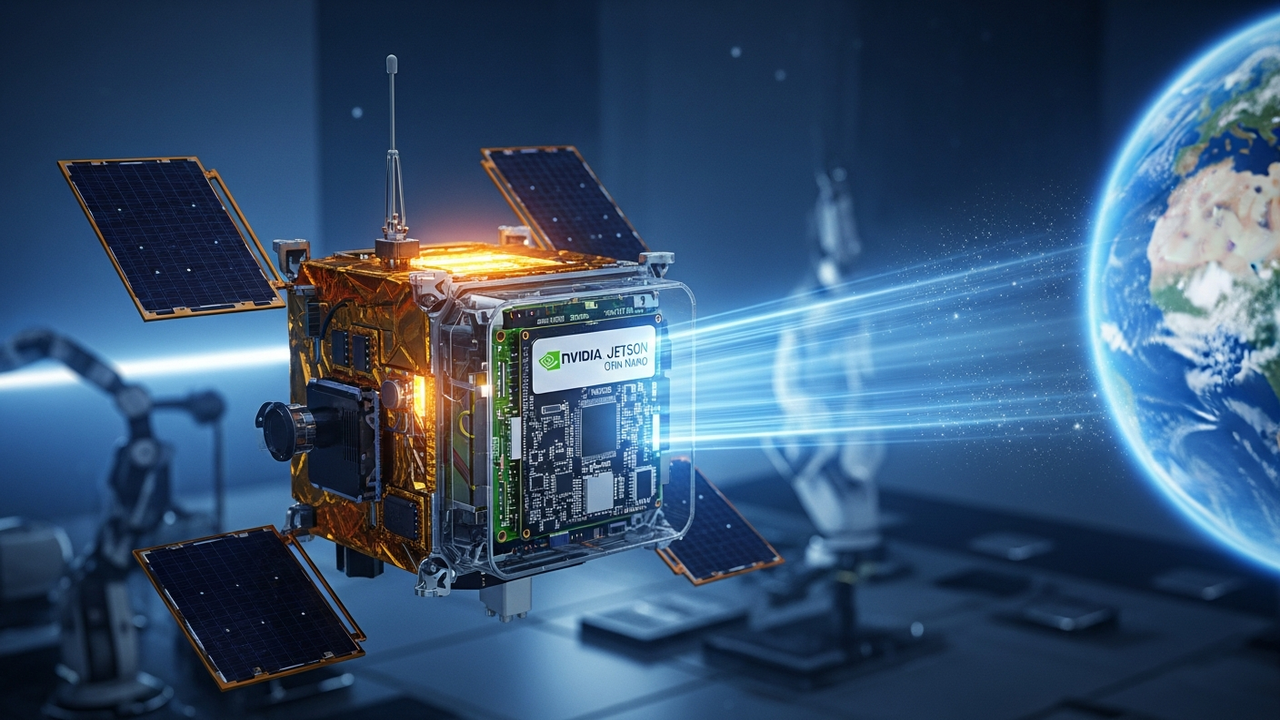
The home-built 2U CubeSat, named ‘KENSAT,’ is in its final stages of preparation for a mission to demonstrate the feasibility of onboard AI data processing in space. This innovative CubeSat, equipped with an NVIDIA Jetson Orin Nano processor, aims to execute AI inference directly on the satellite, diverging from the traditional method of downlinking vast quantities of raw data for terrestrial processing. KENSAT’s successful deployment is anticipated to dramatically enhance data processing efficiency for future satellite missions and reduce dependence on large-scale ground-based computing infrastructure, marking a new frontier for distributed AI in space.
Technical Details
The core of the KENSAT mission lies in deploying a high-performance AI edge computing device into the space environment. Its primary technical features include:
- NVIDIA Jetson Orin Nano Integration: KENSAT is powered by the NVIDIA Jetson Orin Nano, a compact yet powerful AI computing module designed for edge AI applications. This device offers high AI inference performance at low power consumption. The project is actively addressing challenges specific to space, such as radiation tolerance and thermal management, to ensure robust operation.
- Onboard AI Inference: Traditionally, Earth observation satellites collect immense volumes of imagery and sensor data, which are then downlinked entirely to Earth for ground station processing. KENSAT, however, will run AI models onboard to detect and extract features of interest (e.g., specific geological changes, anomalous phenomena, vessel identification) in real-time. This approach significantly reduces the data volume transmitted to Earth, optimizing communication bandwidth and accelerating data analysis.
- 2U CubeSat Platform: KENSAT is designed within the standard 2U CubeSat form factor (approximately 10cm x 10cm x 20cm). The small size and lightweight nature of CubeSats contribute to lower launch costs and enable their potential deployment as part of larger constellations, fostering a more resilient and distributed space infrastructure.
Background & Context
With an explosive increase in data generated from space, existing downlink bandwidth and ground processing capabilities are nearing their limits. In fields such as Earth observation and Space Situational Awareness (SSA), there is an urgent need to quickly extract valuable information from vast amounts of raw data. Onboard AI processing has emerged as a powerful solution to this challenge, gaining significant attention in recent years. Small satellite demonstration missions like KENSAT provide an accessible and frequent opportunity to test this technology in space, potentially resolving bottlenecks in the burgeoning space data economy.
Strategic Significance & Outlook
The success of the KENSAT mission will open new avenues for commercial and scientific applications of distributed AI processing via satellites. This will enable future Earth observation satellites to deliver more information with less communication bandwidth, improving real-time capabilities in areas such as weather forecasting, agricultural monitoring, disaster management, and infrastructure surveillance. For deep-space exploration missions, it will provide foundational technology to enhance autonomous decision-making capabilities in environments with significant communication delays. KENSAT’s achievements are expected to accelerate a future where small satellites evolve from mere data collection platforms into autonomous, intelligent nodes, thereby expanding the potential and impact of the global space economy.
Get our weekly technology intelligence — free
Receive an infographic that lets you judge at a glance whether each field’s analysis report is worth reading.
Subscribe Free — Weekly Tech Intelligence
By subscribing, you’ll receive Troy-Technical’s weekly technology intelligence newsletter.
- Your email and selected fields are used only to deliver the newsletter.
- We never share your information with third parties.
- You can unsubscribe anytime via the link in each email.
See our Privacy Policy for details.
Takes about a minute · Unsubscribe anytime









Comments