Key Findings
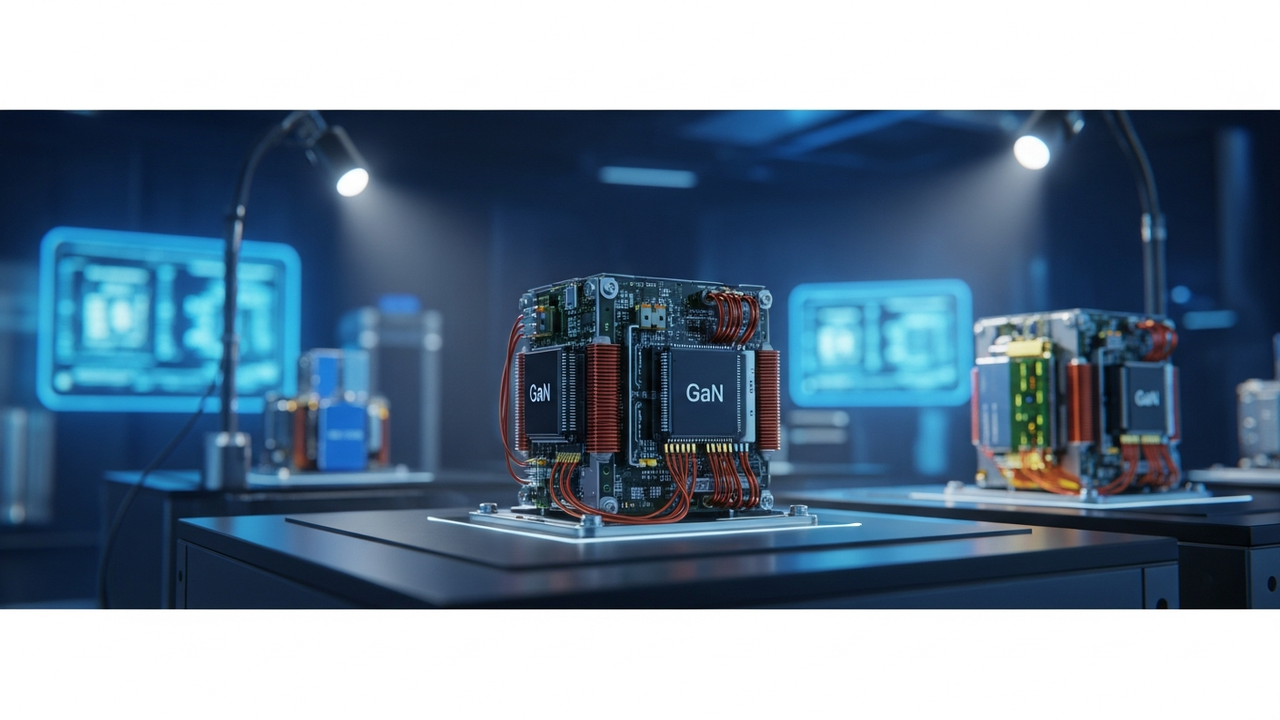
The Defense Advanced Research Projects Agency (DARPA)’s Space Power Conversion Electronics (SPCE) program is spearheading a groundbreaking initiative to dramatically improve the efficiency of power systems for space applications. The program targets the development of power conversion systems achieving over 85% efficiency, while also being highly resilient to the extreme radiation environment of space. By fully embracing wide bandgap (WBG) semiconductor technologies, specifically Gallium Nitride (GaN) and Silicon Carbide (SiC), the SPCE program aims to achieve a radical increase in power density and sustain terrestrial-level performance in orbit. This technological breakthrough is poised to fundamentally transform the operational capabilities of future satellites and deep-space probes.
Technical Details
The SPCE program is driving the adoption of **Wide Bandgap (WBG) semiconductors** to overcome the inherent limitations of conventional Silicon (Si)-based power conversion technologies. GaN and SiC offer significant advantages over silicon:
- Higher Bandgap Energy: This property enables stable operation at higher temperatures and allows for higher voltage and current densities. Given the stringent thermal dissipation constraints in spacecraft, highly efficient, low-heat-generating devices are essential.
- Superior Radiation Tolerance: Space radiation causes single-event effects (SEE) and total ionizing dose (TID) damage in electronics. WBG semiconductors, due to their inherent material properties, exhibit higher intrinsic resistance to these radiation effects, allowing for reduced external radiation shielding compared to silicon devices. This translates directly into reduced system mass and volume, contributing to lower launch costs.
- Higher Switching Frequencies: GaN and SiC devices can operate at significantly higher switching frequencies. This enables a reduction in the size of passive components like inductors and capacitors within power conversion circuits. Consequently, the overall size and weight of power converters are substantially diminished, leading to a dramatic increase in power density.
The program’s ambitious goal is to elevate the efficiency of space-grade power conversion systems (traditionally 60-70%) to over 85% while simultaneously achieving substantial power density improvements. This increase in available power allows for more sophisticated payloads and enhanced data processing capabilities on satellites and probes.
Background & Context
As space missions become more complex and extended in duration, spacecraft power systems are under increasing demand for higher performance and reliability. Traditional space-grade electronics often tend to be bulky and heavy to ensure radiation hardness, imposing significant constraints on launch costs and mission design. The SPCE program addresses this long-standing challenge by applying recent advancements in material science and power electronics to the space domain. GaN and SiC technologies have already demonstrated proven success in terrestrial applications, such as electric vehicles (EVs) and data center power supplies, making their transition to space a critical trend accelerating breakthroughs in space technology.
Strategic Significance & Outlook
Should DARPA’s SPCE program succeed, space power conversion electronics will become dramatically smaller, lighter, and more efficient, opening up new possibilities for next-generation spacecraft design. This will enable the integration of more scientific instruments, communication payloads, and onboard computing systems, thereby significantly enhancing the capabilities of deep-space exploration, Earth observation, satellite communications, and lunar/Martian exploration missions. This technology is expected to be a foundational enabler for the growth of the entire space economy and for expanding the scope of human activity in space.
Source: https://www.strategicmarketresearch.com/blogs/space-power-electronics-satellite-performance
Get our weekly technology intelligence — free
Receive an infographic that lets you judge at a glance whether each field’s analysis report is worth reading.
Subscribe Free — Weekly Tech Intelligence
By subscribing, you’ll receive Troy-Technical’s weekly technology intelligence newsletter.
- Your email and selected fields are used only to deliver the newsletter.
- We never share your information with third parties.
- You can unsubscribe anytime via the link in each email.
See our Privacy Policy for details.
Takes about a minute · Unsubscribe anytime





Comments