Key Findings
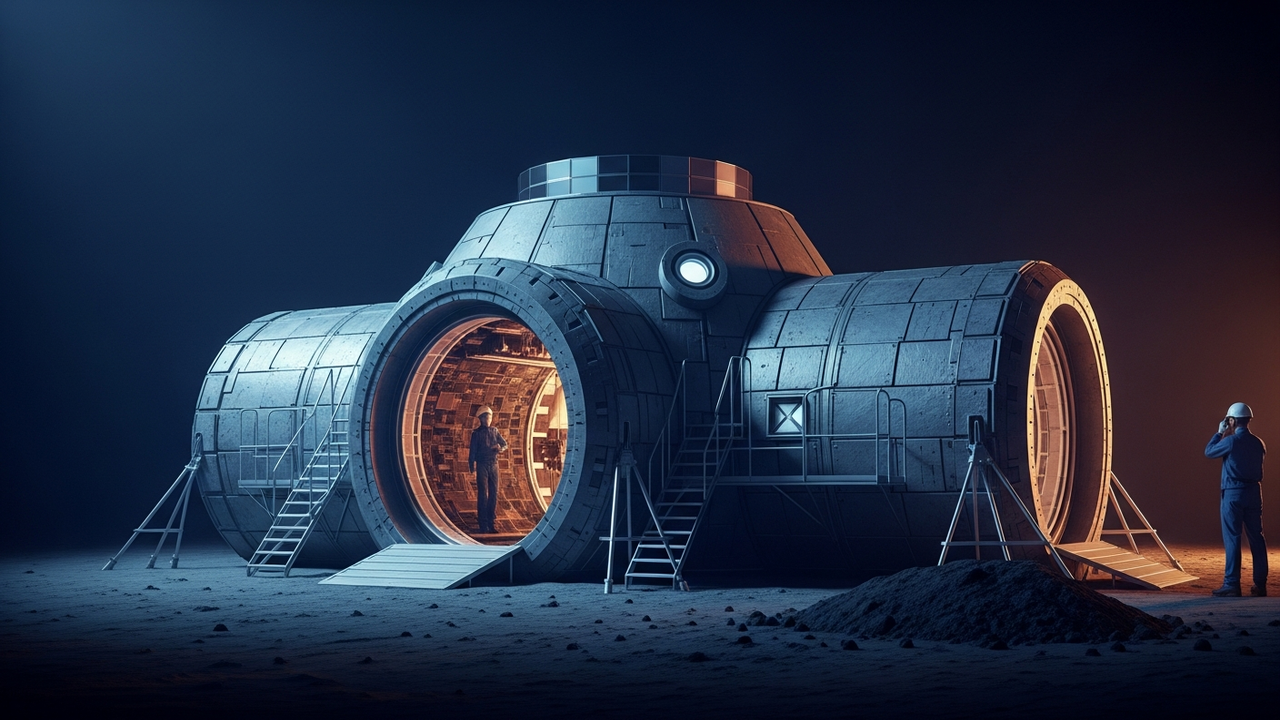
Startup Lunar Forge has unveiled an innovative plan to leverage lunar regolith—the Moon’s dust and broken rock—as a primary construction material for building lunar habitats and shielding structures for potential lunar fission reactors. The core of their technology involves using laser sintering to consolidate the abundant lunar regolith, thereby eliminating the prohibitive cost of transporting building materials from Earth. This approach is poised to fundamentally transform the economics of lunar infrastructure development. Lunar Forge aims to conduct its first lunar demonstration in 2027, with subsequent plans for deploying multiple AI-controlled autonomous construction systems, marking a significant milestone towards sustainable lunar habitation and operations.
Technical Details
At the heart of Lunar Forge’s proposed technology is the application of **Selective Laser Sintering (SLS)** principles to lunar regolith. This process typically involves the following steps:
- Regolith Collection: Lunar rovers collect the fine lunar regolith abundant across the Moon’s surface.
- Laser Sintering: The collected regolith is layered, and a high-powered laser precisely heats and sinters the material, fusing particles together to form solid structures. This process is analogous to terrestrial 3D printing but optimized for the lunar vacuum environment and regolith’s specific material properties. Unlike melting, sintering binds particles without full liquefaction.
- Autonomous Construction: Following initial demonstrations, the company aims to integrate AI and robotics to deploy fully autonomous construction devices. This will enable the efficient construction of large-scale structures without continuous human intervention, greatly enhancing scalability.
This technology promises to drastically reduce transport costs from Earth (which can be tens of thousands of dollars per kilogram), dramatically improving the sustainability and economic viability of lunar operations. The resulting structures will serve as robust shelters, protecting internal environments from the harsh lunar conditions, including radiation, micrometeorites, and extreme temperature fluctuations.
Background & Context
With increasing global interest in the Moon, driven by initiatives like NASA’s Artemis program, long-term lunar habitation and base construction have become urgent priorities. However, the exorbitant cost of transporting materials from Earth remains one of the greatest impediments to lunar development. Consequently, In-Situ Resource Utilization (ISRU) technologies, particularly those that use lunar regolith as a construction material, are a highly active area of research. Lunar Forge’s technology represents one of the most promising approaches within ISRU, offering a pathway to move away from Earth-dependent supply chains. Such innovations are critical for fostering a lunar economy and expanding commercial space activities.
Strategic Significance & Outlook
Lunar Forge’s 2027 lunar demonstration will be a crucial test of the practical viability of its technology. If successful, it could be applied not only to lunar habitats but also to a wide range of lunar infrastructure, including radiation-shielded energy installations (e.g., lunar fission reactors), landing pads, roads, and mining facilities. The deployment of AI-controlled autonomous construction systems will usher in a future where complex lunar projects can be executed with minimal human oversight. This capability will make a permanent human presence on the Moon a tangible reality, ultimately serving as a vital stepping stone for further deep-space exploration to destinations like Mars.
Get our weekly technology intelligence — free
Receive an infographic that lets you judge at a glance whether each field’s analysis report is worth reading.
Subscribe Free — Weekly Tech Intelligence
By subscribing, you’ll receive Troy-Technical’s weekly technology intelligence newsletter.
- Your email and selected fields are used only to deliver the newsletter.
- We never share your information with third parties.
- You can unsubscribe anytime via the link in each email.
See our Privacy Policy for details.
Takes about a minute · Unsubscribe anytime








Comments