Background: The Perovskite Promise and Persistent Challenge
Perovskite solar cells (PSCs) have emerged as a frontrunner in next-generation photovoltaic technology, celebrated for their exceptional power conversion performance. However, their widespread commercialization has been primarily hampered by a critical lack of long-term stability. Degradation under high temperature and humidity, in particular, has presented an urgent challenge that must be overcome for practical, real-world applications. Self-assembled monolayers (SAMs) have been explored as a promising strategy to passivate perovskite interfaces and optimize charge transport, yet their precise mechanisms and full impact on long-term device stability have remained areas requiring further elucidation.
Key Findings: A Dual Leap in Efficiency and Durability
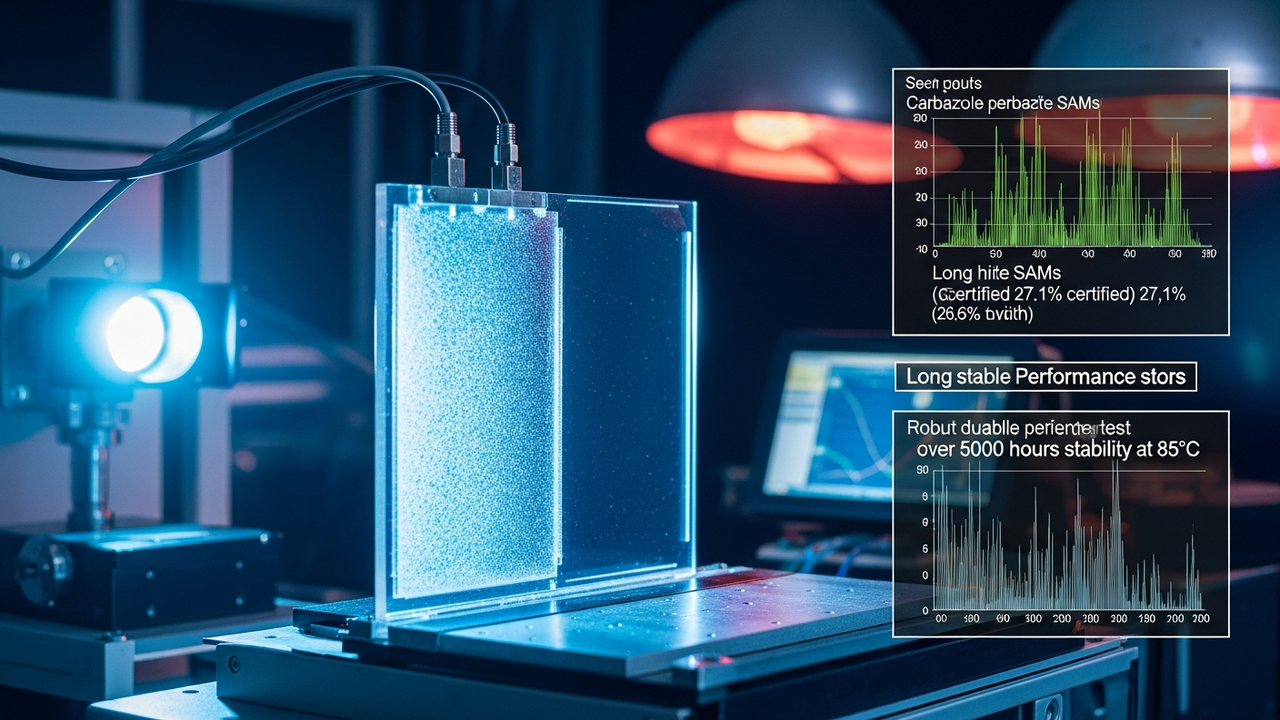
This research marks an astonishing achievement in inverted perovskite solar cells, reporting a power conversion efficiency of 27.1% (26.6% certified) through the innovative introduction of carbazole-based self-assembled monolayers (SAMs). Beyond this remarkable efficiency, these optimized devices demonstrated unprecedented long-term stability. They maintained over 90% of their initial efficiency after approximately 5000 hours of continuous 1-sun illumination in ambient air at a demanding 85°C. This dual breakthrough directly addresses the core limitations hindering perovskite commercialization.
Technical Elucidation: The Dual Role of Carbazole SAMs
The groundbreaking performance stems from a detailed understanding of the dual role played by carbazole SAMs at the PSC interface: the formation of crucial interfacial dipoles and the facilitation of efficient charge tunneling. The interfacial dipoles are instrumental in optimizing the energy band alignment, which significantly enhances the efficiency of charge carrier separation. Simultaneously, the charge tunneling mechanism reduces resistance between the charge transport layer and the perovskite layer, thereby enabling highly efficient charge extraction. These synergistic mechanisms collectively lead to substantial improvements in the device’s open-circuit voltage (Voc) and fill factor (FF), culminating in the dramatic increase in overall power conversion efficiency. The rigorously tested long-term stability of 5000 hours under harsh conditions (85°C, continuous illumination) serves as robust validation of the technology’s reliability, a prerequisite for commercial viability.
Strategic Significance and Future Outlook
The high efficiency and exceptional long-term stability achieved in this study represent a crucial milestone, poised to significantly accelerate the practical deployment of perovskite solar cells. Specifically, the enhanced durability under challenging conditions directly translates to improved reliability in actual outdoor installation environments, paving the way for widespread commercial adoption. Looking ahead, this carbazole-based SAMs technology is expected to simplify manufacturing processes, enable the scaling up of active areas, and contribute to further cost reductions. If broadly applied, perovskite solar cells could play a vital role in the global energy supply—either complementing or partially replacing conventional silicon solar cells—thereby contributing profoundly to the proliferation of clean energy and the realization of a sustainable society.
Get our weekly technology intelligence — free
Receive an infographic that lets you judge at a glance whether each field’s analysis report is worth reading.
Subscribe Free — Weekly Tech Intelligence
By subscribing, you’ll receive Troy-Technical’s weekly technology intelligence newsletter.
- Your email and selected fields are used only to deliver the newsletter.
- We never share your information with third parties.
- You can unsubscribe anytime via the link in each email.
See our Privacy Policy for details.
Takes about a minute · Unsubscribe anytime



Comments