Background and Context
One of the biggest challenges for the commercialization of perovskite solar cells is ensuring their long-term stability. Interface quality is directly related to device degradation mechanisms, and forming stable interfaces with fewer defects is crucial for improving resistance to humidity, heat, and light stress. Previous research primarily focused on optimizing the chemical structure of SAMs, but approaches to address the physical problem of SAM aggregation itself were limited. This study’s strategy of mitigating aggregation with molecular lubricants addresses this physical challenge, opening new avenues for improving the long-term reliability of perovskite solar cells.
Key Findings
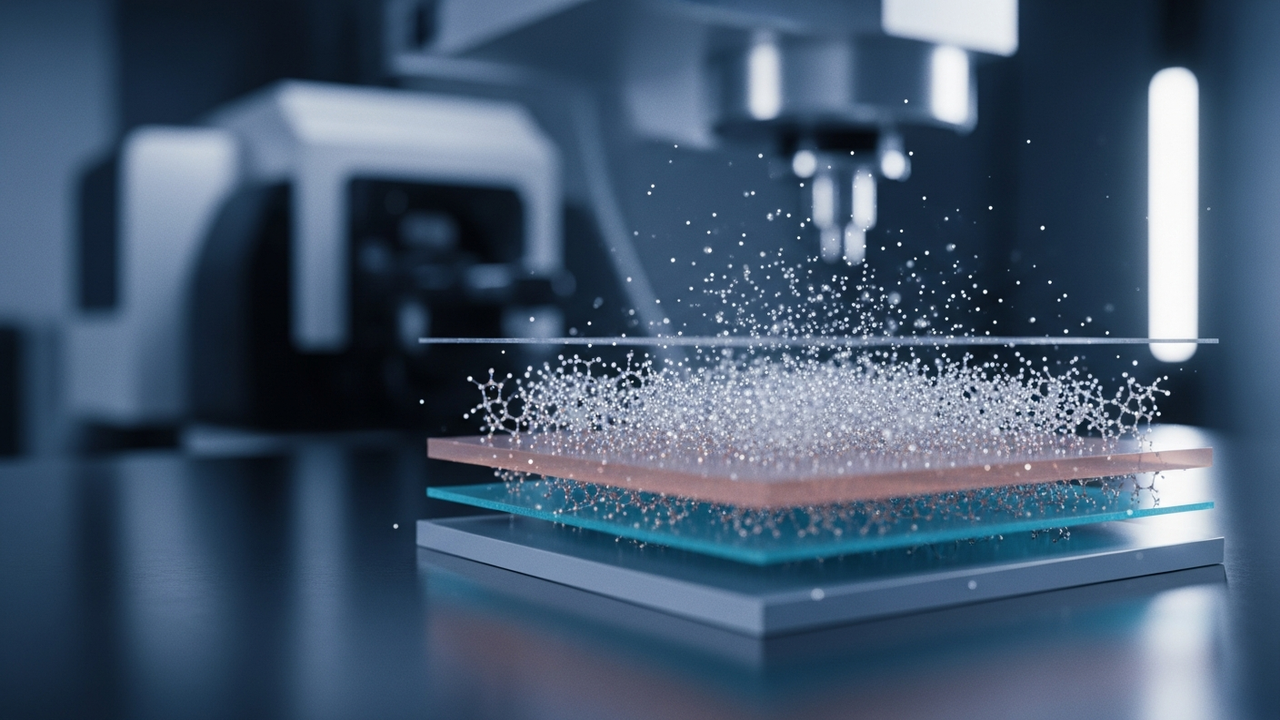
This research reports a novel discovery: molecular lubricants effectively mitigate the aggregation of self-assembled monolayers (SAMs) in perovskite solar cells (PSCs), which significantly impairs device performance and operational stability. It was demonstrated that these molecular lubricants precisely control the molecular packing of SAMs, thereby suppressing aggregation-induced interfacial defects. This offers a new strategy for enhancing the efficiency and long-term reliability of perovskite solar cells.
Technical Details
Self-assembled monolayers (SAMs) have been widely used as charge transport layers or interfacial passivation layers in perovskite solar cells, contributing to their high efficiency. However, it has been noted that non-uniform aggregation of SAMs, particularly at buried interfaces, can create carrier recombination sites, impede charge transport, and consequently reduce the device’s power conversion efficiency and operational stability. The research team successfully adjusted the interactions between SAM molecules and achieved more uniform and dense molecular packing by introducing specific molecular lubricants into the SAM formation process. These molecular lubricants control the movement of SAM molecules during self-assembly, suppressing the formation of aggregation nuclei and significantly reducing the occurrence of interfacial defects. This is expected to improve the open-circuit voltage (Voc) and fill factor (FF) of PSCs, along with enhancing long-term operational stability.
Strategic Significance and Outlook
The molecular lubricant-mediated SAM aggregation mitigation technology is a highly promising approach for simultaneously improving the performance and stability of perovskite solar cells. If applied to large-scale manufacturing processes, this technology could enhance device quality uniformity and improve manufacturing yield. Moving forward, the research team is expected to delve deeper into the types and concentrations of molecular lubricants, their interaction mechanisms with SAMs, and work on further improving device efficiency and long-term durability assessments. This innovative interface engineering technology will be a crucial factor for perovskite solar cells to become a leading next-generation photovoltaic technology in the market.
Get our weekly technology intelligence — free
Receive an infographic that lets you judge at a glance whether each field’s analysis report is worth reading.
Subscribe Free — Weekly Tech Intelligence
By subscribing, you’ll receive Troy-Technical’s weekly technology intelligence newsletter.
- Your email and selected fields are used only to deliver the newsletter.
- We never share your information with third parties.
- You can unsubscribe anytime via the link in each email.
See our Privacy Policy for details.
Takes about a minute · Unsubscribe anytime



Comments